01Facts
The applicants (original accused) sought quashing of two FIRs under S. 482 CrPC (now S. 528 BNSS) and Art. 226.
FIR C.R. No. I-115/2013 (Bardoli P.S., registered 26.04.2013) was lodged by Respondent No. 2 (complainant) and alleges that the applicants obtained agriculturist status through false pedigrees, a family agreement, and a Mamlatdar's certificate dated 25.11.1999, and used a false affidavit to secure Mutation Entry No. 1439 for Block Nos. 86 and 87 at Village Bhatiya, Taluka Choryasi.
pp. 3–9, paras 4, 6Offences alleged in FIR C.R. No. I-115/2013 are IPC ss. 406, 420, 467, 468, 471, 120B, and 114.
pp. 3–9, paras 4, 6FIR C.R. No. I-52/2018 (Sachin P.S., registered 04.04.2018) was registered pursuant to this Court's order dated 14.03.2018 in SCA No. 362/2018 and re-asserts the same land parcels and allegations.
pp. 5–11, paras 5, 7Offences alleged in FIR C.R. No. I-52/2018 are IPC ss. 406, 420, 465, 467, 468, 471, and 120B.
pp. 5–11, paras 5, 7The complainant's inquiry history includes an ACP report (31.01.2013) suggesting offences under ss. 406, 420, and 114, and an SIT/Land Protection Committee closure on 27.03.2015 after a report that the dispute was civil/revenue in nature.
pp. 14–15, para 10Tenancy authorities dropped S. 84-C proceedings (orders dated 24.02.2015 and 21.04.2017), and the Deputy Collector (Land Reforms), Surat, on 27.01.2023 in Remand Appeal Case No. 16/2022 held the applicants to be hereditary agriculturists.
pp. 15–16, para 11A consent decree in Special Civil Suit No. 3/2014 (Navsari) was upheld up to the Supreme Court, which dismissed SLPs on 24.08.2015.
p. 16, para 12The 2013 FIR was stayed by interim orders in the applicants' petition (07.05.2013), and no investigation occurred under it.
p. 19, para 15.1 · p. 21, para 15.9The complainant also sought transfer to CBI.
pp. 29–30, para 17.102Issues
i.1. Whether the second FIR (C.R. No. I-52/2018) is barred as a successive FIR on the same transaction under the rule in T.T. Antony, and whether a prior High Court direction to register it insulates it from quashing.
¶ 18.2, 20.2–20.3 · pp. 31–32, 40–41ii.2. Whether the allegations in both FIRs, taken at face value, disclose the essential ingredients of cheating (s. 420), forgery and use of forged documents (ss. 463–471), and criminal breach of trust (s. 406) IPC.
¶ 16.1–16.3 · pp. 24–26iii.3. Whether the revenue and tenancy determinations on agriculturist status, and the finality of the civil decrees, bar or render abusive the continuation of criminal proceedings.
¶ 16.4, 16.6, 20.4 · pp. 26–28, 41–42iv.4. Whether the complainant's locus, the 19–21-year delay, and the alleged malice render the FIRs an abuse of process.
¶ 14.3, 16.5, 20.5–20.7 · pp. 18, 26–27, 43–46v.5. Whether a CBI investigation may be ordered on a counter-prayer in the complainant's reply.
¶ 17.3 · p. 3003Law Applied
The Court applied S. 482 CrPC (now S. 528 BNSS) and Art. 226 as the source of inherent power to quash.
¶ 1On successive FIRs, the Court followed T.T. Antony v. State of Kerala (2001) 6 SCC 181, under which a second FIR on the same cognizable incident is impermissible and further material must be investigated under S. 173(8) CrPC, with Babubhai v. State of Gujarat (2010) 12 SCC 254 and Amitbhai Anilchandra Shah v. CBI (2013) 6 SCC 348 applied to the "sameness" test, which does not depend on whether the first FIR was stayed.
¶ 18.2–18.3, 20.3On exoneration, the Court relied on Radheshyam Kejriwal v. State of West Bengal (2011) 3 SCC 581 and K.C. Builders v. CIT (2004) 2 SCC 731 for the rule that criminal prosecution on identical allegations cannot proceed once a competent authority has removed its foundation.
¶ 18.5, 20.4.3On forgery and cheating, the Court applied S. 464 IPC and Mohammed Ibrahim v. State of Bihar (2009) 8 SCC 751, under which claiming status or executing documents in one's own name is not a "false document" absent impersonation, and a non-deceived stranger cannot sustain S. 420.
¶ 16.2, 18.6, 20.8.1For abuse of process, the Court applied State of Haryana v. Bhajan Lal 1992 Supp (1) SCC 335, categories (1), (3), and (7).
¶ 18.7On tenancy jurisdiction, the Court relied on Ss. 70, 84-C, 85, and 85A of the Bombay Tenancy and Agricultural Lands Act, 1948, Gundaji Satwaji Shinde (1979) 2 SCC 495, and Salim D. Agboatwala (2021).
¶ 16.4, 18.8On delay and malice, the Court relied on Hasmukhlal D. Vora (2022) 15 SCC 164 and Kishan Singh v. Gurpal Singh (2010) 8 SCC 775.
¶ 18.10, 20.7.2On ss. 406 and 420 IPC, the Court relied on Hrdaya Ranjan Prasad Verma (2000) 4 SCC 168 for the rule that dishonest intention at inception is essential to cheating and that the two offences are mutually exclusive on the same facts.
¶ 18.9The Court distinguished Neeharika Infrastructure (2021) 19 SCC 401, Aryan Singh (2023), Pratima Mohanty (2021), Lal Chandra Ram (2025), Accamma Sam Jacob (2026), Yuvrajsinh Rathod (2026), and Ramanlal Bhailal Patel (2008) 5 SCC 499.
¶ 19.1–19.6Provisions in the judgment · 16 · Linked ones open on LawLens
Code of Criminal Procedure, 1973 Section 482Section 173
Bharatiya Nagarik Suraksha Sanhita, 2023 Section 528
Indian Penal Code, 1860 9 provisions
Section 114Section 406Section 420Section 463Section 464Section 465Section 467Section 468Section 471Bombay Tenancy and Agricultural Lands Act-1948 Section 43Section 63Section 70Section 85
04Reasoning
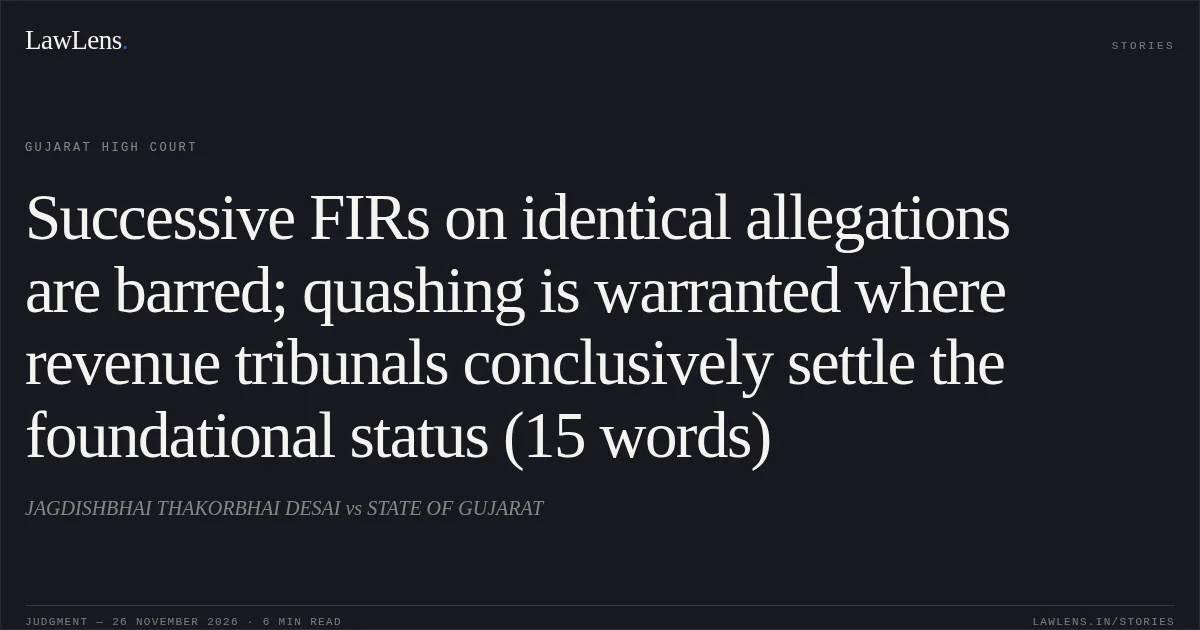
The Court first held that the 2018 FIR, which replicates the 2013 FIR's parcels, parties, and allegations, falls within the T.T. Antony bar.
¶ 20.2The direction in SCA No. 362/2018 did not preclude quashing because a threshold mandamus to register an FIR remains subject to the statutory limits on successive FIRs and to the accused's right to seek quashing on merits.
¶ 20.2–20.3On the merits, the Court held that even if the allegations were accepted in full, they did not disclose cheating, because the complainant, a stranger to the sale deeds, parted with no property and was not deceived.
¶ 16.1The Court held that submitting family pedigrees and affidavits in one's own name is not "making a false document" under S. 464, and that the ss. 406 and 420 charges were mechanically combined without entrustment or inception-stage dishonesty.
¶ 16.2–16.3The Court treated the revenue and civil findings as decisive on the "foundational" allegation. The Deputy Collector's 2023 order, the Mamlatdar's orders dropping S. 84-C proceedings, and the Supreme Court-affirmed civil decree were treated as having removed the premise that the applicants were non-agriculturists who faked status, and under Radheshyam Kejriwal a criminal trial on that premise was an abuse.
¶ 20.4.2–20.4.3, 20.8.2The Court acknowledged that revenue findings do not automatically bar prosecution, and it relied on the exoneration rather than on the tenancy bar alone.
¶ 20.4.2The Court rejected the complainant's locus and "victim" status, noting that the sale-deed vendors raised no grievance and that the complainant's stake lay in a different parcel.
¶ 20.5, 20.6The Court treated the 1991–1999 transactions, with complaints filed in 2012–2018, as an unexplained delay pointing to malice.
¶ 16.5, 20.7The Court held that the complainant's "fraud on court" allegations were scandalous and that a CBI transfer cannot be sought through a counter-prayer in a quashing reply.
¶ 17.2–17.305Holding
The Court held that continuing both FIRs is a flagrant abuse of process.
¶ 21The Court allowed both applications, quashed and set aside FIR C.R. No. I-115/2013 (Bardoli P.S.) and FIR C.R. No. I-52/2018 (Sachin P.S.), along with all consequential proceedings.
¶ 22The Court rejected the complainant's CBI-transfer demand as lacking merit and not properly sought.
¶ 17.3The Court declined to impose fresh costs on Respondent No. 2, given his age (about 73), his unconditional apology, and the earlier costs in civil proceedings.
¶ 23The Rule was made absolute and direct service was permitted.
¶ 24Original Court PDF
JAGDISHBHAI THAKORBHAI DESAIvsSTATE OF GUJARAT
Click to open original judgment
Original judgment, available to read, download and summarize on LawLens.in