01Facts
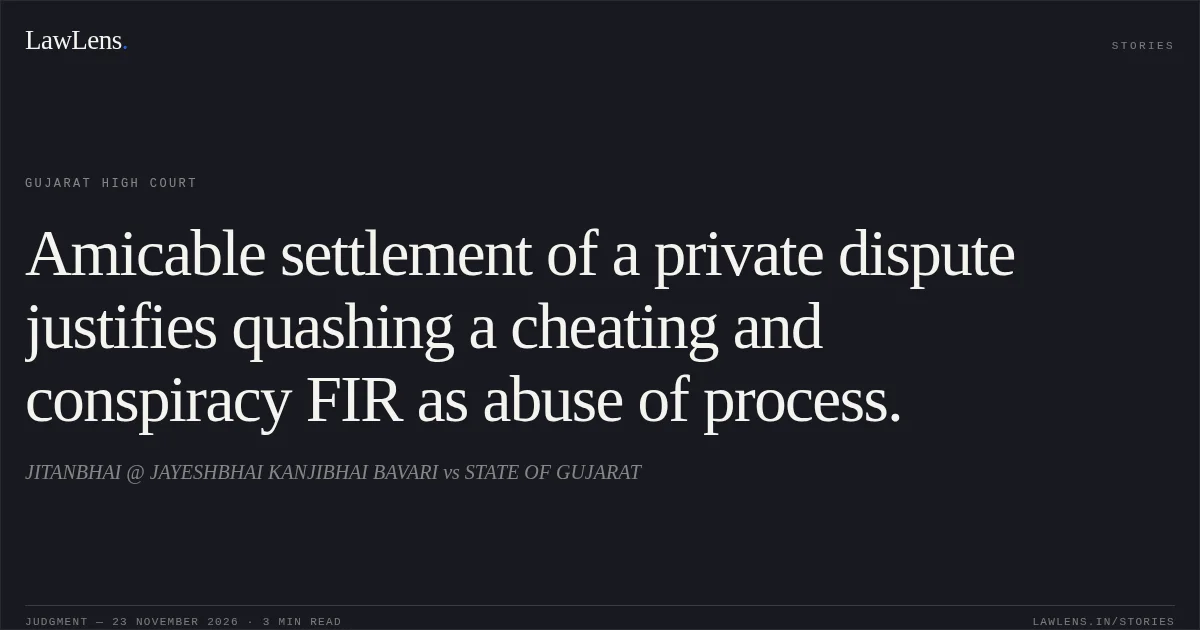
The petitioners sought quashing under Article 226 of the Constitution read with Section 528 of the BNSS of C.R. No. 11215029250503 of 2025, registered at Tarapur Police Station, Anand, on 11.12.2025 under Sections 316(2), 351(3) and 61(2) of the Bharatiya Nyaya Sanhita, 2023 (BNS), together with all consequential proceedings
p. 1The respondent-State appeared through the APP, and respondent No. 2 (the original complainant) appeared through counsel, was identified in court, and was present in person
p. 2 · ¶ 2 · ¶ 3.1Counsel for the petitioners submitted that the dispute had been amicably settled and placed reliance on several Supreme Court and Gujarat High Court decisions
pp. 2–3 · ¶ 4The APP opposed the petition, characterising the allegations as serious
p. 3 · ¶ 5Respondent No. 2 stated through counsel that he had no objection to quashing
p. 3 · ¶ 5.1The complainant's affidavit, reproduced at paras. 1–6, stated that the dispute was settled voluntarily, without coercion, that he had no surviving grievance, and that he consented to quashing
pp. 3–4 · ¶ 6In open court he reiterated the settlement and consent
pp. 4–5 · ¶ 702Issues
i.1. Whether the High Court, in exercise of its inherent jurisdiction, may quash an FIR and consequential proceedings on the basis of a settlement between the accused and the complainant, where the offences are not expressly compoundable under the BNS
pp. 2–3 · ¶ 4 · p. 5 · ¶ 8ii.2. Whether the complainant's settlement and consent were voluntary, genuine, and free from coercion
pp. 3–4 · ¶ 6 · pp. 4–5 · ¶ 7iii.3. Whether continuation of the criminal proceedings would amount to an abuse of the process of law, such that quashing is necessary to secure the ends of justice
p. 5 · ¶ 803Law Applied
The Court relied on Section 528 BNSS, the statutory successor to Section 482 CrPC, which preserves the High Court's inherent power to prevent abuse of process and secure the ends of justice
p. 1 · ¶ 1It principally applied the line of Supreme Court authority holding that the High Court may quash criminal proceedings, including for non-compoundable offences, where the parties have genuinely settled and continuation would be futile: Gian Singh v. State of Punjab, (2012) 10 SCC 303, and Madan Mohan Abbot v. State of Punjab, (2008) 4 SCC 582
p. 2 · ¶ 4 · p. 5 · ¶ 8It further relied on Narinder Singh v. State of Punjab, (2014) 6 SCC 466, which applied these principles to compromise-based quashing, and on State of Haryana v. Bhajan Lal, AIR 1992 SC 604, which sets out the categories in which inherent power to quash may be exercised
pp. 2–3 · ¶ 4 · p. 5 · ¶ 8It also relied on Gujarat High Court decisions in Nikhil Merchant v. CBI, 2009 (1) GLH 31, and Manoj Sharma v. State, 2009 (1) GLH 190, applying the same settlement-based approach
pp. 2–3 · ¶ 4 · p. 5 · ¶ 8The Court also relied on the voluntariness of the settlement as a precondition for exercising this power
pp. 3–4 · ¶ 6Provisions in the judgment · 4 · Linked ones open on LawLens
Bharatiya Nagarik Suraksha Sanhita, 2023 Section 528
Bharatiya Nyaya Sanhita, 2023 Section 316Section 351Section 61
04Reasoning
The Court first examined the complainant's affidavit, which affirmed that the settlement was voluntary, uncoerced, and made with full understanding of its consequences, and that he had no surviving grievance
pp. 3–4 · ¶ 6The complainant then confirmed this position personally before the Court and in open court
pp. 4–5 · ¶ 7Having accepted the genuineness of the settlement, the Court concluded that continuing the prosecution would serve no fruitful purpose and would constitute an abuse of process, applying the principles in Gian Singh, Madan Mohan Abbot, Narinder Singh, Bhajan Lal, and the Gujarat decisions
p. 5 · ¶ 8The APP's objection based on the seriousness of the allegations was noted but not separately examined
p. 3 · ¶ 5 · p. 5 · ¶ 8The order does not expressly classify the offences as compoundable or non-heinous, nor does it record the Court's reasoning on the gravity of the offences, which is a consideration that Gian Singh and Madan Mohan Abbot treat as relevant to quashing non-compoundable offences. The Court's reasoning therefore rests primarily on the settlement, the complainant's consent, and the absence of any continuing dispute
p. 5 · ¶ 805Holding
The Court held that the petition was to be allowed because continuation of the proceedings would be an abuse of process and quashing would secure the ends of justice, given the voluntary settlement and the complainant's consent
p. 5 · ¶ 8It ordered that C.R. No. 11215029250503 of 2025, registered at Tarapur Police Station, Anand, and all consequential proceedings arising from it, be quashed and set aside
p. 5 · ¶ 9Original Court PDF
VIPULBHAI @ MUKHI LAXMANBHAI BHARVADvsSTATE OF GUJARAT
Click to open original judgment
Original judgment, available to read, download and summarize on LawLens.in