01Facts
The petitioner sought quashing, under Articles 14, 21 and 226 of the Constitution and Section 528 of the BNSS, 2023, of FIR Cr. No. 11191011240005/2024 registered at D.C.B. Police Station, Ahmedabad, for offences under Sections 406, 420 and 114 of the IPC, together with all consequential proceedings against him.
¶ 1The original complainant, Sumankumar Ravjibhai Patel (respondent no. 2), filed an affidavit stating that the dispute had been amicably settled.
¶ 2Both sides jointly submitted that the settlement made continuation of the prosecution purposeless and relied on Gian Singh, Madan Mohan Abbot, Nikhil Merchant, Manoj Sharma, Narinder Singh and Bhajan Lal.
¶ 4The learned APP opposed the petition, contending that the seriousness of the matter warranted rejection.
¶ 5The complainant's affidavit stated that he had settled with the petitioner, had no objection to quashing of Criminal Case No. 19045 of 2025 pending before the 3rd Additional Chief Judicial Magistrate, Ahmedabad City, and that the compromise was reached voluntarily, without coercion, force or undue influence.
¶ 6 · pp. 2–302Issues
i.1. Whether the FIR and consequential criminal proceedings may be quashed under the High Court's inherent jurisdiction where the complainant has settled the dispute with the accused, and continuation of the prosecution would amount to abuse of process.
¶ 7 · p. 303Law Applied
The court's power to quash rests on Section 528 of the BNSS, 2023, the successor provision to the inherent powers under Section 482 CrPC, read with Articles 14, 21 and 226 of the Constitution.
p. 1Criminal proceedings may be quashed on the parties' settlement where the dispute is predominantly private or civil in character, and where continuing the prosecution would amount to abuse of process, as laid down in Gian Singh v. State of Punjab (2012) 10 SCC 303 and Madan Mohan Abbot v. State of Punjab (2008) 4 SCC 582.
¶ 4, 7The court relied on Nikhil Merchant v. CBI, 2009 (1) GLH 31, Manoj Sharma v. State, 2009 (1) GLH 190, Narinder Singh v. State of Punjab (2014) 6 SCC 466, and the categories of cases in State of Haryana v. Bhajan Lal, AIR 1992 SC 604, under which inherent power may be exercised to prevent abuse of process.
¶ 4, 7Provisions in the judgment · 4 · Linked ones open on LawLens
Bharatiya Nagarik Suraksha Sanhita, 2023 Section 528
Indian Penal Code, 1860 Section 406Section 420Section 114
04Reasoning
The court accepted the complainant's affidavit as establishing a genuine, voluntary settlement, and noted the complainant's express non-objection to quashing.
¶ 6Having found the matter amicably settled, the court held that continuing the prosecution under the impugned FIR would be an abuse of process and that no useful purpose would be served by allowing it to continue.
¶ 7The APP's objection based on the seriousness of the allegations was not separately discussed in the judgment.
¶ 5The decision rests on the settlement and the complainant's consent, and on the authorities cited, without a detailed articulation of the Gian Singh and Narinder Singh criteria.
¶ 7The relief is confined to the petitioner, as the quashing is expressed "qua the present petitioner".
¶ 805Holding
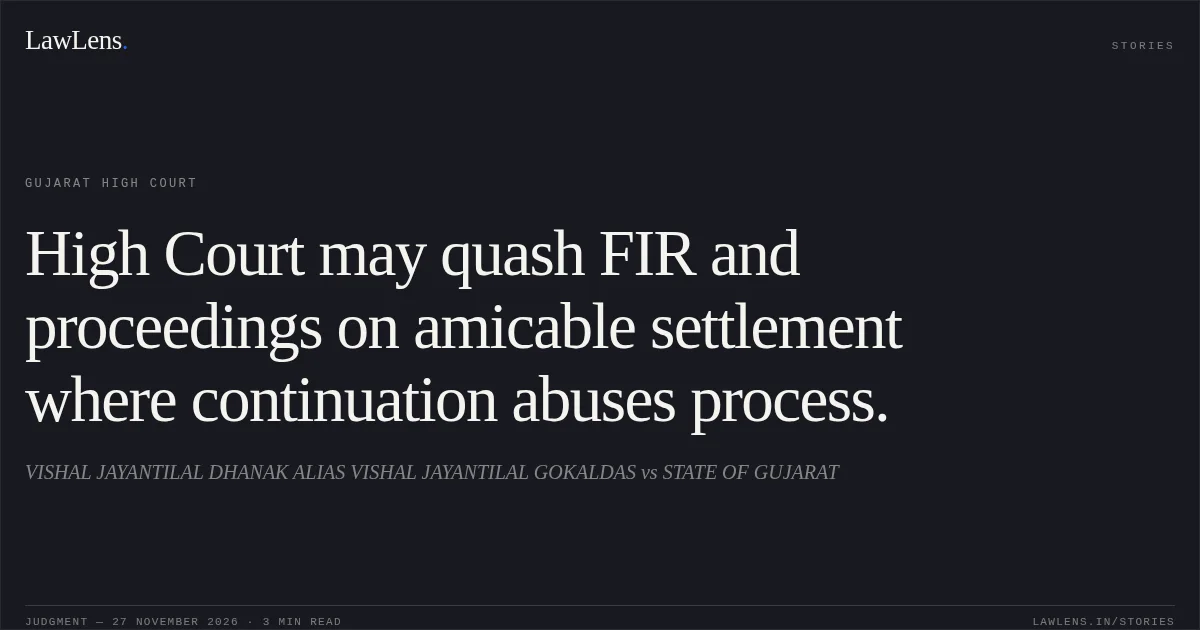
The court answered the issue in the affirmative: continuation of the proceedings would be an abuse of process, and quashing was necessary to secure the ends of justice.
¶ 7The application is allowed. FIR No. 11191011240005/2024 (D.C.B. P.S., Ahmedabad) and all consequential proceedings, including Criminal Case No. 19045 of 2025, are quashed and set aside qua the petitioner. The registry is directed to accept the vakalatnama of Mr. Ullash N. Gohil for the complainant, and the rule is made absolute.
¶ 6, 8, 9, 10Original Court PDF
VISHAL JAYANTILAL DHANAK ALIAS VISHAL JAYANTILAL GOKALDASvsSTATE OF GUJARAT
Click to open original judgment
Original judgment, available to read, download and summarize on LawLens.in