01Facts
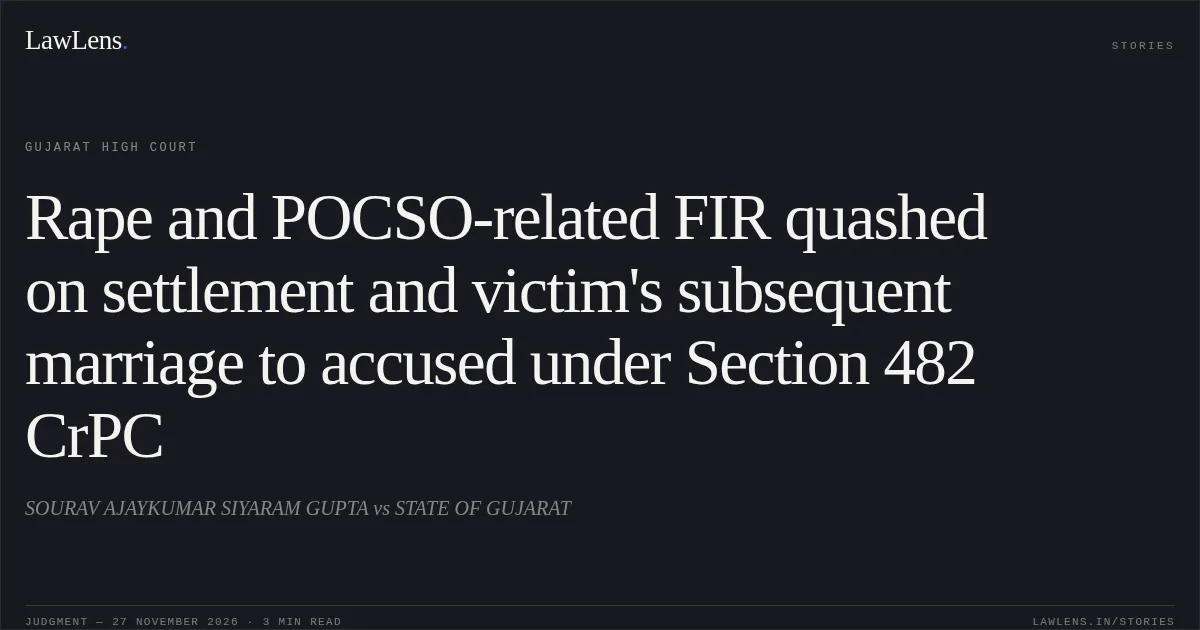
The petitioners sought quashing of FIR CR No. 11191024201345/2020 registered at Ramol Police Station, Ahmedabad, under Sections 363, 366, 376(2)(N) and 114 IPC, along with consequential proceedings. The petition was filed under Articles 14, 19, 21, 226 and 227 of the Constitution and Section 482 CrPC.
¶ 1The original complainant (respondent no. 2, the victim's father) appeared and stated the dispute had been settled amicably.
¶ 2Counsel for the petitioners and respondent no. 2 jointly submitted that petitioner no. 1 and the victim had married on 09.10.2023, that a marriage certificate was on record, and that the complainant's affidavit had been filed.
¶ 4The APP opposed quashing, citing the seriousness of the matter.
¶ 5The victim's affidavit stated that she is now a major, that she married the petitioner on 09.10.2023, that they live together with his mother, that his family has accepted her, and that she has no objection to quashing.
¶ 6The victim's affidavit states that a POCSO case is pending as Special POCSO Case No. 229/2020, that the petitioners are on bail, and that a non-bailable warrant has been issued against petitioner no. 1.
¶ 6The victim's affidavit refers to offences under Sections 3(A), 4, 5(L), 6, 17 and 18 of the POCSO Act, in addition to the IPC sections.
¶ 602Issues
i.1. Whether the criminal proceedings arising from the FIR, which involve serious offences including rape and abduction of a minor, can be quashed under Section 482 CrPC and Article 226 on the basis of a settlement and subsequent marriage between the accused and the victim, where continuing the prosecution would amount to an abuse of the process of law.
¶ 703Law Applied
Section 482 CrPC and the inherent power of the High Court to prevent abuse of process and secure the ends of justice.
¶ 4 · ¶ 7Gian Singh v. State of Punjab, (2012) 10 SCC 303: the High Court may quash criminal proceedings, including non-compoundable offences, on the basis of a settlement between parties, where the dispute is essentially private in nature and continuation would be futile.
¶ 4 · ¶ 7Madan Mohan Abbot v. State of Punjab, (2008) 4 SCC 582: settlement principle applied for quashing criminal proceedings.
¶ 4 · ¶ 7Narinder Singh v. State of Punjab, (2014) 6 SCC 466: categories of cases suitable for quashing despite settlement.
¶ 4 · ¶ 7State of Haryana v. Bhajan Lal, AIR 1992 SC 604: categories of cases in which the inherent power may be exercised to quash FIRs.
¶ 4 · ¶ 7Nikhil Merchant v. CBI, 2009 (1) GLH 31 and Manoj Sharma v. State, 2009 (1) GLH 190: Gujarat High Court decisions relied upon.
¶ 4 · ¶ 7Provisions in the judgment · 11 · Linked ones open on LawLens
Code of Criminal Procedure, 1973 Section 482
Indian Penal Code, 1860 Section 363Section 366Section 376Section 114
Protection of Children from Sexual Offences Act, 2012 Section 3Section 4Section 5Section 6Section 17Section 18
04Reasoning
The Court first noted that the marriage between petitioner no. 1 and the victim had taken place on 09.10.2023 and that the couple was living together.
¶ 6The Court recorded that the original complainant had no grievance and that the victim, now an adult, had filed an affidavit supporting quashing, stating that she wished to continue living with the petitioner and that she had no objection to quashing.
¶ 6Applying the settlement principles of Gian Singh, Madan Mohan Abbot, Narinder Singh and Bhajan Lal, the Court held that continuation of the prosecution would be an abuse of process, as it would serve no fruitful purpose once the parties had settled and cohabited.
¶ 705Holding
The Court held that continuation of the proceedings arising from FIR CR No. 11191024201345/2020 would amount to abuse of the process of law, and that quashing was necessary to secure the ends of justice.
¶ 7The application was allowed. The FIR and all consequential proceedings were quashed and set aside qua the petitioners, and the Rule was made absolute.
¶ 8Original Court PDF
SOURAV AJAYKUMAR SIYARAM GUPTAvsSTATE OF GUJARAT
Click to open original judgment
Original judgment, available to read, download and summarize on LawLens.in