Facts
The four petitioners were employed as daily wage Cleaners/Sanitation workers (Class IV posts) under the Municipal Corporation, Durg.
Source reference: p. 2Despite continuous service on these posts, they were not regularized or absorbed into permanent status.
Source reference: p. 2Some petitioners had received previous orders rejecting their claims for regularization.
Source reference: p. 3The petitioners approached the High Court seeking a direction to the respondent authorities for permanent status, absorption, and consequential benefits.
Source reference: p. 2-3Issues
1. Whether the petitioners are entitled to seek a direction for regularization or absorption in their respective posts based on their continuous service as daily wagers.
Source reference: p. 42. Whether the respondent authorities must consider and decide the petitioners' representation for regularization in light of established Supreme Court precedents.
Source reference: p. 4-5Law Applied
Legal principles governing the regularization of temporary or daily wage employees who have completed substantial years of service.
Source reference: no citationNarendra Kumar Tiwari Others v. State of Jharkhand Others [2018 (2) SCC (LS) 472], which addressed the claim of regularization for employees completing 10 years of service.
Source reference: p. 4Jaggo v. Union of India [2024 SCC Online SC 3826], which emphasizes that government departments should provide fair and stable employment and that extended temporary engagement for integral roles contravenes international labour standards and undermines morale.
Source reference: p. 4Reasoning
The Court analyzed the petitioners' claim of continuous engagement as daily wage employees in the context of the cited Supreme Court mandates.
Source reference: p. 3-4Justice Bibhu Datta Guru observed that since the petitioners are seeking specific administrative action (regularization), the appropriate legal course is to allow them to submit a comprehensive representation to the competent authorities first.
Source reference: p. 4By invoking the principles in Narendra Kumar Tiwari and Jaggo, the Court suggested that the state has a duty to act as a model employer and evaluate such claims within a framework of fairness and statutory rules.
Source reference: p. 4-5The Court did not adjudicate the merits itself but created a time-bound procedural obligation for the State to exercise its administrative discretion.
Source reference: p. 5Holding
The High Court disposed of the writ petition by permitting the petitioners to file a fresh, comprehensive representation before the concerned authorities.
The Court directed the respondents to consider and take a decision on said representation in accordance with the law and extant rules, expeditiously, preferably within four months from the date of receipt.
Source reference: p. 4-5The Court clarified it expressed no opinion on the merits of the petitioners' claim for regularization.
Source reference: p. 5Original Court PDF
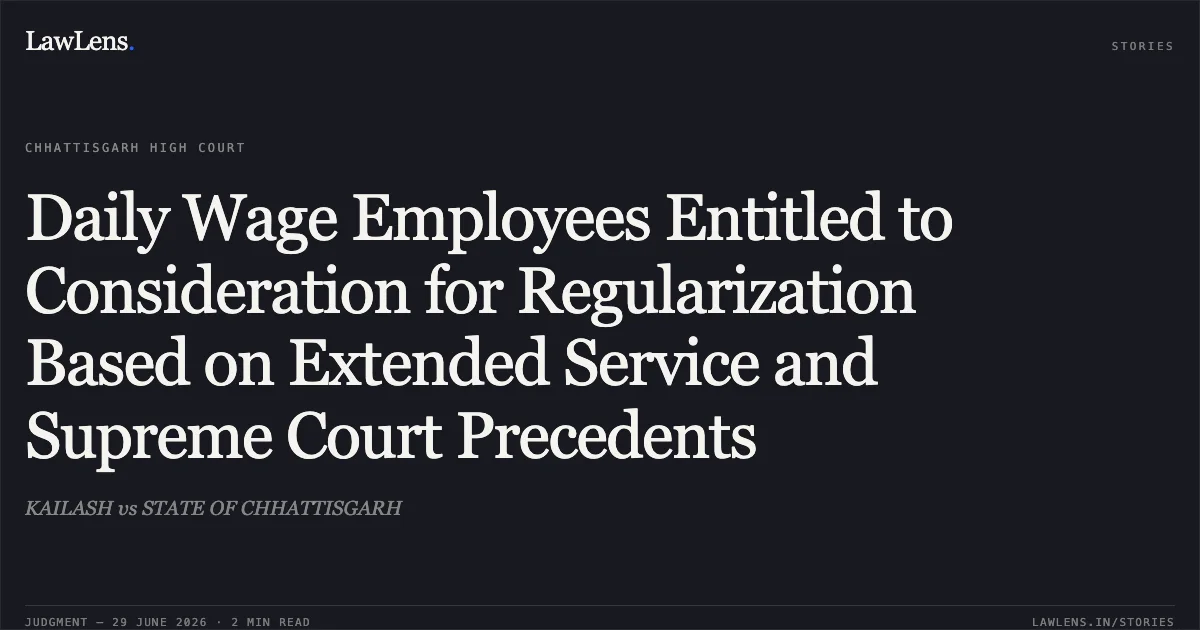
KAILASHvsSTATE OF CHHATTISGARH
Click to open original judgment
Original judgment, available to read, download and summarize on LawLens.in