Facts
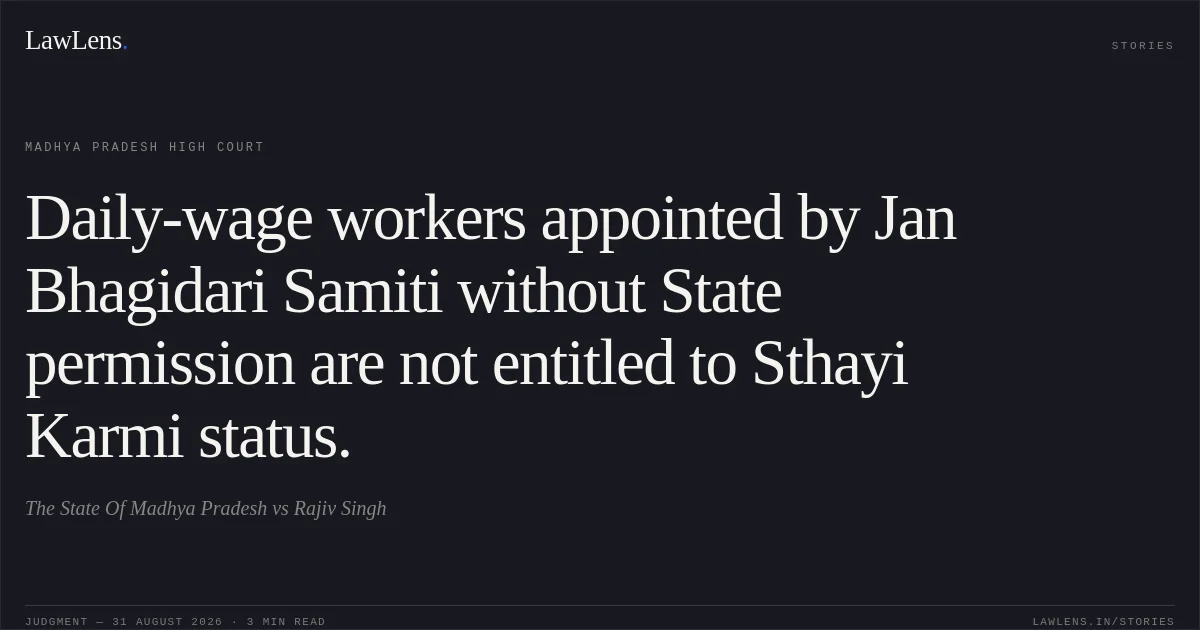
The respondents were Class III and Class IV personnel working at Sanjay Gandhi Smriti Government College, Sidhi, and claimed to have served as daily-wage employees for more than 15 years.
Source reference: para. 9Their engagement was stated to have been made under the “Jan Bhagidari Samiti” scheme introduced by the Higher Education Department’s notification dated 30 September 1996.
Source reference: para. 9The respondents claimed eligibility for conferment of “Sthayi Karmi” status under the General Administration Department circular dated 7 October 2016, which extended the benefit to daily-wage employees working on 16 May 2007 and continuing up to 1 September 2016.
Source reference: para. 10The Single Judge allowed their writ petition and directed the State to grant them such status.
Source reference: para. 11The State’s writ appeal was initially dismissed with liberty to seek review in view of the circular dated 9 May 2023. The subsequent review petition was dismissed on 5 May 2026, leading to the present appeal.
Source reference: para. 12The State also sought condonation of a delay of 119 days.
Source reference: paras. 1–7Issues
Whether the respondents established that they were daily-wage employees working on or before 16 May 2007 and continuously up to 1 September 2016, so as to qualify for “Sthayi Karmi” status under the circular dated 7 October 2016?
Source reference: paras. 10–11, 18–19Whether engagement under the “Jan Bhagidari Samiti” scheme, without prior permission of the State Government or creation of sanctioned posts, could confer eligibility for the benefits available to State daily-wage employees?
Source reference: paras. 14–15, 20–21Whether the circulars dated 9 May 2023 and 5 October 2023, including considerations concerning the financial resources of autonomous colleges, supported or restricted the respondents’ claim?
Source reference: paras. 13–15, 23Law Applied
The Court applied Section 5 of the Limitation Act, 1963, under which delay may be condoned where sufficient cause is shown.
Source reference: paras. 1–6It considered the eligibility conditions under the General Administration Department circular dated 7 October 2016, particularly clause 1.8, requiring the employee to have been engaged on or before 16 May 2007 and to have continued up to 1 September 2016, subject to the applicable requirement of governmental permission.
Source reference: paras. 10, 18–20The Court also relied on the notification dated 30 September 1996 governing the “Jan Bhagidari Samiti,” under which the Samiti could not appoint employees or create new posts without prior permission of the State Government.
Source reference: para. 20The Court referred to Motilal Songara v. Prem Prakash alias Pappu, (2013) 9 SCC 199; Sheo Raj Singh (Deceased) through Legal Representatives v. Union of India, (2023) 10 SCC 531; and Vishnu Vardhan @ Vishnu Pradhan v. State of Uttar Pradesh, 2025 SCC OnLine SC 1501, in support of consideration of the matter on merits after condonation of delay.
Source reference: para. 3It further considered the circulars dated 9 May 2023 and 5 October 2023, including the financial capacity of the concerned college.
Source reference: paras. 13, 23Reasoning
The Court held that the respondents had not produced documentary evidence proving that they were working as daily-wage employees on 16 May 2007.
Source reference: para. 18The labour-charge bills produced by them commenced from October 2010 and did not establish service from the qualifying date or continuous engagement until 1 September 2016.
Source reference: paras. 18–19Further, their engagement was attributable to the “Jan Bhagidari Samiti,” and not to an appointment by the State Government or against sanctioned posts.
Source reference: para. 20Under the 1996 notification, the Samiti lacked authority to appoint employees or create posts without prior governmental approval, and no such approval was shown.
Source reference: para. 20The Court therefore found that payment of labour charges alone could not establish the status of regular daily-wage employees entitled to the 2016 policy.
Source reference: para. 21It also observed that the later circular dated 5 October 2023 required consideration of the college’s financial position, particularly since colleges had become autonomous and were required to generate their own resources.
Source reference: para. 23Accordingly, the Single Judge’s finding that the respondents were eligible for “Sthayi Karmi” status was held to be erroneous.
Source reference: para. 22Holding
The Court answered the issues against the respondents.
It held that they failed to prove the requisite period of engagement, lacked evidence of valid governmental appointment or permission, and could not claim “Sthayi Karmi” status merely on the basis of labour-charge bills or engagement through the “Jan Bhagidari Samiti”.
Source reference: paras. 18–22The 119-day delay in filing the appeal was condoned.
Source reference: paras. 5–6The writ appeal was allowed, and the order of the Single Judge directing conferment of “Sthayi Karmi” status was set aside.
Source reference: para. 24Acts & Sections Cited
1 provisions across 1 statute referred to in this judgment. Each provision opens on LawLens.
Limitation Act, 19631
Original Court PDF
The State Of Madhya PradeshvsRajiv Singh
Click to open original judgment
Original judgment, available to read, download and summarize on LawLens.in