Facts
The appellant was convicted for sexually assaulting his approximately six-year-old step-daughter, repeatedly subjecting her to penetrative sexual assault, throttling her to death, and attempting to conceal the offence by proposing immediate burial of the body.
Source reference: paras. 3, 6.1–6.5, 34–37The prosecution primarily relied upon the testimony of the victim’s mother, who claimed to have witnessed the throttling and to have received a disclosure from the child concerning the sexual assault.
Source reference: paras. 3, 6.1–6.5, 34–37The Trial Court convicted the appellant under Sections 376(2)(f), 376(2)(n), 376AB, 302 and 201 of the IPC and Sections 5 and 6 of the POCSO Act, imposing the death penalty under Sections 376AB and 302 IPC. The High Court affirmed both the conviction and the death sentence.
Source reference: paras. 1–2, 10–12Before the Supreme Court, it emerged that the victim’s mother had been cross-examined on the same day that legal-aid counsel was appointed, without adequate preparation. The Supreme Court therefore directed further cross-examination, which was conducted through counsel of the appellant’s choice in 2025.
Source reference: paras. 13–17, 23–26Issues
Whether the defect in the original cross-examination of the victim’s mother, conducted by legal-aid counsel without adequate preparation, was cured by the further cross-examination directed by the Supreme Court?
Source reference: paras. 20(i), 23–26Whether the testimony of the victim’s mother, despite alleged omissions, contradictions, delayed disclosures and allegedly unnatural conduct, was reliable and sufficient, with corroboration, to sustain the conviction?
Source reference: para. 20(ii); paras. 27–32, 41–86Whether the victim’s death was homicidal and whether the appellant was responsible for the throttling?
Source reference: para. 20(iii); paras. 33–40, 124–125Whether the prosecution established aggravated penetrative sexual assault and the offences under Sections 376(2)(f), 376(2)(n), 376AB IPC and Sections 5 and 6 of the POCSO Act?
Source reference: paras. 20(iv), 126–129Whether the appellant’s plea of alibi, false implication and police fabrication raised a reasonable doubt?
Source reference: paras. 20(v), 109–116Whether the alleged defects in the investigation vitiated the prosecution case?
Source reference: paras. 20(vi), 117–123Whether the death sentence was justified, or whether it should be commuted in view of the mitigating circumstances, the possibility of reformation and the availability of a sentence for the remainder of natural life without remission?
Source reference: paras. 146–161, 181–203Law Applied
The Court applied Article 21 of the Constitution and Sections 391 and 367 CrPC to hold that an appellate court may cure a specific prejudice caused by ineffective cross-examination through further evidence rather than ordering a retrial.
Source reference: paras. 23–26Under Section 134 of the Evidence Act, conviction may rest on a solitary witness if the testimony is reliable; a related witness is not necessarily an interested witness; minor discrepancies and omissions do not destroy otherwise credible evidence; and falsus in uno, falsus in omnibus is not a rule of law.
Source reference: paras. 28–32Sections 145 and 162 CrPC require that alleged contradictions through prior statements be specifically put to the witness, and an omission becomes a contradiction only when it is material and irreconcilable with the testimony in court.
Source reference: paras. 52–60Statements of a deceased person concerning the cause or circumstances of death are admissible under Section 32(1) of the Evidence Act, while spontaneous statements forming part of the same transaction may be admitted under Section 6.
Source reference: paras. 87–95Sections 8, 101, 106 and 293 of the Evidence Act govern relevant conduct, burdens of proof, facts especially within an accused’s knowledge, and admissibility of Government scientific reports.
Source reference: paras. 38–39, 100, 102–108The Court also applied Sections 302, 376(2)(f), 376(2)(n), 376AB and 201 IPC and Sections 5, 6, 29 and 42 of the POCSO Act.
Source reference: paras. 124–131On sentencing, Sections 235(2) and 354(3) CrPC, Bachan Singh v. State of Punjab, Machhi Singh v. State of Punjab, Shankar Kisanrao Khade v. State of Maharashtra, Manoj v. State of Madhya Pradesh, Rajendra Pralhadrao Wasnik v. State of Maharashtra and Union of India v. V. Sriharan establish that death is reserved for the rarest of rare cases, that aggravating and mitigating circumstances must be individually weighed, that the State must establish that the offender is beyond reform, and that imprisonment for the remainder of natural life without remission is an available intermediate sentence.
Source reference: paras. 148–160Reasoning
The Court held that the original denial of effective legal assistance was confined to the cross-examination of PW-1 and was adequately cured when she was recalled and extensively cross-examined by counsel of the appellant’s choice, with access to the complete record.
Source reference: paras. 23–26, 138On the merits, the mother’s core testimony was accepted because it was specific, consistent on material particulars and corroborated by the post-mortem findings, the call-detail record showing two calls to the appellant shortly before his return, the child’s disclosure, the appellant’s conduct, and his extra-judicial confession.
Source reference: paras. 41–49, 87–101The Court treated the alleged omissions as largely relating to background or peripheral details, while the core allegation of sexual assault and throttling remained intact.
Source reference: paras. 50–80It also rejected the arguments based on the mother’s delayed reporting, controlled access to communication, failure to escape, and washing of the body, holding that such conduct had to be assessed in the context of domestic violence, coercive control, fear and economic dependence.
Source reference: paras. 50–80The medical evidence independently established homicidal death by throttling and recent sexual assault.
Source reference: paras. 34–40, 87–95The child’s disclosure was held admissible under Sections 32(1) and 6 of the Evidence Act because the assault, deterioration, threatened disclosure and subsequent killing formed one continuous transaction.
Source reference: paras. 34–40, 87–95The appellant’s alibi did not cover the time of murder, while his alternative defence was inconsistent with the medical evidence and the established circumstances.
Source reference: paras. 109–116Investigation lapses, including the initial registration against an unknown person and the absence of a formal alteration report, did not cause prejudice or undermine otherwise reliable evidence.
Source reference: paras. 117–123Accordingly, the Court found the offences proved beyond reasonable doubt.
Source reference: paras. 124–145As to sentence, the Court recognised exceptionally grave aggravating factors: the victim’s extreme youth, the appellant’s position as step-father and guardian, repeated sexual abuse, withholding of medical assistance, killing to silence the victim, throttling by hand, and attempted concealment of the crime.
Source reference: paras. 162–171However, the appellant’s childhood deprivation, absence of prior convictions, satisfactory prison conduct, family ties, age and period of incarceration constituted genuine mitigation.
Source reference: paras. 172–180, 185–192The State had not produced evidence establishing that he was beyond reform, and the possibility of reformation therefore remained open.
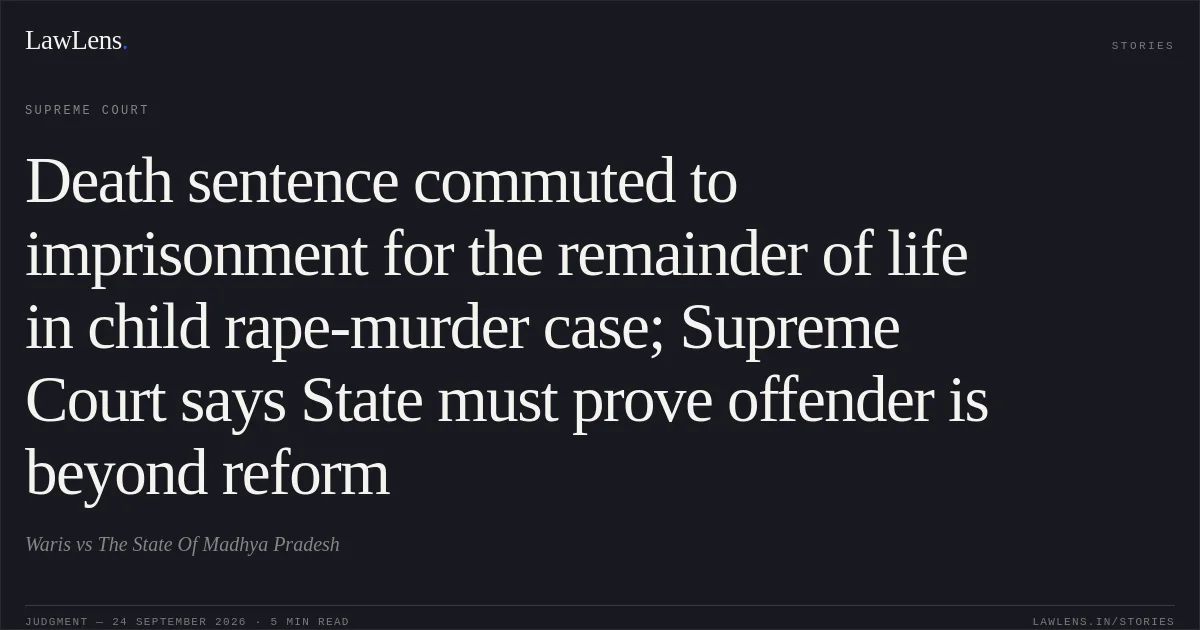
Source reference: paras. 172–180, 185–192Applying the “rarest of rare” standard and considering the intermediate option recognised in Sriharan, the Court held that death was not the only adequate sentence.
Source reference: paras. 193–199Holding
The Supreme Court upheld the appellant’s conviction under Sections 302, 376(2)(f), 376(2)(n), 376AB and 201 IPC and Sections 5 and 6 of the POCSO Act.
It rejected the challenges based on ineffective cross-examination, witness credibility, alibi, false implication, DNA evidence and investigative defects.
Source reference: paras. 138–144However, the Court commuted the death sentences imposed under Sections 302 and 376AB IPC to imprisonment for the remainder of the appellant’s natural life, without remission.
Source reference: paras. 201–205The sentences for the remaining offences were affirmed, all substantive sentences were directed to run concurrently, and Section 42 of the POCSO Act was applied so that the punishment under the POCSO Act or the corresponding IPC provisions, whichever was greater, would govern.
Source reference: paras. 201–205Acts & Sections Cited
21 provisions across 4 statutes referred to in this judgment. Each provision opens on LawLens.
Indian Penal Code, 18604
Protection of Children from Sexual Offences Act, 20125
Code of Criminal Procedure, 1973
Bharatiya Nagarik Suraksha Sanhita, 20232
Original Court PDF
WarisvsThe State Of Madhya Pradesh
Click to open original judgment
Original judgment, available to read, download and summarize on LawLens.in