Facts
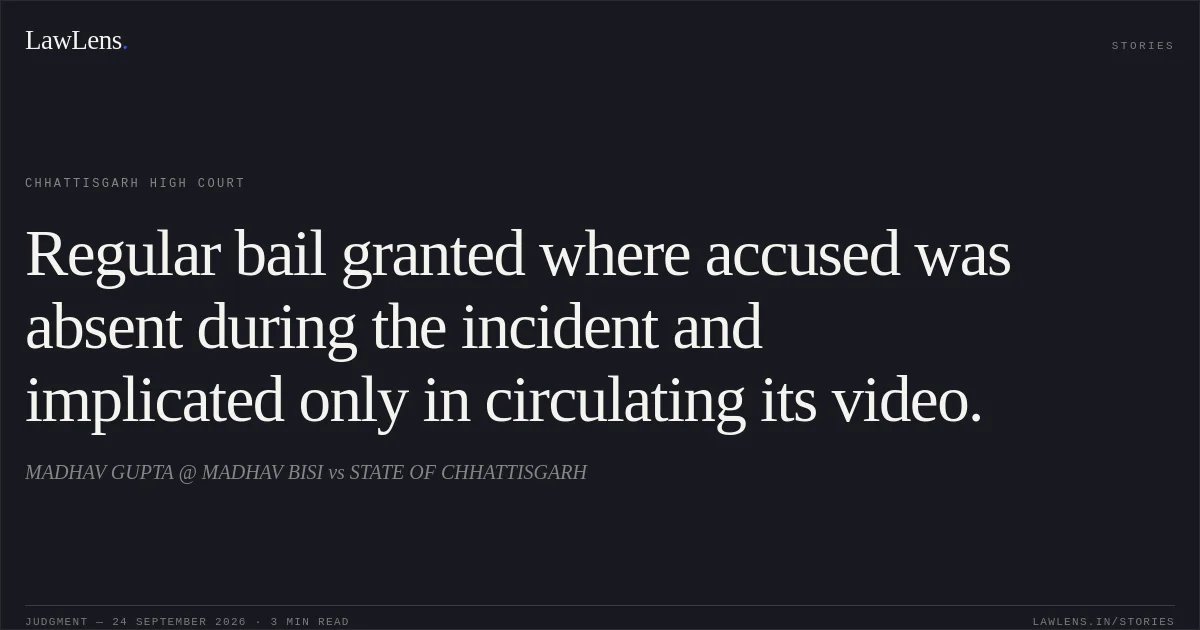
The appellant challenged the order dated 22 June 2026 by which the Special Court under the Scheduled Castes and the Scheduled Tribes (Prevention of Atrocities) Act, Raigarh, rejected his regular-bail application under Section 14A of the Act.
Source reference: para. 1The prosecution alleged that, during a protest on 27 December 2025, members of the protesting group allegedly assaulted a female police constable, abused and threatened her, tore her clothes, attempted to disrobe and kill her, and recorded and circulated a video of the incident.
Source reference: para. 2The appellant was subsequently charge-sheeted along with other accused persons for offences under various provisions of the Bharatiya Nyaya Sanhita, 2023, Section 3(2)(v) of the SC/ST Act, and Sections 66(e) and 67(a) of the Information Technology Act, 2008.
Source reference: para. 1The appellant argued that he was not named in the FIR, was not present at the spot, had no active participation in the assault, and was implicated only because he allegedly forwarded a video.
Source reference: para. 4The State opposed bail, relying on the seriousness of the offences, seizure of a mobile phone and two SIM cards, and the appellant’s criminal antecedents, including seven previous cases.
Source reference: para. 5The appellant had remained in judicial custody since 26 March 2026.
Source reference: paras. 4, 7Issues
Whether the Special Court’s rejection of the appellant’s regular-bail application under Section 14A of the SC/ST Act required appellate interference.
Source reference: paras. 1, 7Whether the appellant was entitled to regular bail having regard to the absence of his name in the FIR, absence of evidence showing his presence or active participation at the scene, his alleged limited role in forwarding a video, the period of custody, and the likely duration of the trial.
Source reference: paras. 4, 7Law Applied
The Court exercised appellate jurisdiction under Section 14A of the Scheduled Castes and the Scheduled Tribes (Prevention of Atrocities) Act, 1989, which permits an appeal against an order refusing or granting bail.
Source reference: para. 1In deciding bail, the Court considered the prima facie material, the nature and gravity of the alleged offences, the applicant’s specific role, the possibility of prolonged trial, the period of custody, and the risk of misuse of liberty.
Source reference: no citationReasoning
The Court found that the record did not show that the appellant was present at the place of occurrence or that he had actively participated in the principal incident.
Source reference: para. 7His name was also absent from the FIR, and the material against him appeared to relate primarily to the alleged forwarding of a video.
Source reference: paras. 4, 7Although the prosecution relied on the seriousness of the allegations and the appellant’s criminal antecedents, the Court gave weight to the appellant’s custody since 26 March 2026, the fact that investigation and charge-sheeting had substantially progressed, and the likelihood that the trial would take time.
Source reference: paras. 4, 5, 7On this assessment, continued detention was not considered necessary, subject to safeguards securing his appearance and compliance with the conditions of bail.
Source reference: paras. 7–8Holding
The appeal was allowed.
The Special Court’s order rejecting bail was set aside, and the appellant was directed to be released on regular bail upon furnishing a personal bond of ₹25,000 with one solvent surety for the same amount, subject to his regularly appearing before the trial court until conclusion of the criminal proceedings.
Source reference: para. 8The Registry was directed to transmit a copy of the order to the trial court for compliance.
Source reference: para. 9Original Court PDF
MADHAV GUPTA @ MADHAV BISIvsSTATE OF CHHATTISGARH
Click to open original judgment
Original judgment, available to read, download and summarize on LawLens.in