01Facts
The plaintiffs, the class-I legal heirs of Smt. Dundawwa, sued for a declaration that a Will dated 15.11.1983 executed by her in favour of the defendant was null and void and not binding on them, and for rectification of revenue records.
¶ 4They contended that Dundawwa died intestate and that the defendant had created a false Will and obtained mutation in his name.
¶ 4The defendant claimed to be the son of Dundawwa's husband's nephew, and relied on the Will as executed in return for services rendered.
¶ 5The mutation was effected in 1986.
¶ 21The plaintiffs challenged the mutation before the Assistant Commissioner in 2008, which directed them to approach the Civil Court.
¶ 22The Trial Court (O.S. No. 175/2012, decided 30.05.2015) held the plaintiffs to be owners by succession and declared the Will null and void, but dismissed the claims for rectification of records and permanent injunction.
¶ 8On appeal, the First Appellate Court (R.A. No. 45/2015, decided 02.02.2017) set aside the Trial Court's judgment and dismissed the suit.
¶ 11During cross-examination, PW1 admitted that the plaintiffs were not in possession of the suit property.
¶ 20, 23, 25The plaintiffs never sought amendment of the plaint to claim possession.
¶ 20, 23, 2502Issues
i.1. Whether the First Appellate Court was justified in reversing the judgment and decree of the Trial Court.
¶ 16, 17ii.2. Whether the First Appellate Court was justified in dismissing the suit on the ground that the plaintiffs did not seek the relief of recovery of possession, in view of the proviso to Section 34 of the Specific Relief Act, 1963.
¶ 16, 23–2503Law Applied
The Court applied Section 34 of the Specific Relief Act, 1963, which permits a declaration of title, but provides in its proviso that no court shall make such a declaration where the plaintiff, being able to seek further relief, omits to do so.
¶ 23–24The Court relied on Vasantha (Dead) through LRs v. Rajalakshmi alias Rajam (2024) 5 SCC 282, which, following Vinay Krishna v. Keshav Chandra (1993), Union of India v. Ibrahim Uddin, Ram Saran v. Ganga Devi (1973), Venkataraja v. Vidyane Doureradjaperumal (2014) and Arulmigu Chokkanatha Swamy Koil Trust v. Chandran (2017), holds that a suit for declaration of title without consequential relief of possession, where the plaintiff is out of possession, is not maintainable, and that the proviso prevents multiplicity of proceedings.
¶ 26, quoting Vasantha paras 49–52Provisions in the judgment · 2 · Linked ones open on LawLens
Code of Civil Procedure, 1908 Section 100
Specific Relief Act, 1963 Section 34
04Reasoning
The Court found that PW1's admission that the plaintiffs were out of possession was undisputed, and that the plaintiffs neither sought possession in the plaint nor amended it after evidence was led.
¶ 20, 23, 25Because the plaintiffs could have sought recovery of possession but omitted to do so, the proviso to Section 34 barred the declaratory relief, and the Trial Court's declaration of ownership and nullity of the Will could not stand.
¶ 23–25, 27The Court noted that the Trial Court's dismissal of the permanent injunction claim had not been appealed and had therefore attained finality.
¶ 27Applying Vasantha, the Court held that the First Appellate Court had correctly re-appreciated the evidence and rightly dismissed the suit under the proviso.
¶ 27–28The Court's decision rests on this procedural bar; it did not adjudicate the genuineness of the 1983 Will.
05Holding
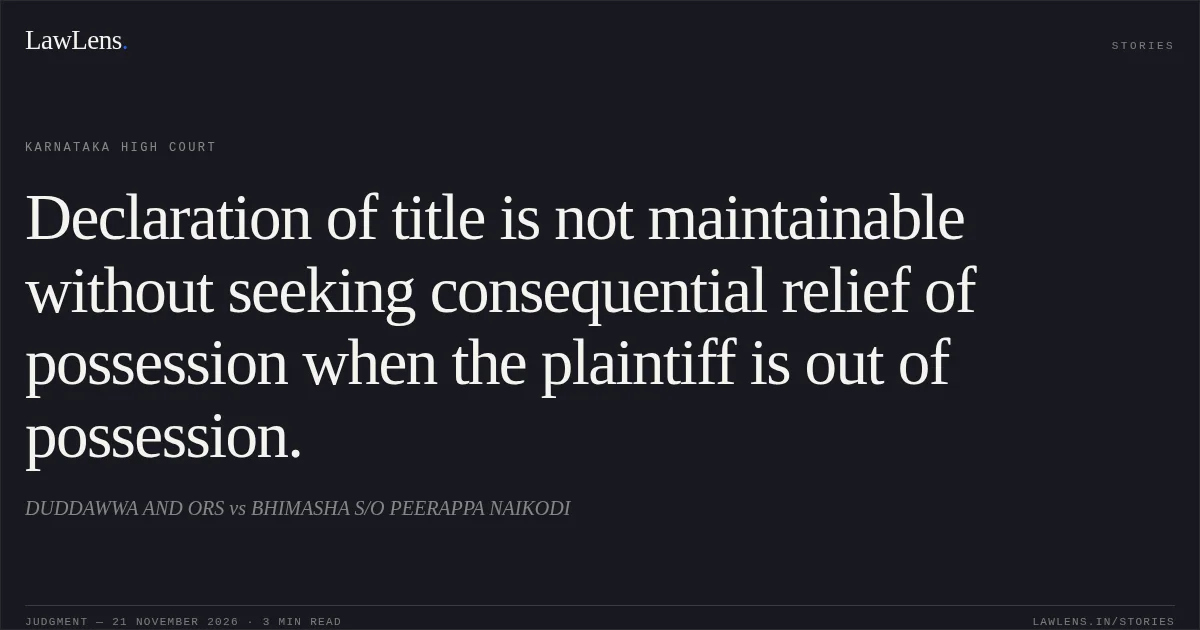
Both substantial questions of law were answered in the negative. The First Appellate Court was justified in reversing the Trial Court and in dismissing the suit, because a suit for declaration of title without a prayer for possession, by a plaintiff admittedly out of possession, is barred by the proviso to Section 34 of the Specific Relief Act.
¶ 27–29The Regular Second Appeal is dismissed. The judgment and decree dated 02.02.2017 in R.A. No. 45/2015 are confirmed, with no order as to costs.
¶ 30Original Court PDF
DUDDAWWA AND ORSvsBHIMASHA S/O PEERAPPA NAIKODI
Click to open original judgment
Original judgment, available to read, download and summarize on LawLens.in