01Facts
Respondent No.1 (plaintiff), sister of Defendants 1–3, sued for partition and separate possession of a 1/4th share in the suit schedule properties, alleging they were joint family properties of herself and her brothers (D1, D2) and sister (D3).
pp. 2–3D1 and D2 admitted the jointness and her 1/4th share; D3 was ex parte.
p. 3The appellant (D4) contested the suit, claiming that D1 and D2 had executed a registered Agreement of Sale dated 16.11.2006 in his favour for Item No.1, and that he had filed O.S. No.114/2008 for specific performance. He also pleaded earlier partition and that the properties were D1 and D2's self-acquired properties.
pp. 3–4The Trial Court (O.S. No.103/2008) found the suit properties to be joint family properties, with the plaintiff and D1–D3 each entitled to 1/4th, and held that the agreement did not bind the plaintiff's share.
pp. 5–6, para 5The Trial Court restrained D1 and D2 from alienating the properties to third parties until shares were determined, and kept D4's interest protected by the outcome of O.S. No.114/2008.
pp. 20–21, para 19 · pp. 21–22, para 6The First Appellate Court (R.A. No.104/2010, decided 19.02.2016) dismissed D4's appeal. It held the properties to be the self-acquired properties of the father, Maheshwarappa, who died in 2003, so that the plaintiff and D1–D3 took as Class I heirs under s.8 of the Hindu Succession Act.
pp. 25–27, para 22 · pp. 30–31, para 26–27The record is inconsistent on the father's death year (2002 at p.10; 2003 at p.18 and p.22).
p. 10 · p. 18 · p. 22Meanwhile, O.S. No.114/2008 was decreed on 02.06.2011 in D4's favour, directing D1 and D2 to execute a sale deed for their 1/4th shares each. RFA Nos.1534/2011 (D4) and 1533/2011 (D1, D2) were pending before the First Appellate Court.
pp. 31–32, para 802Issues
i.1. Whether a substantial question of law arises for consideration under s.100 CPC in the second appeal, such that the concurrent findings of the courts below require interference.
pp. 32–33, para 9ii.2. Whether D4's rights under the Sale Agreement dated 16.11.2006 are adequately safeguarded, given the pending specific performance suit and appeals, so that the decree in the partition suit need not be disturbed.
p. 22, para 6 · pp. 32–33, para 903Law Applied
Section 100 CPC, under which a second appeal lies only on a substantial question of law.
pp. 32–33, para 9Section 8 of the Hindu Succession Act governs the devolution of the suit properties where they are the self-acquired properties of the propositus, and not s.6 (coparcenary devolution, as amended in 2005).
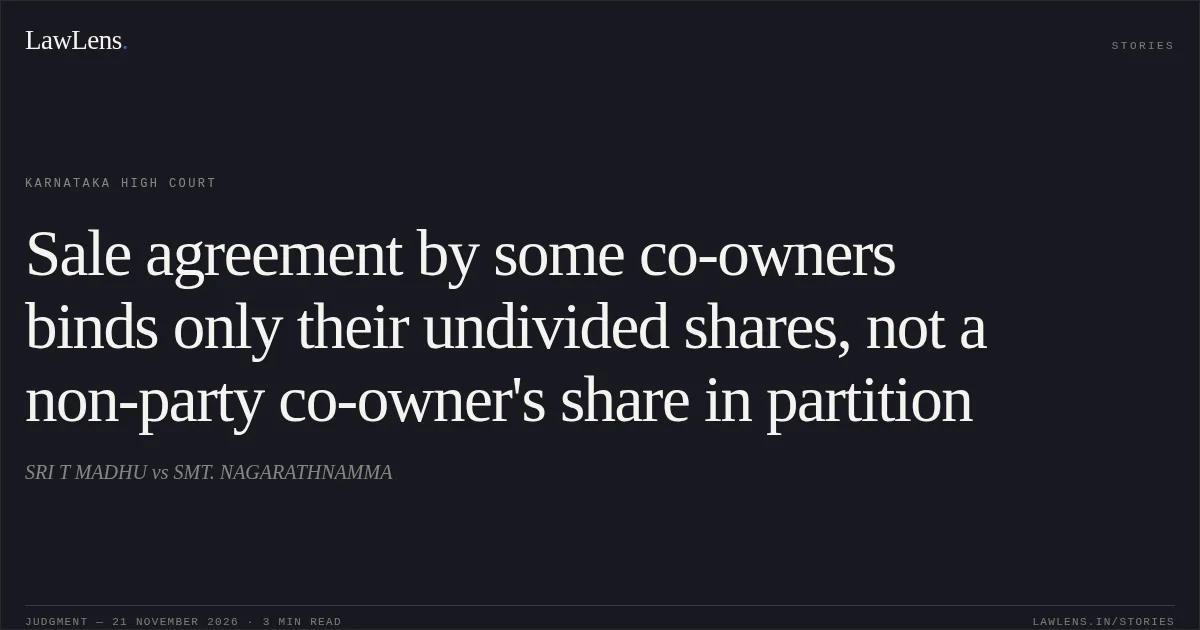
pp. 25–27, para 22 · pp. 19–20, para 18 (trial court)A sale agreement executed by co-owners binds only the executants' interests and not that of a non-party co-owner, so that the sale binds only D1 and D2's undivided shares.
pp. 19–20, para 18 (trial court)Kenchegowda v. Siddegowda (1994) 4 SCC 294 and Kalloomal Tapeswari Prasad v. CIT (AIR 1982 SC 716) were held inapplicable on these facts.
p. 17, para 16 (trial court)M. Prithiviraj v. Leelamma N (ILR 2009 Kar 3612) is distinguishable, since the succession there opened before the 2005 Amendment and the properties were ancestral.
pp. 18–19, para 17 (trial court)Provisions in the judgment · 3 · Linked ones open on LawLens
Code of Civil Procedure, 1908 Section 100
04Reasoning
Both courts below concurrently held, on the evidence, that the suit properties were the father's self-acquired properties. D4 failed to prove earlier partition or the joint-family character of the properties, as his own admissions showed hearsay knowledge only.
pp. 8–9, para 10 · p. 9, para 11 (trial court)D1 and D2 did not dispute the plaintiff's share. Accordingly, s.8 governed the devolution, and the s.6 arguments failed.
p. 7, para 9 (trial court) · pp. 25–27, para 22 · pp. 18–19, para 17–18 (trial court)On the agreement, because the plaintiff was not a party, the agreement could not bind her share, but it did bind D1 and D2's undivided interests.
pp. 13–14, para 14–15 (trial court) · pp. 19–20, para 18 (trial court)Once D1 and D2's 1/4th shares are carved out in the partition decree, D4's claim to Item No.1 can be worked out in O.S. No.114/2008. That suit has since been decreed, and the appeals against it are pending, so D4's interest was adequately protected and the partition decree was not required to decide the sale question.
pp. 20–21, para 18 (trial court) · pp. 31–33, para 8–905Holding
No substantial question of law arises for consideration.
pp. 32–33, para 9The second appeal is dismissed at the admission stage. The concurrent decrees of the Trial Court (O.S. No.103/2008, dated 21.04.2010) and the First Appellate Court (R.A. No.104/2010, dated 19.02.2016) are sustained. The plaintiff is held entitled to a 1/4th share, subject to the injunction against D1 and D2 alienating the suit properties to third parties until shares are determined in the final decree. The dismissal does not prejudice the parties' rival claims in RFA Nos.1534/2011 and 1533/2011, which are to be decided by the First Appellate Court on their merits.
pp. 32–33, para 9 · pp. 20–21, para 19 (trial court)Original Court PDF
SRI T MADHUvsSMT. NAGARATHNAMMA
Click to open original judgment
Original judgment, available to read, download and summarize on LawLens.in