Facts
The Respondent/Plaintiff, Arun Kumar, filed a Civil Suit for Possession, Mesne Profits, and Permanent Injunction against the Appellant/Defendant, Neeraj Kumar Jaggi, in respect of the first floor of property bearing No. A-45, Mangal Bazar, Uttam Nagar, New Delhi.
Source reference: p.2The Plaintiff claimed ownership via a registered Sale Deed dated September 30, 2005, having purchased the property from R.K. Chopra.
Source reference: p.3, p.5, p.7He asserted that the Defendant, his brother, was in illegal possession of the residential complex on the first floor.
Source reference: p.3The Defendant contended that there was a family settlement dated December 15, 2011, after their father's demise, and that the Plaintiff had executed necessary documents in respect of the property in his favour.
Source reference: p.3-4The Defendant also relied on a "Rajinama" dated April 21, 2005, and a "Declaration" dated April 26, 2005, claiming they showed his father was the rightful owner and indicating an agreement for his share in the property.
Source reference: p.7-8The Plaintiff alleged his signatures were obtained on blank papers due to his health condition after his father's demise.
Source reference: p.2-3The Defendant failed to appear and was proceeded ex parte, but his application under Order IX Rule 7 CPC was later allowed.
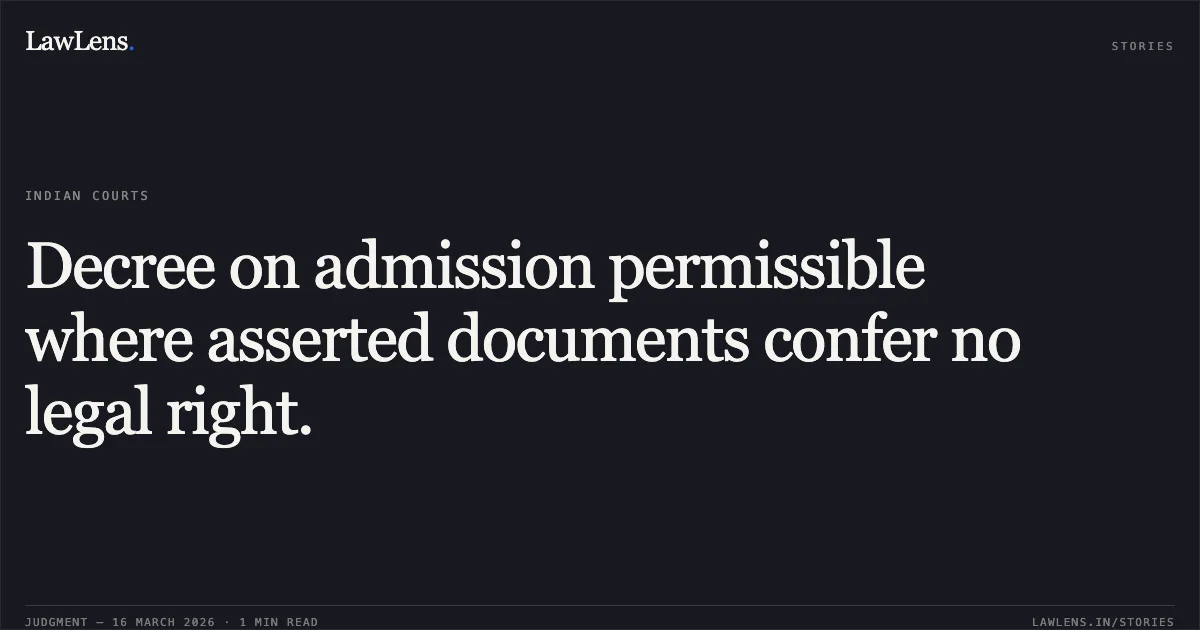
Source reference: p.4The learned District Judge decreed the Suit for possession under Order XII Rule 6 CPC via Order dated January 8, 2025, finding that the Rajinama and Declaration did not create any ownership right in favour of the Defendant.
Source reference: p.5The Appellant challenged this judgment, arguing that the family settlement was not considered, that his possession for over 17 years barred the suit by limitation, and that a judgment on admission under Order XII Rule 6 CPC was inappropriate due to ambiguous and conditional admissions.
Source reference: p.6Issues
Whether the learned District Judge erred in decreeing the Suit for possession under Order XII Rule 6 CPC.
Source reference: p.5Whether the documents relied upon by the Appellant, namely the Rajinama dated April 21, 2005, the Declaration dated April 26, 2005, and the Family Settlement dated December 15, 2011, create any right, title, or interest in favour of the Appellant in the Suit Property.
Source reference: p.5, p.7, p.9Law Applied
The court primarily applied Section 96 of the Code of Civil Procedure, 1908 (CPC) for Regular First Appeal.
Source reference: p.1It further applied Order XII Rule 6 CPC, which allows for a judgment on admission, subject to the condition that such admission must be clear, unambiguous, unequivocal, and unconditional, as held in *Himani Alloys Ltd. vs. Tata Steel Ltd.* (2011) and *Rajesh Kumar Mitra vs. Karnani Properties Limited* (2024).
Source reference: p.6Additionally, the court referenced Section 54 of the Transfer of Property Act, which mandates registration of a Sale Deed/Gift Deed for effective transfer of rights in immovable property, and Section 17 of the Registration Act, which requires compulsory registration for documents creating rights in immovable property.
Source reference: p.10Reasoning
The court affirmed the Plaintiff’s ownership based on the undisputed registered Sale Deed dated September 30, 2005, issued by Sh. R.K. Chopra.
Source reference: p.5, p.7The documents relied upon by the Defendant, the Rajinama dated April 21, 2005, and the Declaration dated April 26, 2005, were found to predate the Sale Deed and were merely reflective of an adjustment between parties when neither had ownership, thus creating no rights for the Appellant.
Source reference: p.8-9The court noted that these documents, even if admitted, would not create ownership rights for the Appellant and if the Declaration had merit, the Appellant failed to seek specific performance within the limitation period.
Source reference: p.5, p.9The Family Settlement dated December 15, 2011, signed only by the Respondent, was deemed a self-serving document.
Source reference: p.9Furthermore, being an unregistered document purporting to create rights in immovable property, it was ineffective under Section 54 of the Transfer of Property Act and Section 17 of the Registration Act, and thus inadmissible as evidence.
Source reference: p.10Therefore, the Appellant failed to establish any defence or right over the property, making the District Judge's decree under Order XII Rule 6 CPC appropriate due to the lack of a valid defence.
Source reference: p.10Holding
The High Court concluded that there was no merit in the appeal.
It held that the Plaintiff/Respondent was undeniably the owner of the property by virtue of the registered Sale Deed dated September 30, 2005.
Source reference: p.7The documents relied upon by the Appellant/Defendant (Rajinama, Declaration, Family Settlement) did not create any right, title, or interest in his favour in the Suit Property.
Source reference: p.9-10The Court found that the District Judge rightly decreed the Suit under Order XII Rule 6 CPC, as the Appellant's purported defence did not establish any legal right and even if proved, would merely characterize him as a permissive user.
Source reference: p.10Accordingly, the appeal was dismissed along with any pending applications.
Source reference: p.11Acts & Sections Cited
3 provisions across 3 statutes referred to in this judgment. Each provision opens on LawLens.
Registration Act, 19081
Transfer of Property Act, 18821
Code of Civil Procedure, 19081
Original Court PDF
Neeraj Kumar JaggivsArun Kumar
Click to open original judgment
Original judgment, available to read, download and summarize on LawLens.in