Facts
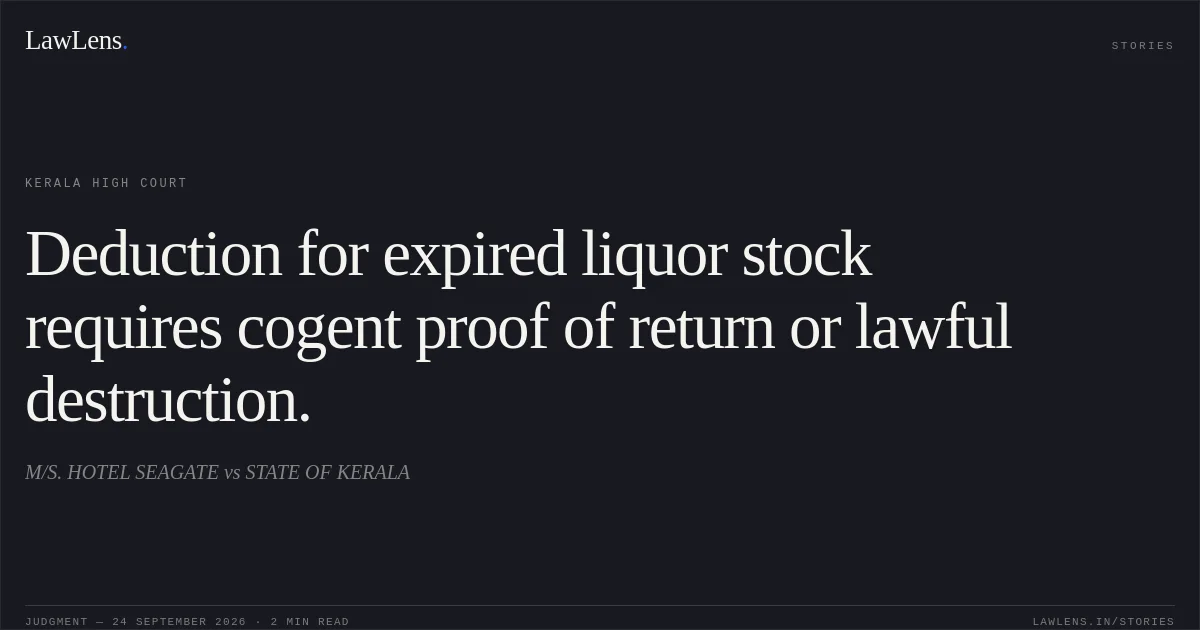
The petitioner, a licensed liquor retailer, claimed that certain beer stock had become unusable after its expiry date during the assessment year 2016–17 and had been destroyed in accordance with law.
Source reference: paras. 1, 6–8The Assessing Authority under the Kerala General Sales Tax Act, 1963 (“KGST Act”) disallowed the claim and included the disputed amount in the taxable turnover. The First Appellate Authority and the Kerala Agricultural Income Tax and Sales Tax Appellate Tribunal, Additional Bench, Ernakulam, upheld the assessment.
Source reference: paras. 1, 6–8Issues
Whether the Tax Authorities were justified in including the value of the allegedly damaged and expired beer stock in the petitioner’s taxable turnover.
Source reference: para. 3Whether the petitioner’s books of account could be rejected, or the claimed deduction disallowed, without assigning cogent reasons.
Source reference: para. 3Law Applied
The Court applied the KGST Act’s requirement of strict and implicit compliance with the statutory scheme governing taxable stock and returns, particularly where the commodity is liquor.
Source reference: paras. 7–9, 11–12A taxpayer seeking exclusion or deduction of the value of expired or damaged stock must cogently establish both that the stock had become unusable and that it had either been returned to the competent authorities or destroyed in the manner prescribed by law. The Court also considered the Food Safety and Standard (Labelling and Display) Regulations, 2020, which require expiry dates to be displayed and unsafe commodities to be destroyed after completion of the prescribed legal formalities; however, those Regulations did not themselves establish that the petitioner’s particular stock had actually been destroyed.
Source reference: paras. 7–9, 11–12Reasoning
The Court held that the petitioner’s reliance on the Excise letter was insufficient because the letter merely stated the general legal position and did not certify that the disputed beer stock had been destroyed in 2016 or 2017, or that the statutory formalities had been followed.
Source reference: paras. 7–8The petitioner therefore failed to prove either that the stock had become unusable or that it had been lawfully destroyed. The assertion that the destruction occurred in the presence and under the directions of Excise Officers, but that no certificate or record was provided, could not cure the evidentiary deficiency; strict compliance was especially necessary in relation to liquor.
Source reference: paras. 9–12Holding
As the petitioner neither claimed that the stock had been returned to the authorities nor produced legally sufficient proof of destruction, the disputed amount was correctly added to its returns. The Court consequently found no substantial question of law warranting admission of the revision.
The Kerala High Court dismissed the revision petition at the admission stage. It held that the petitioner was not entitled to exclude the value of the alleged damaged beer stock from its taxable turnover because it had failed to prove lawful return or destruction of the stock. The orders of the Assessing Authority, the First Appellate Authority, and the Tribunal were therefore left undisturbed.
Source reference: paras. 13–14Original Court PDF
M/S. HOTEL SEAGATEvsSTATE OF KERALA
Click to open original judgment
Original judgment, available to read, download and summarize on LawLens.in