Facts
The petitioner contested the 2024 Lok Sabha election from 78-Bhadohi Parliamentary Constituency. The respondent, Dr. Vinod Kumar Bind, was declared elected after securing 4,59,982 votes against the petitioner’s 4,15,910 votes.
Source reference: p.1The petitioner challenged the election on five grounds under Section 100 of the Representation of the People Act, 1951: improper acceptance of the respondent’s nomination; the respondent’s alleged disqualification under the Tenth Schedule; improper rejection of the nominations of Zia-Ul-Haq and Lalti Devi; non-compliance with election laws and orders; and commission of the corrupt practice of bribery.
Source reference: pp.1–3The respondent applied under Order VII Rule 11(a), Code of Civil Procedure, read with Sections 83 and 87 of the Representation of the People Act, contending that the petition disclosed no cause of action and lacked material facts and particulars.
Source reference: pp.2–4Issues
1. Whether the election petition disclosed a cause of action under Section 100 of the Representation of the People Act, 1951, so as to avoid rejection under Order VII Rule 11(a) CPC?
Source reference: pp.12–16, 30–402. Whether the respondent’s alleged voluntary relinquishment of membership of the NISHAD Party, while contesting the parliamentary election as a BJP candidate, disqualified him from being chosen as a Member of Parliament under Article 102(2) and the Tenth Schedule of the Constitution?
Source reference: pp.18–263. Whether the allegations of improper acceptance of the respondent’s nomination and non-compliance with Section 33 of the Representation of the People Act and paragraph 13 of the Election Symbols (Reservation and Allotment) Order, 1968 contained the material facts necessary to invoke Section 100(1)(d)(i) or (iv)?
Source reference: pp.26–334. Whether the allegations concerning improper rejection of the nominations of Zia-Ul-Haq and Lalti Devi contained sufficient material facts to constitute a ground under Section 100(1)(c)?
Source reference: pp.33–355. Whether the allegations of an agreement between the NISHAD Party and BJP concerning the respondent’s candidature constituted a sufficiently pleaded corrupt practice of bribery under Section 123(1)(B)(a)?
Source reference: pp.35–39Law Applied
Section 83(1)(a) of the Representation of the People Act requires an election petition to contain a concise statement of material facts, while Section 83(1)(b) requires full particulars of any corrupt practice; failure to plead a material fact necessary to constitute a complete cause of action is fatal.
Source reference: pp.12–16Under Order VII Rule 11(a) CPC, an election petition may be rejected where, taking its averments as a whole, it discloses no cause of action; however, the court cannot ordinarily dissect the pleading or test the truth of its allegations at that stage, as held in D. Ramachandran v. R. V. Janakiraman.
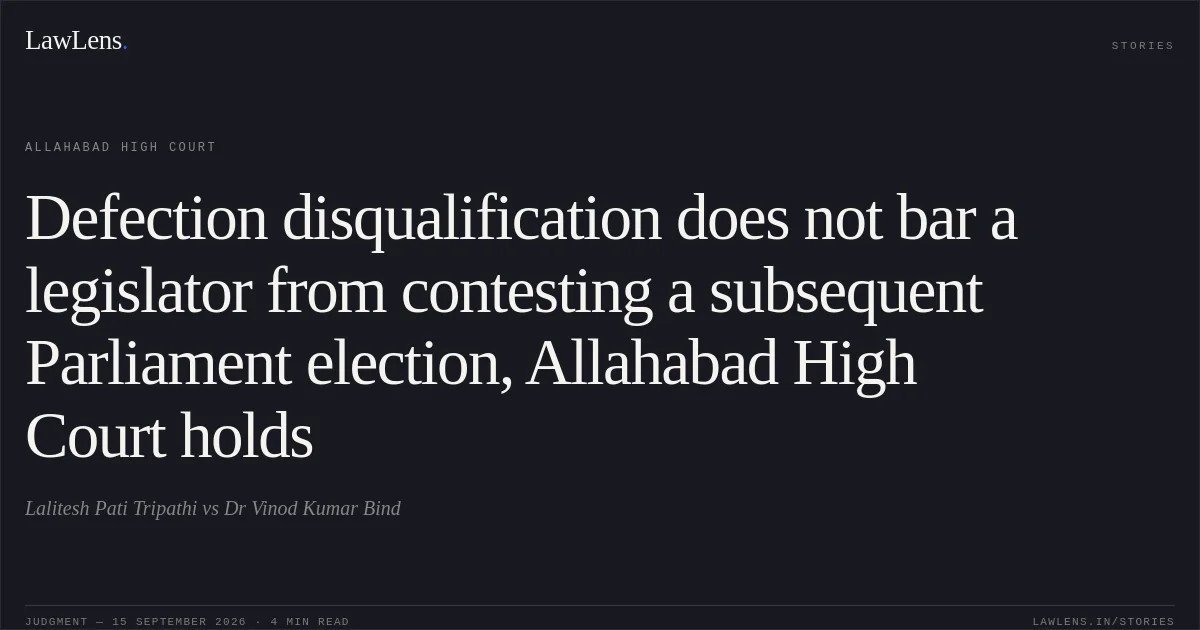
Source reference: p.13Article 102(2) and paragraph 2 of the Tenth Schedule impose disqualification for being a member of a House on the ground of defection, but, following Shrimanth Balasaheb Patil v. Hon’ble Speaker and K.M. Mune Gowda v. State of Karnataka, such disqualification does not by itself bar a person from contesting a subsequent election.
Source reference: pp.21–25Paragraph 13 of the Election Symbols Order requires a candidate claiming to be set up by a political party to be a member of that party and to have his name on its membership rolls.
Source reference: p.27Allegations of corrupt practice, being quasi-criminal in nature, must be pleaded with precision, including the parties involved, the act, date, place, and other material particulars, as required by Section 83(1)(b) and explained in Azhar Hussain v. Rajiv Gandhi and Karim Uddin Barbhuiya v. Aminul Haque Laskar.
Source reference: pp.35–37Reasoning
The Court held that the respondent’s conduct could amount to voluntary relinquishment of NISHAD Party membership for purposes of his existing Legislative Assembly membership, even without a formal resignation, applying Ravi S. Naik and Rajendra Singh Rana.
Source reference: pp.18–23However, Article 102(2) concerned disqualification from being a Member of Parliament and did not disqualify the respondent from being chosen or contesting a parliamentary election; therefore, ground B did not disclose a legally sustainable challenge under Section 100(1)(a).
Source reference: pp.23–26As to grounds A and D, the petition merely asserted that the respondent’s nomination had been improperly accepted and that the result was materially affected. It did not plead how the alleged violation of Section 33 or paragraph 13 of the Election Symbols Order actually affected the result. The Court therefore found the pleadings insufficient under Section 100(1)(d)(i) and (iv).
Source reference: pp.26–33Ground C similarly failed because the petitioner did not identify the defects allegedly relied upon by the Returning Officer in rejecting the nominations of Zia-Ul-Haq and Lalti Devi, nor plead facts showing why those rejections were improper.
Source reference: pp.33–35Ground E was also held defective. The petition did not plead the date, place, source, terms, or participants of the alleged agreement between the NISHAD Party and BJP; nor did it allege that the respondent received or agreed to receive gratification for standing or not standing as a candidate. The allegations were therefore speculative and did not satisfy Sections 83(1)(b) and 123(1)(B)(a).
Source reference: pp.35–39Holding
The alleged Tenth Schedule disqualification did not prevent the respondent from contesting the parliamentary election.
The Court allowed the respondent’s application under Order VII Rule 11 CPC and dismissed the election petition. It held that the alleged Tenth Schedule disqualification did not prevent the respondent from contesting the parliamentary election, and that the petition lacked the material facts necessary to sustain the challenges based on improper acceptance of nomination, statutory non-compliance, improper rejection of other nominations, or bribery.
Source reference: pp.39–40The parties were directed to bear their own costs.
Source reference: p.40Acts & Sections Cited
13 provisions across 1 statute referred to in this judgment. Each provision opens on LawLens.
Representation of the People Act, 1951
Original Court PDF
Lalitesh Pati TripathivsDr Vinod Kumar Bind
Click to open original judgment
Original judgment, available to read, download and summarize on LawLens.in