01Facts
The prosecution alleged that on 28.03.2017, while the complainant (PW3) was grazing sheep and his wife (PW5) was away, the appellant allured and kidnapped his 16-year-old daughter (PW4) by promising marriage.
p. 3He allegedly took her to Hosadurga (Chitradurga District), where he repeatedly committed penetrative sexual intercourse and wrongfully confined her for over 10 days.
pp. 3–4 · ¶ 10 · p. 12FIR No. 93/2017 was registered on 25.04.2017 under Section 363 IPC and later amended to include Section 376(1) IPC and Sections 5(l) r/w 6 POCSO Act.
p. 4The Sessions Court (Special Case (POCSO) No. 34/2017, judgment dated 20.11.2020) framed charges under Sections 366, 344 and 376(1) IPC and Sections 5(l) r/w 6 POCSO Act. The accused pleaded not guilty.
pp. 4–5The prosecution examined 22 witnesses and marked 30 documents and 4 material objects.
p. 5The Sessions Court convicted the accused and imposed life imprisonment (till natural death) with a fine of Rs.50,000 under POCSO, 10 years' RI with Rs.20,000 fine under Section 366 IPC, and 3 years' RI with Rs.20,000 fine under Section 344 IPC, with substantive sentences running concurrently.
pp. 7–9The accused appealed. Defence contended that the victim was 18 at the time of the alleged missing, that Ex.P15 (study certificate) did not prove age under Section 94 of the JJ Act, that the relationship was consensual, and that life imprisonment exceeded the pre-amendment range of 10 years to life.
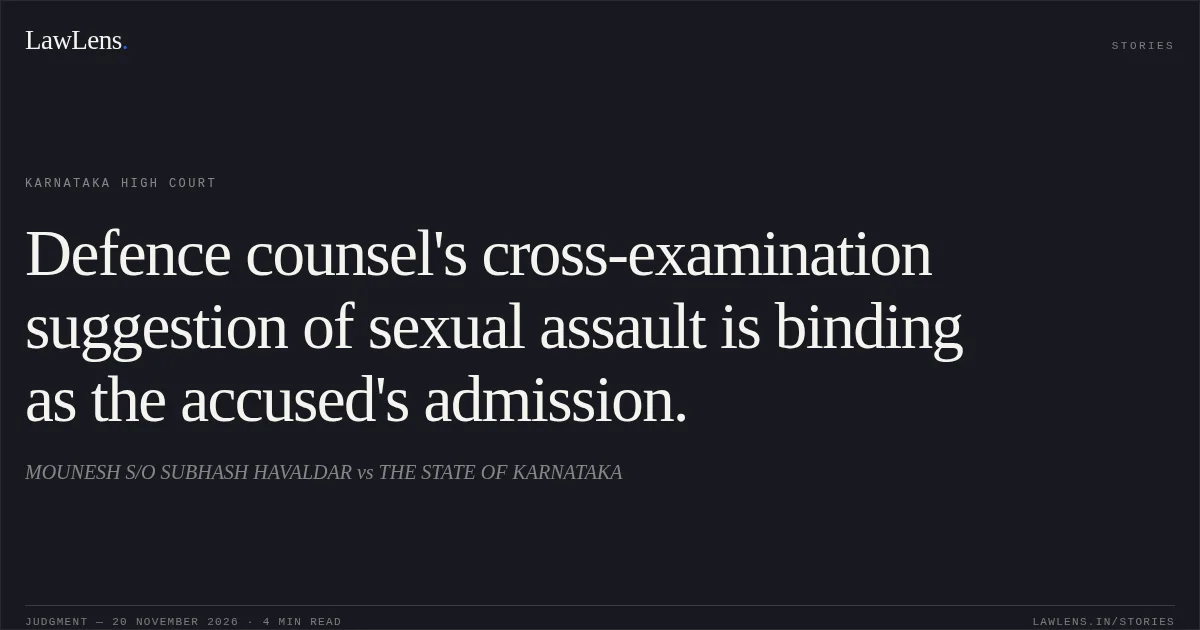
pp. 9–11The State contended that defence counsel's cross-examination suggestion of sexual assault amounted to an admission.
p. 11PW4's testimony is the key evidence.
¶ 14–14.1 · pp. 17–19PW1–PW2 panchanama and clothing seizure is key evidence.
¶ 11–12 · pp. 13–14PW3's testimony is key evidence.
¶ 13 · pp. 15–16PW5 and PW6 gave hearsay evidence.
¶ 15–16 · pp. 19–2002Issues
i.1. Whether the impugned judgment of conviction and order of sentence are arbitrary and erroneous.
p. 12, para 9(i)ii.2. Whether the accused proves that the order of sentencing him to life imprisonment is contrary to Section 6 of the POCSO Act.
p. 12, para 9(ii)03Law Applied
The court applied Section 6 of the POCSO Act, as it stood before the 2019 amendment, which prescribed rigorous imprisonment of not less than 10 years extending to life, and held that offences committed before 06.08.2019 are governed by that pre-amendment regime, with Section 61 of the Act as it then stood.
pp. 21–22, paras 20–22Under the 2019 amendment, Section 6 prescribes a minimum of 20 years and imprisonment for the remainder of natural life or death.
p. 22, footnote quoting amended s.6The court applied the principle that a sentence of maximum punishment requires assignment of valid reasons, and that sentencing must reflect reformation and rehabilitation, relying on Sandeep v. State of Uttarakhand, Crl. Appeal No. 2224 of 2014 (decided 14.10.2024).
pp. 22–23, paras 21–23On conviction, it relied on the principle that a lawyer is the authorised agent of the accused and that a suggestion put to a witness in cross-examination on the accused's behalf operates as an admission binding on the accused.
pp. 20–21, paras 17–18The offences are under Sections 366, 344 and 376(1) IPC and Sections 5(l) r/w 6 POCSO Act.
p. 21, para 19The victim's status as a "child" under Section 2(1)(d) POCSO and proof of age under Section 94 JJ Act were raised by the defence.
p. 9, para 6Provisions in the judgment · 11 · Linked ones open on LawLens
Code of Criminal Procedure, 1973 Section 374Section 164
Indian Penal Code, 1860 Section 366Section 376Section 344Section 363
Protection of Children from Sexual Offences Act, 2012 Section 2Section 5Section 6Section 61
Juvenile Justice (Care and Protection of Children) Act, 2015. Section 94
04Reasoning
The court held that the conviction was sound. It relied on defence counsel's suggestion during PW4's cross-examination that the accused had sexually assaulted her by intercourse, which PW4 admitted.
¶ 17–18 · pp. 20–21Treating that suggestion as an admission binding the accused, the court held that it corroborated the prosecution case and proved the offence beyond reasonable doubt.
¶ 17–18 · pp. 20–21The court did not separately address the consent plea or the age-proof challenge to Ex.P15 under Section 94 JJ Act, although these were raised.
pp. 9–10, para 6 · ¶ 19 · p. 21On sentence, the court found life imprisonment disproportionate because the Sessions Court recorded no reasons for imposing the maximum term.
¶ 21–22 · pp. 22–23It then weighed the appellant's age at the time of the incident, lack of criminal antecedents, first-offender status, more than nine years already served, and good conduct in custody.
¶ 23–24 · pp. 23–24It concluded that the ends of justice would be met by reducing the sentence to 10 years' RI, which is the statutory minimum under the applicable pre-amendment provision.
¶ 23–24 · pp. 23–24The judgment does not separately discuss the Section 376(1) IPC sentence.
05Holding
Point (i) is answered in the negative: the conviction under Sections 366, 344 and 376(1) IPC and Sections 5(l) r/w 6 POCSO Act is not arbitrary or erroneous.
¶ 25 · p. 25Point (ii) is answered in the affirmative: the life sentence is contrary to the pre-amendment Section 6 POCSO Act, as it lacked reasons for the maximum term.
¶ 21–25 · pp. 22–25The appeal is allowed in part. The POCSO sentence is modified to 10 years' RI with a fine of Rs.50,000 (default: 3 years' RI) under Sections 5(l) r/w 6 POCSO Act.
pp. 24–26, order (iv)The sentences under Sections 366 and 344 IPC are maintained.
order (v) · p. 26Substantive sentences run concurrently; default sentences run consecutively.
order (vi) · p. 26Original Court PDF
MOUNESH S/O SUBHASH HAVALDARvsTHE STATE OF KARNATAKA
Click to open original judgment
Original judgment, available to read, download and summarize on LawLens.in