01Facts
The plaintiffs instituted O.S. No. 3975/2018 before the III Addl. City Civil Judge, Bengaluru (CCH-25), seeking specific performance of a preferential right to purchase the suit properties, which they claim arises from a condition incorporated in a sale deed executed in favour of defendant No. 1.
¶ 5During the pendency of the suit, defendant No. 1, acting through a General Power of Attorney holder, alienated the suit properties to the proposed defendants.
¶ 6The plaintiffs filed I.A. No. 13 under Order I Rule 10 read with Section 151 CPC seeking impleadment of these subsequent purchasers.
¶ 1The trial court rejected the application by order dated 13.12.2022.
¶ 1The proposed defendants resisted the application, contending that they acquired title through a registered sale deed executed by the first transferee and are neither necessary nor proper parties.
¶ 3The plaintiffs, appearing in person, challenged the order under Article 227 of the Constitution.
¶ 1 · ¶ 2The Court notes that the trial court's reasons (para. 10 of the impugned order) were ambiguous and traversed the merits of the plaintiffs' claim.
¶ 1202Issues
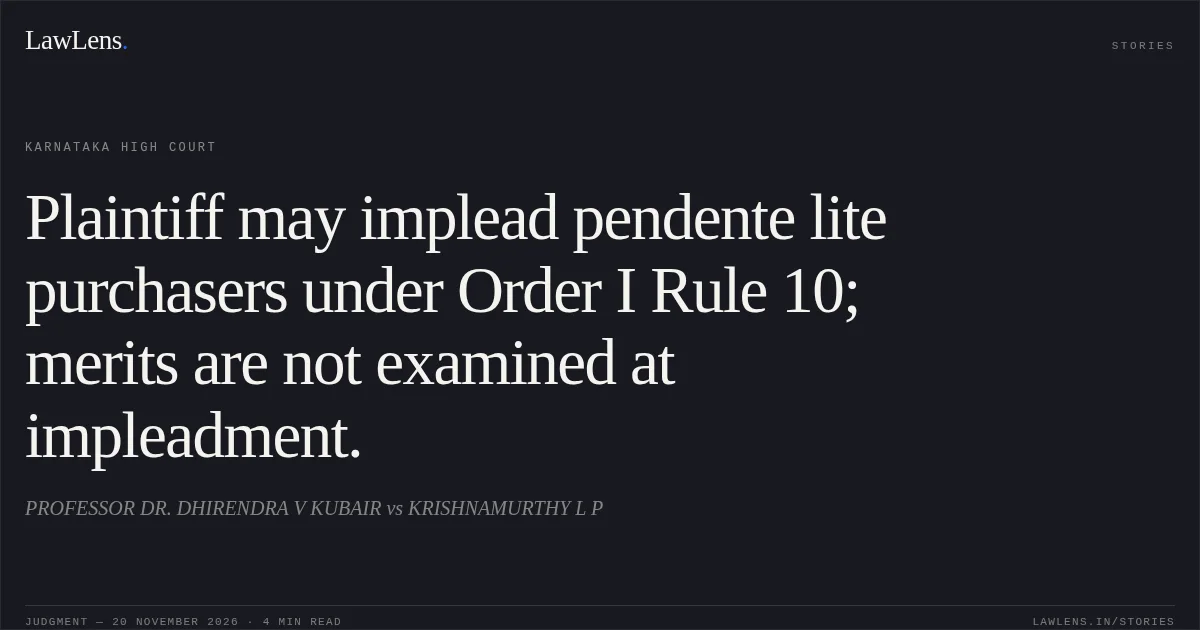
i.1. Whether the trial court erred in rejecting the plaintiffs' application under Order I Rule 10 CPC for impleadment of pendente lite purchasers, where the plaintiffs themselves sought their impleadment.
¶ 8 · ¶ 9 · ¶ 12ii.2. Whether the trial court was justified in examining the merits of the plaintiffs' claim, including enforceability of the condition in the sale deed, while deciding an impleadment application.
¶ 12 · ¶ 13iii.3. Whether the doctrine of lis pendens bars the plaintiff, as dominus litis, from seeking impleadment of a pendente lite transferee.
¶ 7 · ¶ 803Law Applied
Order I Rule 10 CPC permits the Court to bring in proper or necessary parties to enable it to effectually and completely adjudicate on all questions involved in the suit and to avoid multiplicity of proceedings.
¶ 10Under the doctrine of lis pendens, a transferee pendente lite acquires no independent right to defeat the pending adjudication and is bound by the eventual decree, although the judgment does not expressly cite the statutory provision.
¶ 7A pendente lite purchaser cannot claim impleadment as of right, but the plaintiff, as dominus litis, may seek impleadment of such a purchaser where the alienation may affect effective enforcement of the decree.
¶ 8At the Order I Rule 10 stage, the Court must not undertake a detailed examination of the merits or record findings on enforceability of the contractual stipulation.
¶ 13The Court exercised supervisory jurisdiction under Article 227 of the Constitution to interfere with the impugned order for material infirmity.
¶ 16No precedents are cited in the judgment.
Provisions in the judgment · 1 · Linked ones open on LawLens
Code of Civil Procedure, 1908 Section 151
04Reasoning
The Court distinguished between a pendente lite purchaser seeking impleadment on his own initiative, which is not a matter of right, and a plaintiff seeking impleadment of such a purchaser to secure complete adjudication.
¶ 8Because the plaintiffs themselves sought impleadment, with the object of ensuring that the purchasers are bound by the decree and that enforcement is not complicated, the Court held that their presence would assist effective adjudication.
¶ 9 · ¶ 10The Court reasoned that impleadment would confer no additional substantive right on the purchasers, and that their defence would remain confined to what is legally permissible given the lis pendens character of their acquisition.
¶ 11The trial court's rejection was found flawed because it failed to draw this distinction and, in substance, adjudicated the merits of the specific performance claim and the enforceability of the sale-deed condition.
¶ 12 · ¶ 13The Court also noted that participation in the suit would be in the proposed defendants' own interest, as it would prevent them from facing a decree in proceedings to which they were not parties.
¶ 14To prevent the impleadment from being read as a finding, the Court expressly kept open the validity of the subsequent sale deeds, the enforceability of the preferential right, and the entitlement to specific performance.
¶ 1505Holding
The Court held that the trial court's order suffered from material infirmity, and that the proposed defendants ought to have been permitted to come on record at the instance of the plaintiffs, who are dominus litis.
¶ 14 · ¶ 16The writ petition is allowed. The order dated 13.12.2022 in O.S. No. 3975/2018 is quashed and set aside, and the Order I Rule 10 application is allowed. The plaintiffs are permitted to implead the proposed defendants as defendant Nos. 3 and 4, must amend the cause title, and must furnish an amended plaint to them. Defendant Nos. 3 and 4 may file written statements confined to legally permissible pleas, having regard to their acquisition and lis pendens. The trial court is directed to proceed with the suit in accordance with law, uninfluenced by the observations, which are confined to the impleadment application, with all merits contentions kept open.
¶ 15 · ¶ 17(i)–(vi)Original Court PDF
PROFESSOR DR. DHIRENDRA V KUBAIRvsKRISHNAMURTHY L P
Click to open original judgment
Original judgment, available to read, download and summarize on LawLens.in