01Facts
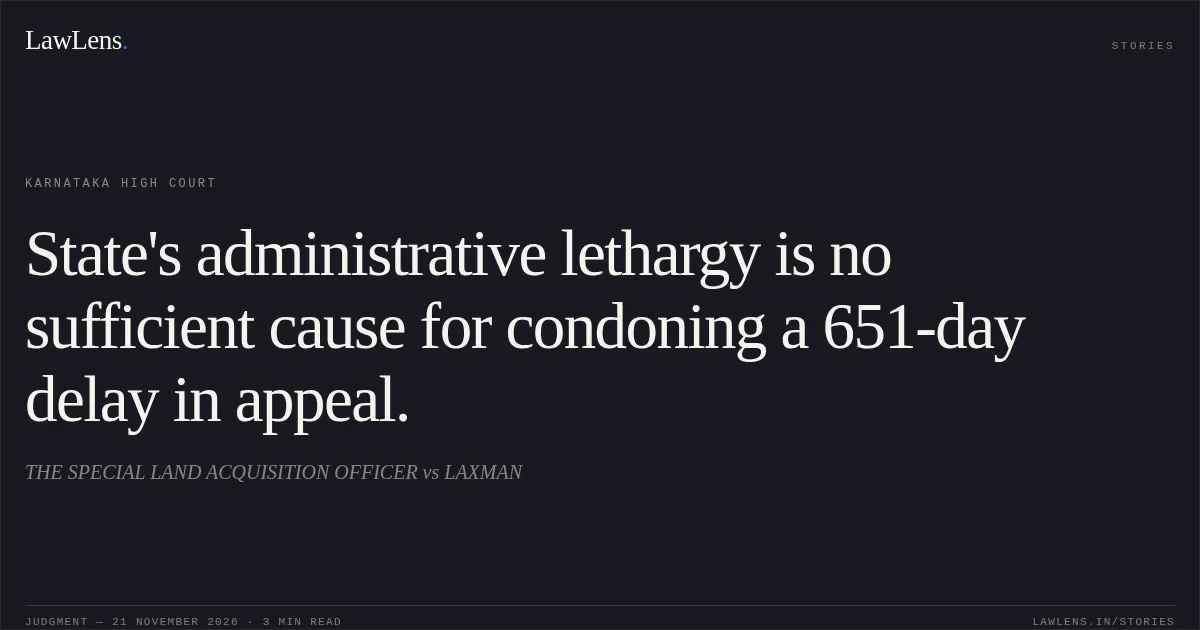
The appellants, the Special Land Acquisition Officer (UKP, Almatti), the Commissioner for Rehabilitation and Resettlement, and the General Manager, Rehabilitation and Resettlement (Land Acquisition Division), filed this appeal under Section 74(1) of the Right to Fair Compensation and Transparency in Land Acquisition, Rehabilitation and Resettlement Act, 2013, challenging the judgment and award dated 31.08.2023 in LAC No. 1708/2021.
p. 2The appeal was filed on 20.09.2025 with a delay of 651 days.
p. 2 · ¶ 1I.A. No. 1/2026 was filed on 04.08.2026 seeking condonation of that delay.
p. 2 · ¶ 1The affidavit accompanying the application stated the reasons for delay, but the judgment does not set out their content.
p. 16 · ¶ 4The Court found that the appellants had not approached it within the stipulated period and had not shown sufficient cause.
p. 16 · ¶ 402Issues
i.1. Whether the appellants, being State instrumentalities, have shown sufficient cause for condonation of a 651-day delay in filing the appeal under Section 74(1) of the 2013 Act.
p. 2 · ¶ 1 · p. 16 · ¶ 4ii.2. Whether, in the absence of condonation, the appeal can be entertained on merits.
p. 16 · ¶ 503Law Applied
The Court relied primarily on the principles of limitation as stated in Shivamma v. Karnataka Housing Board, 2025 SCC OnLine SC 1969, which hold that limitation is founded on public policy and that a State is not to receive liberal condonation of delay merely because public interest is invoked.
pp. 2–3 · ¶ 228–229It treated administrative lethargy as insufficient cause and required the State to show bona fides and vigilance throughout the period.
pp. 11–12 · ¶ 261It applied the principle of dura lex sed lex from Basawaraj, as quoted in Shivamma, that limitation must be applied with full rigour even where it causes hardship.
pp. 6–8 · ¶ 234It further relied on State of Odisha v. Managing Committee of Namatara Girls High School, 2026 SCC OnLine SC 191, which held that condonation is a matter of discretion, not of right, and that a bureaucratic explanation amounting to a "lame excuse" does not justify condonation.
pp. 13–15 · ¶ 16–21The Court also relied on Section 5 of the Limitation Act, 1963, as construed in Shivamma, which requires sufficient cause to be shown before delay is condoned.
pp. 9–10 · ¶ 254, 258 · p. 8 · ¶ 235Provisions in the judgment · 4 · Linked ones open on LawLens
Right to Fair Compensation and Transparency in Land Acquisition, Rehabilitation and Resettlement Act, 2013 Section 74
Limitation Act, 1963 Section 5Section 3
Code of Civil Procedure, 1908 Section 100
04Reasoning
The Court first noted the length of delay, 651 days, and the State's status as the appellant.
p. 2 · ¶ 1Applying Shivamma, it held that the State's institutional status does not relax the requirement of sufficient cause, and that the reasons offered in the affidavit did not satisfy the Court.
p. 16 · ¶ 4Following Namatara, it treated the explanation as an excuse rather than an explanation, consistent with the Supreme Court's rejection of bureaucratic inertia as a ground for condonation.
pp. 14–15 · ¶ 17–21Because the delay was not condoned, the appeal was held to be time-barred, and the Court did not reach the merits of the award.
p. 16 · ¶ 5The judgment does not identify the specific reasons in the affidavit, so the precise factual shortfall is not discernible from the text.
05Holding
The Court held that the appellants failed to show sufficient cause for the 651-day delay and that the explanation was not acceptable.
p. 16 · ¶ 4I.A. No. 1/2026 seeking condonation of delay is dismissed, and consequently the Miscellaneous First Appeal No. 207664 of 2025 is dismissed as time-barred.
p. 16 · ¶ 5The judgment and award dated 31.08.2023 in LAC No. 1708/2021 stand unaffected.
p. 16 · ¶ 5Original Court PDF
THE SPECIAL LAND ACQUISITION OFFICERvsLAXMAN
Click to open original judgment
Original judgment, available to read, download and summarize on LawLens.in