Facts
On 8 November 2001, the appellant/claimant was travelling on a motorcycle from Hyderabad towards Chevella when a DCM van, allegedly driven rashly and negligently, collided with the motorcycle.
Source reference: para. 3The claimant sustained a fracture to his right leg and other injuries, while his accompanying friend died in the accident.
Source reference: no citationThe claimant alleged that he was earning ₹4,500 per month and filed a claim petition under Section 166 of the Motor Vehicles Act seeking ₹2,50,000 as compensation.
Source reference: para. 3The Tribunal relied on the FIR and charge sheet and held that the accident occurred due to the rash and negligent driving of the offending vehicle.
Source reference: para. 9It awarded only ₹20,000 in compensation.
Source reference: para. 9The claimant appealed seeking enhancement.
Source reference: para. 6Issues
Whether the claimant was entitled to enhancement of compensation on account of the permanent disability suffered in the accident, including whether the disability certificate issued after a delay could be relied upon?
Source reference: paras. 8, 11–14Whether the claimant’s physical disability should be assessed as functional disability affecting his earning capacity, and if so, to what extent?
Source reference: paras. 14–15What would be the appropriate compensation under the heads of loss of future income, pain and suffering, loss of earnings, transportation and extra nourishment, and what rate of interest should apply?
Source reference: paras. 16, 19–22Law Applied
The Court applied Section 166 of the Motor Vehicles Act, under which a victim of a motor accident may claim just compensation for injuries caused by the rash or negligent driving of a motor vehicle.
Source reference: para. 3It held that disability must be assessed on the basis of medical evidence and the actual functional impact of the injury, and that the absence of surgery does not, by itself, negate permanent disability.
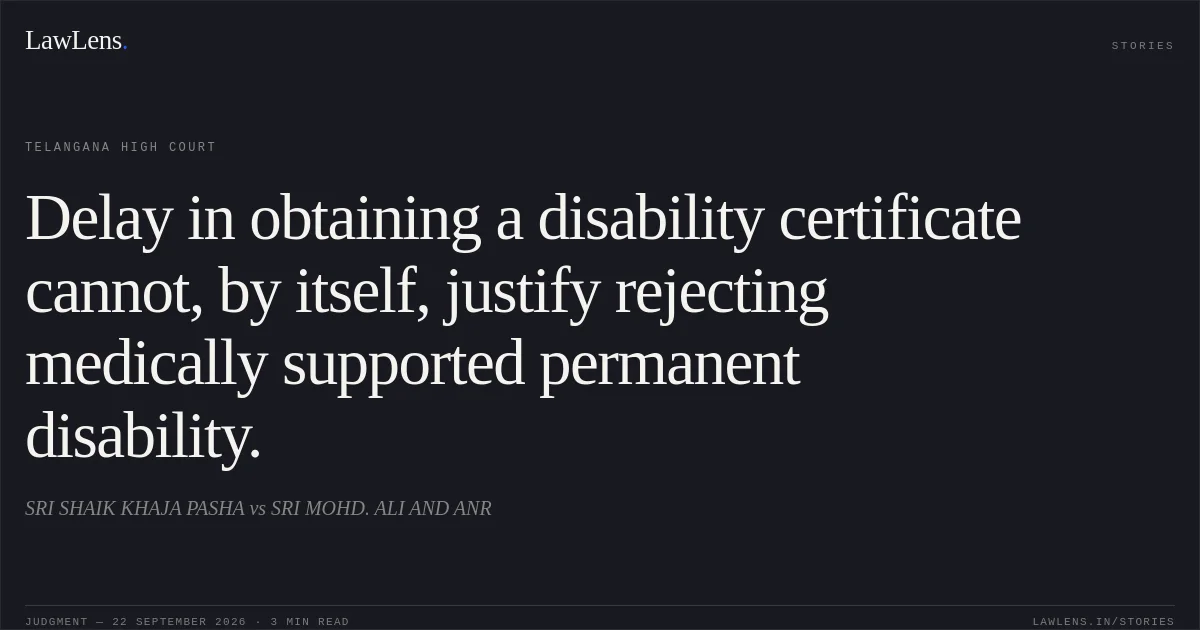
Source reference: para. 12Relying on United India Insurance Co. Ltd. v. Miss K. Subhashini, the Court held that a delay in obtaining a disability certificate is not, by itself, a ground to reject it, since disability may require time to stabilise and be assessed.
Source reference: para. 13For computation, the Court applied Sarla Verma v. Delhi Transport Corporation, prescribing a multiplier of 18 for a person aged between 15 and 20 years.
Source reference: para. 16The Court applied National Insurance Co. Ltd. v. Pranay Sethi, allowing 40% addition towards future prospects for a self-employed person below 40 years of age.
Source reference: para. 19The Court further applied the principle that physical disability must be translated into functional disability according to its effect on the claimant’s earning capacity.
Source reference: paras. 14–15Reasoning
The Court accepted the claimant’s age as approximately 20 years and his monthly income as ₹4,500, as determined by the Tribunal.
Source reference: para. 19Although the medical evidence certified 30% disability in the right leg, the Court found that the certificate primarily established shortening of the leg by three-fourths of an inch and difficulty in sitting, squatting and walking for long distances; it therefore assessed functional disability affecting earning capacity at 10%, rather than accepting the entire 30% physical disability.
Source reference: paras. 14–15The delayed issuance of the disability certificate in 2004, although more than two years after the accident, was not treated as fatal to the claim.
Source reference: para. 13Adding 40% future prospects, the monthly income was calculated at ₹6,300 and the annual income at ₹75,600.
Source reference: para. 19Applying the multiplier of 18 and functional disability of 10%, the Court awarded ₹1,36,080 for loss of future income.
Source reference: para. 19It enhanced pain and suffering from ₹5,000 to ₹20,000, while retaining the Tribunal’s awards of ₹500 for transportation, ₹1,000 for extra nourishment and ₹13,500 for loss of earnings.
Source reference: paras. 20–21The Court reduced the interest rate from 9% to 7.5% per annum, consistent with its approach in motor accident claims.
Source reference: para. 22Holding
The appeal was partly allowed.
The compensation was enhanced from ₹20,000 to ₹1,71,080, comprising ₹1,36,080 for loss of future income, ₹1,500 for transportation and extra nourishment, ₹13,500 for loss of earnings and ₹20,000 for pain and suffering.
Source reference: paras. 21, 25The award would carry interest at 7.5% per annum.
Source reference: paras. 22, 25The respondents, being the insured and insurer, were held jointly and severally liable to deposit the amount within four weeks, after which the claimant could withdraw the entire compensation with accrued interest without furnishing security.
Source reference: paras. 23, 25No order as to costs was made.
Source reference: para. 25Acts & Sections Cited
1 provisions across 1 statute referred to in this judgment. Each provision opens on LawLens.
Motor Vehicles Act, 19881
Original Court PDF
SRI SHAIK KHAJA PASHAvsSRI MOHD. ALI AND ANR
Click to open original judgment
Original judgment, available to read, download and summarize on LawLens.in