Facts
The appellant, formerly a Village Administrative Officer (VAO), was issued a charge memorandum on 12.09.2013 under Rule 17(b) of the Tamil Nadu Civil Services (Discipline and Appeal) Rules, 1955, alleging financial irregularities in drought compensation disbursement
Source reference: p. 2Following an enquiry where charges were proved, he was removed from service on 31.12.2016
Source reference: p. 2The appellant preferred an appeal to the District Revenue Officer on 06.01.2017
Source reference: p. 2During the pendency of the appeal, the District Collector issued memos in 2018 directing the appellant to remit a loss of Rs. 3,19,355/-, which remained unpaid
Source reference: p. 2-3After a long period of inactivity, save for two reminders in 2019 and 2024, the appellant challenged the removal order via W.P. No. 7852 of 2024
Source reference: p. 3The Writ Court dismissed the petition on the grounds of laches and lack of merit
Source reference: p. 3Issues
1. Whether the writ petition was liable for dismissal on the grounds of delay and laches, notwithstanding the alleged pendency of a statutory appeal
Source reference: p. 4 / para. 5 82. Whether the punishment of removal from service was disproportionate to the gravity of the charges involving financial irregularities by a public servant
Source reference: p. 5 / para. 9Law Applied
Rule 17(b) of the Tamil Nadu Civil Services (Discipline and Appeal) Rules, 1955, which governs the procedure for imposing major penalties for grave charges
Source reference: p. 2Equitable doctrine of Laches, asserting that litigants must pursue legal remedies with due diligence and that unexplained delays disentitle a party to discretionary relief under Article 226
Source reference: p. 3, 5Principle of Proportionality in judicial review, assessing whether the disciplinary punishment shocks the conscience of the court relative to the nature of the misconduct
Source reference: p. 5Reasoning
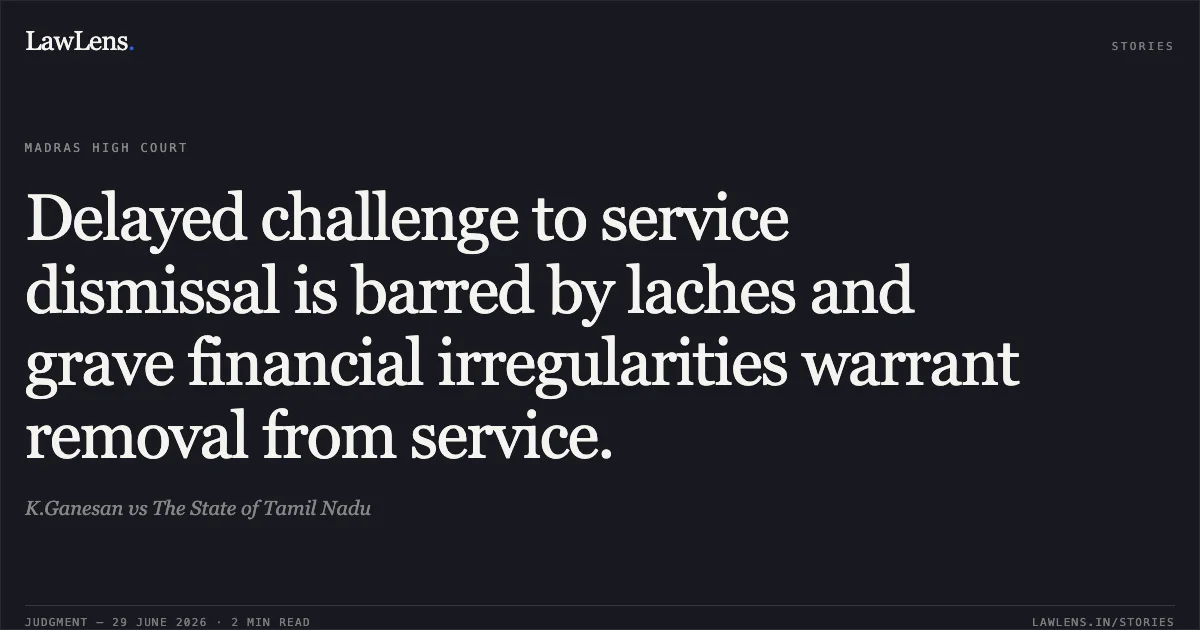
The court reasoned that the appellant failed to demonstrate diligence in pursuing his statutory appeal filed in 2017. Although the appellant claimed the appeal remained pending, the court noted a significant gap in action—specifically a four-and-a-half-year silence between reminders in 2019 and 2024
Source reference: p. 4-5The court found that the appellant could not use the pendency of an appeal as a perpetual shield against laches when he himself failed to actively pursue the matter
Source reference: p. 5On the merits, the court observed that the disciplinary process followed the principles of natural justice, providing the appellant an opportunity to defend himself
Source reference: p. 5The court emphasized that the role of a VAO in distributing government compensation is of "paramount importance"; therefore, illegalities in such a sensitive area constitute grave misconduct
Source reference: p. 5Holding
The court answered that the Writ Court was justified in dismissing the petition due to both laches and the gravity of the proved charges
It held that the punishment of removal from service was not disproportionate to financial irregularities involving public funds designated for drought relief
Source reference: p. 5The Writ Appeal was dismissed, and the order of the Writ Court was upheld
Source reference: p. 6Acts & Sections Cited
1 provisions across 1 statute referred to in this judgment. Linked provisions open on LawLens.
Madras High Court (Establishment of a Permanent Bench at Madurai) Order, 20041
Original Court PDF
K.GanesanvsThe State of Tamil Nadu
Click to open original judgment
Original judgment, available to read, download and summarize on LawLens.in