Facts
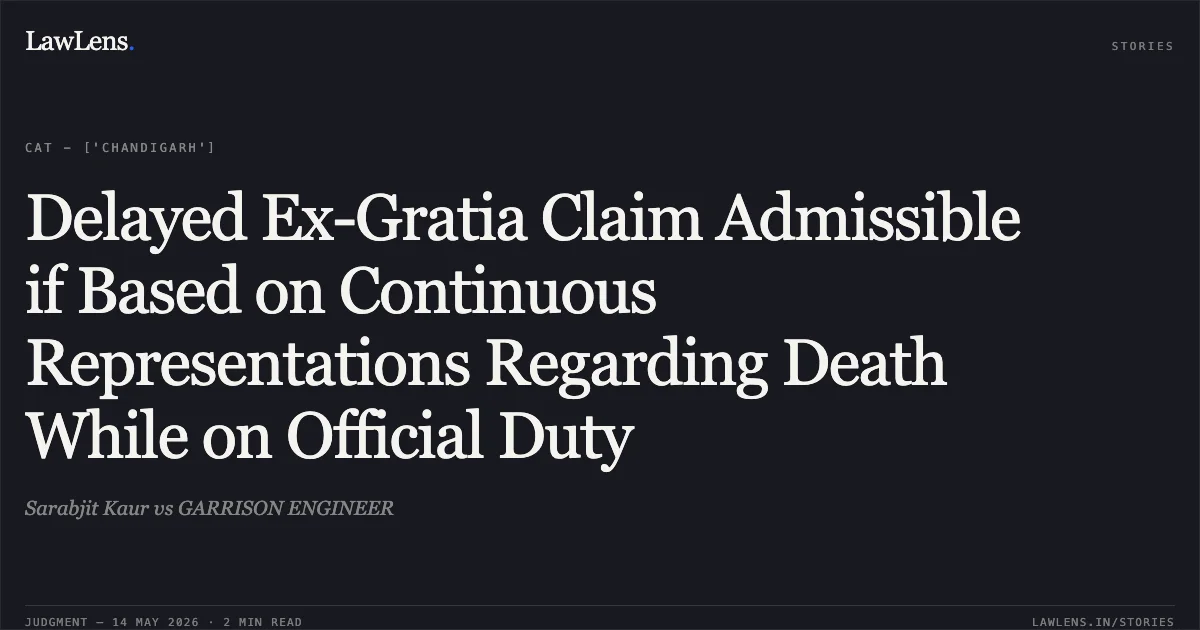
The applicant, widow of Late Harnek Singh (a Valveman in the Military Engineer Services), sought ex-gratia compensation of Rs. 25 lakhs following her husband's death on July 6, 2016, allegedly due to a snake bite sustained while on duty on July 3, 2016.
Source reference: p. 2The applicant submitted representations starting in 2017 and a legal notice in 2023, claiming that a similarly situated employee (Rajesh Kumar) had received such compensation.
Source reference: p. 2-3The respondents contested the claim on two grounds: first, that the application was barred by limitation due to a 7.5-year delay; and second, on merits, asserting there was no evidence the snake bite occurred during duty hours, supported by statements from co-workers who claimed the deceased completed his shift fit and fine.
Source reference: p. 3-5Issues
1. Whether the Original Application is barred by the principles of limitation and delay/laches under Section 21 of the Administrative Tribunals Act, 1985.
Source reference: p. 32. Whether the deceased employee died due to a snake bite while on official duty, thereby entitling the applicant to ex-gratia compensation under the government’s revised schemes.
Source reference: p. 6Law Applied
Section 21 of the Administrative Tribunals Act, 1985, regarding the limitation period for filing applications.
Source reference: p. 3Popat Bahiru Govardhane v. Special Land Acquisition Officer, which emphasizes the rigour of limitation law.
Source reference: p. 4State of T.N. v. Seshachalam, which holds that mere representations do not save limitation and law favors the vigilant.
Source reference: p. 4-5Ministry of Personnel, Public Grievances and Pension Notification dated September 11, 1998 (revised per the 6th and 7th Pay Commissions), which governs ex-gratia payments for employees dying in the performance of bona fide official duties.
Source reference: p. 3, 6Reasoning
The Tribunal first addressed the delay, ruling that since the applicant had been making continuous representations and the claim concerned a compensation benefit, the delay was condonable in the interest of justice.
Source reference: p. 6The Tribunal reasoned that the case required a technical factual verification—specifically an expert opinion on the "duration between the reported bite and time of death" and an analysis of medical records from all treating hospitals—rather than a summary dismissal.
Source reference: p. 6-7The court emphasized that the spirit of the ex-gratia scheme is to provide relief, provided the causal link to duty is established.
Source reference: p. 6Holding
The Tribunal allowed the O.A.
The Tribunal condoned the delay and directed the applicant to submit all requisite documents within four weeks; the respondents were ordered to consider the claim on its merits within eight weeks thereafter, specifically assessing expert medical opinions on the cause and timing of the death in relation to duty hours.
Source reference: p. 6-7If the claim is found valid, the ex-gratia compensation must be paid within a further eight weeks, though no interest was awarded.
Source reference: p. 7Acts & Sections Cited
2 provisions across 1 statute referred to in this judgment. Each provision opens on LawLens.
Administrative Tribunals Act, 19852
Original Court PDF
Sarabjit KaurvsGARRISON ENGINEER
Click to open original judgment
Original judgment, available to read, download and summarize on LawLens.in