01Facts
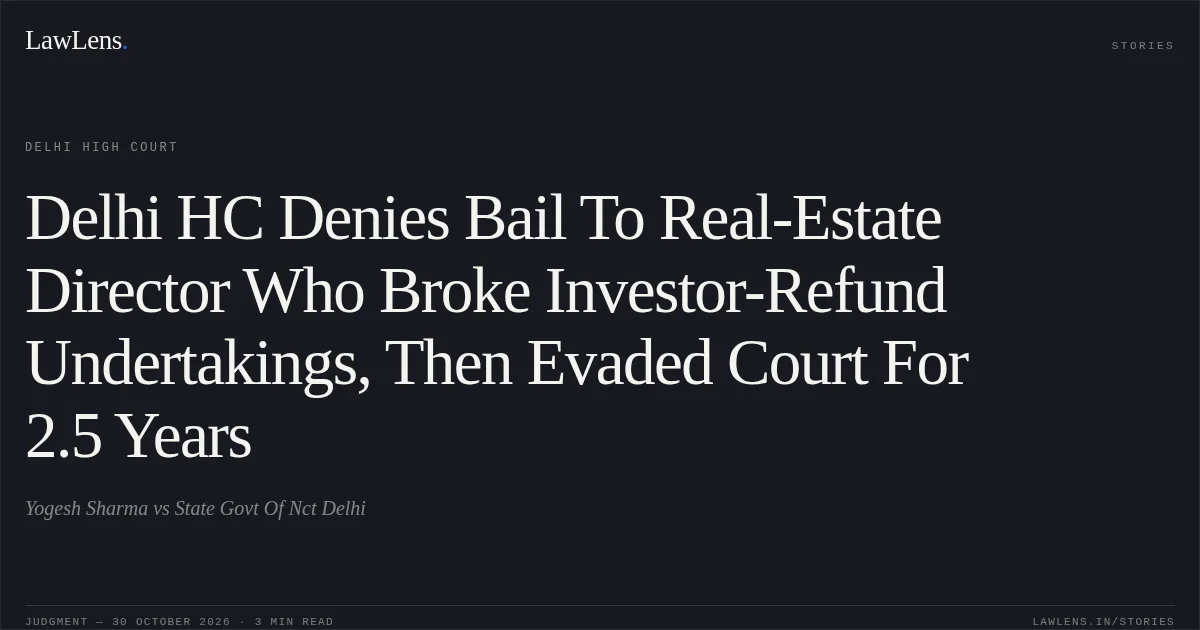
The petitioner, a director of Big Bull Infrastructure Ltd., was accused in an EOW case under Sections 409/420/120B IPC concerning investors who purchased plots in a real-estate project allegedly promoted on land the company did not possess.
pp. 4–8He was arrested on 11 January 2019 and released on interim bail in 2019 after entering a settlement with complainants.
pp. 4–8In May 2023, the High Court declined regular bail, vacated interim relief, and directed him to surrender; he did not do so, was declared a proclaimed offender, and was re-arrested on 24 September 2025.
pp. 4–8He sought regular bail, relying on custody, delay, medical needs, a deposit of ₹22.8 lakh, and parity with a co-accused granted anticipatory bail.
pp. 4–8The State and complainants opposed the application, citing his breach of undertakings and abscondence.
pp. 4–8The petitioner also sought interim bail on medical grounds.
pp. 4–8The High Court dismissed his earlier bail application, and separately granted him bail in the Section 174A IPC case in September 2026.
p. 1, 702Issues
i.1. Whether the petitioner should be granted regular bail, having regard to the allegations, his prior breach of bail-related undertakings, and his failure to surrender?
pp. 8–10ii.2. Whether the petitioner was entitled to bail on parity with the co-accused who had received anticipatory bail?
p. 7, 10iii.3. Whether the petitioner’s medical condition justified interim bail?
p. 1103Law Applied
Section 483 of the Bharatiya Nagarik Suraksha Sanhita, 2023, empowers the High Court to grant bail.
pp. 8–9In exercising bail discretion, the court must consider, among other matters, the prima facie case, gravity of the accusation, likely punishment, risk of absconding, likelihood of influencing witnesses, and danger of justice being thwarted, as set out in *Prasanta Kumar Sarkar v. Ashis Chatterjee*, (2010) 14 SCC 496.
pp. 8–9The Court also considered *Arshad Neyaz Khan v. State of Jharkhand*, 2025 SCC OnLine SC 2058, concerning the alleged incompatibility of offences of criminal breach of trust and cheating on the facts of that case, but noted that it did not establish that no offence was disclosed here and that a bail hearing was not the occasion for a detailed merits determination.
pp. 9–10Provisions in the judgment · 3 · Linked ones open on LawLens
Bharatiya Nagarik Suraksha Sanhita, 2023 Section 483
Indian Penal Code, 1860 Section 409Section 420
04Reasoning
The Court considered the petitioner’s prior release and subsequent conduct decisive. He had failed to honour undertakings given in connection with the settlement and had not surrendered despite an express direction, remaining at large for approximately two and a half years.
pp. 9–10The Court treated this as demonstrated evasion of the judicial process and a real risk that he would not face trial if released; his custody period did not outweigh that concern, particularly as the present period of custody followed his failure to surrender.
pp. 9–10Parity was unavailable because the co-accused’s anticipatory bail followed his joining the investigation and was subject to specific conditions, making his circumstances materially different.
p. 7, 10The medical report stated that the petitioner was stable, receiving anti-seizure medication, and had no recent seizure episodes; there was no evidence that necessary treatment could not be provided in custody.
p. 1105Holding
The High Court dismissed the regular-bail application and refused interim bail on medical grounds.
p. 11It directed the Jail Superintendent to ensure continued medical treatment, including necessary hospital follow-ups.
p. 11The petitioner may renew his bail application after material prosecution witnesses have been examined, or if the trial does not materially progress within six months for reasons not attributable to him.
p. 11The Court made no determination on the merits of the case.
p. 11Original Court PDF
Yogesh SharmavsState Govt Of Nct Delhi
Click to open original judgment
Original judgment, available to read, download and summarize on LawLens.in