01Facts
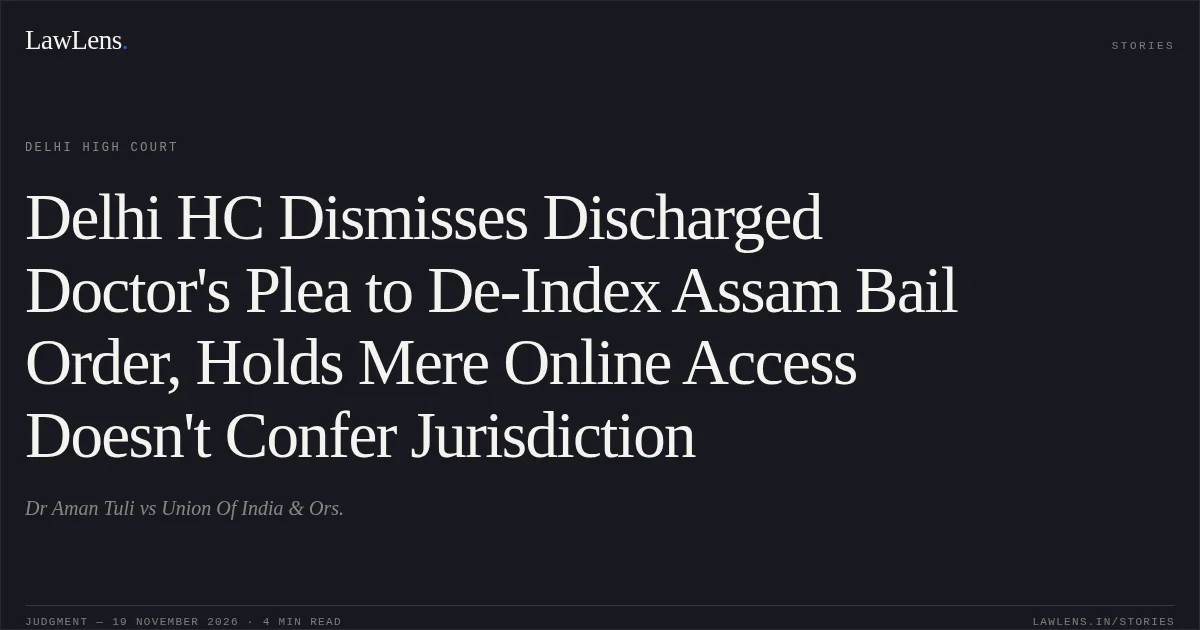
The petitioner, a practising doctor, was named in FIR No. 265/2019 at P.S. Sonari, Charaideo, Assam, for offences under Sections 493/496/376 IPC, and was arrested on 18.09.2019.
¶ 2The Gauhati High Court granted him bail on 27.09.2019 in Bail Application No. 3007/2019.
¶ 2A chargesheet was later filed for Section 498A IPC alone (PRC Case No. 274/2019), and on 08.01.2021 the Judicial Magistrate First Class, Sonari, discharged him. The discharge is said to have attained finality.
¶ 2–3A name-based Google search for "Dr. Aman Tuli" surfaces the Gauhati High Court bail order hosted on Indian Kanoon (indiankanoon.org/doc/66728927/).
¶ 3The petitioner seeks de-indexing of Google search results and disabling of name-based search on Indian Kanoon, relying on Laksh Vir Singh Yadav v. Union of India.
¶ 1, 4The respondents raised a preliminary objection to territorial jurisdiction. They argued that every event in the criminal proceedings occurred in Assam and that the Gauhati High Court is the appropriate forum.
¶ 5, 7The petitioner argued that his Delhi residence and the order's accessibility in Delhi give the Court jurisdiction, relying on Kokkanti Venkata Maheswara Reddy v. Google LLC.
¶ 602Issues
i.1. Whether this Court has territorial jurisdiction under Article 226(2) to entertain a writ petition seeking de-indexing of a judicial order of the Gauhati High Court, where the petitioner resides in Delhi and the order is accessible in Delhi.
¶ 9ii.2. If territorial jurisdiction exists, whether this Court ought to exercise it in the facts of the case, applying the doctrine of forum conveniens.
¶ 9, 2403Law Applied
Article 226(1) and (2) of the Constitution allow a High Court to issue writs within its territory and permit jurisdiction where the cause of action arises wholly or in part there.
¶ 10Oil and Natural Gas Commission v. Utpal Kumar Basu (1994) 4 SCC 711 holds that jurisdiction turns on the averments in the petition.
¶ 11Alchemist Ltd. v. State Bank of Sikkim (2007) 11 SCC 335 and State of Goa v. Summit Online Trade Solutions (2023) 7 SCC 791 hold that only material, essential or integral facts that have a nexus with the relief sought form part of the cause of action, and that a "slender" part of the cause of action does not compel the court to hear the matter.
¶ 12–13National Textile Corporation v. Haribox Swalram (2004) 9 SCC 678 holds that the petitioner's residence or place of business is not by itself an integral part of the cause of action.
¶ 14Kusum Ingots & Alloys v. Union of India (2004) 6 SCC 254 and the Full Bench decision in Sterling Agro Industries v. Union of India (2011 SCC OnLine Del 3162 (LB)) permit a court to decline jurisdiction on forum conveniens grounds even where part of the cause of action arises within its territory.
¶ 15–16Kokkanti was distinguished, and Laksh Vir Singh Yadav directed masking applications to the court that passed the original order.
¶ 22–24Provisions in the judgment · 4 · Linked ones open on LawLens
Indian Penal Code, 1860 Section 493Section 496Section 376
Code of Criminal Procedure, 1973 Section 439
04Reasoning
The only jurisdictional averment, that the petitioner is a Delhi resident, is not an integral part of the cause of action.
¶ 17, 20The integral facts (the FIR, the bail order sought to be de-indexed, the discharge, and its finality) all arose in Assam, within the Gauhati High Court's jurisdiction.
¶ 18–19The Court rejected accessibility in Delhi as a basis for jurisdiction, reasoning that online accessibility would let every High Court entertain challenges to any other court's records, which would render "wholly or in part" under Article 226(2) meaningless and invite forum shopping.
¶ 21Kokkanti was distinguished on four grounds: it concerned news reports with national English-language circulation, the respondents there were concededly within Delhi, notices had been served there, and the grievance concerned news reportage rather than a court record.
¶ 22–23Even if a slender part of the cause of action had arisen in Delhi, the Gauhati High Court is the forum conveniens. Directions on how a Gauhati High Court record is searched or masked would be most appropriately examined by that court, and entertaining the petition would risk conflicting directions on the same record from two High Courts.
¶ 2405Holding
No material, essential or integral part of the cause of action arose within this Court's territorial jurisdiction, and the Gauhati High Court is the forum conveniens.
¶ 25The petition and pending applications are dismissed for lack of territorial jurisdiction. The petitioner is left free to pursue available remedies in law, including approaching the Gauhati High Court.
¶ 26Nothing in the order expresses an opinion on the merits.
¶ 27Original Court PDF
Dr Aman TulivsUnion Of India & Ors.
Click to open original judgment
Original judgment, available to read, download and summarize on LawLens.in