01Facts
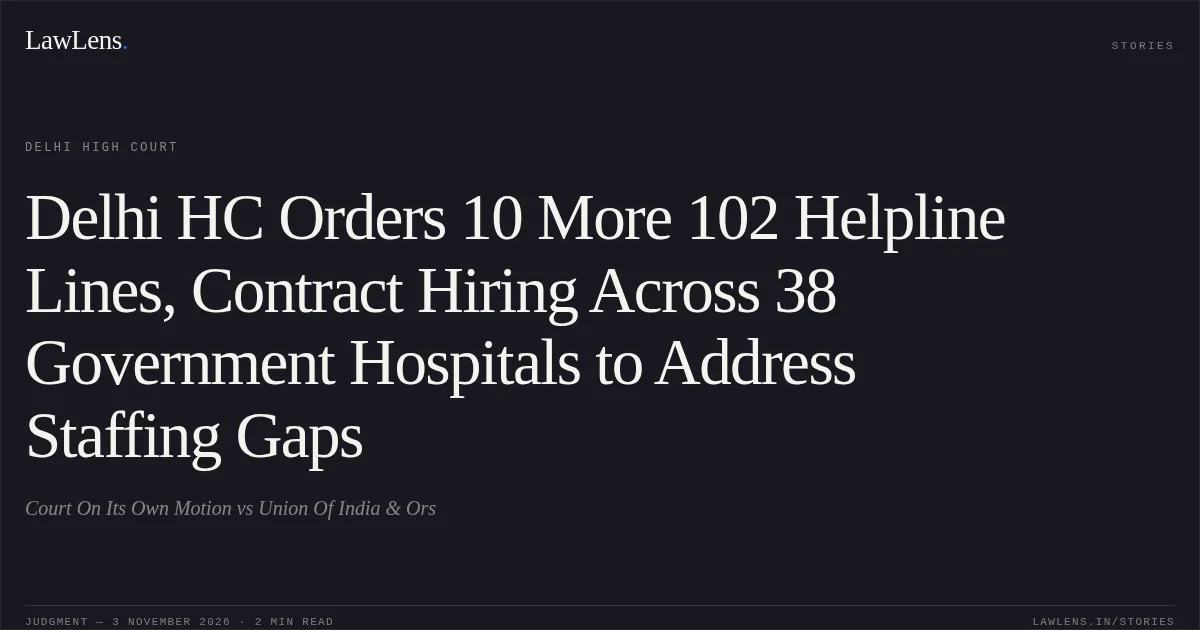
In these connected writ petitions, the Delhi High Court was monitoring the functioning of 38 government hospitals in Delhi.
p. 2Following directions made on 18 September 2026, the GNCTD filed a status report addressing a common helpline, hospital referral coordinators, appointments of Medical Superintendents/Medical Directors, staff shortages and unused equipment.
pp. 2–3The report recorded call volumes and dropped calls on helpline 102, gaps in referral-coordinator coverage and hospital leadership, and substantial vacancies among medical, non-teaching and paramedical staff.
pp. 3–12The Court considered the report and issued further directions.
pp. 13–1502Issues
i.Whether the arrangements for helpline 102 and hospital referral coordinators were sufficient to assist patients seeking information, including about ICU beds.
pp. 3–6ii.Whether the vacant Medical Superintendent/Medical Director positions in government and society-run hospitals required urgent appointments.
pp. 7–10iii.Whether steps and timelines were needed to address staff vacancies and the resulting underuse of hospital equipment.
pp. 10–1503Law Applied
The order does not identify or apply a specific statute, precedent or substantive legal test.
pp. 2–3It proceeds as part of the Court’s continuing oversight of pending writ petitions and its earlier directions concerning Delhi’s government hospitals.
pp. 2–3The approach reflected in the order is to require accountable authorities to provide information, set implementation timelines and report back on measures affecting hospital administration and patient access.
pp. 3–1504Reasoning
The Court assessed the GNCTD’s reported arrangements against the practical needs identified in its earlier directions.
pp. 3–15Call data showed continuing dropped calls, while the CATS representative considered ten additional lines sufficient; the Court therefore directed an increase in capacity and corresponding staffing.
pp. 3–6It required three-shift referral-coordinator coverage and public access to contact details.
pp. 6–7It treated the absence of regular hospital leadership and significant staff vacancies as requiring time-bound recruitment measures, including interim contractual staffing while regular recruitment proceeded.
pp. 7–14For equipment, the Court directed hospital-level requisitions and a joint assessment of equipment and staffing needs, including radiology services.
pp. 14–1505Holding
The Court issued directions rather than determining a contested question of substantive law.
GNCTD was directed to add ten helpdesk lines with 24×7 staffing within four weeks and publish referral-coordinator contacts online.
pp. 6–7The Chief Secretary was to coordinate appointments for two hospitals by 30 November 2026; appointments for seven society-run hospitals were to be completed by 25 November, with a status report by 30 November.
pp. 9–10GNCTD was to requisition vacant GDMO and non-teaching posts from UPSC within two weeks; contractual recruitment measures were also ordered, with stated timelines and reporting obligations.
pp. 12–14Five hospitals were to submit equipment requisitions by 30 November, and hospital heads were to prepare a joint report on equipment and staffing needs.
pp. 14–15The matters were listed for 17 December 2026.
p. 15Original Court PDF
Court On Its Own MotionvsUnion Of India & Ors
Click to open original judgment
Original judgment, available to read, download and summarize on LawLens.in