01Facts
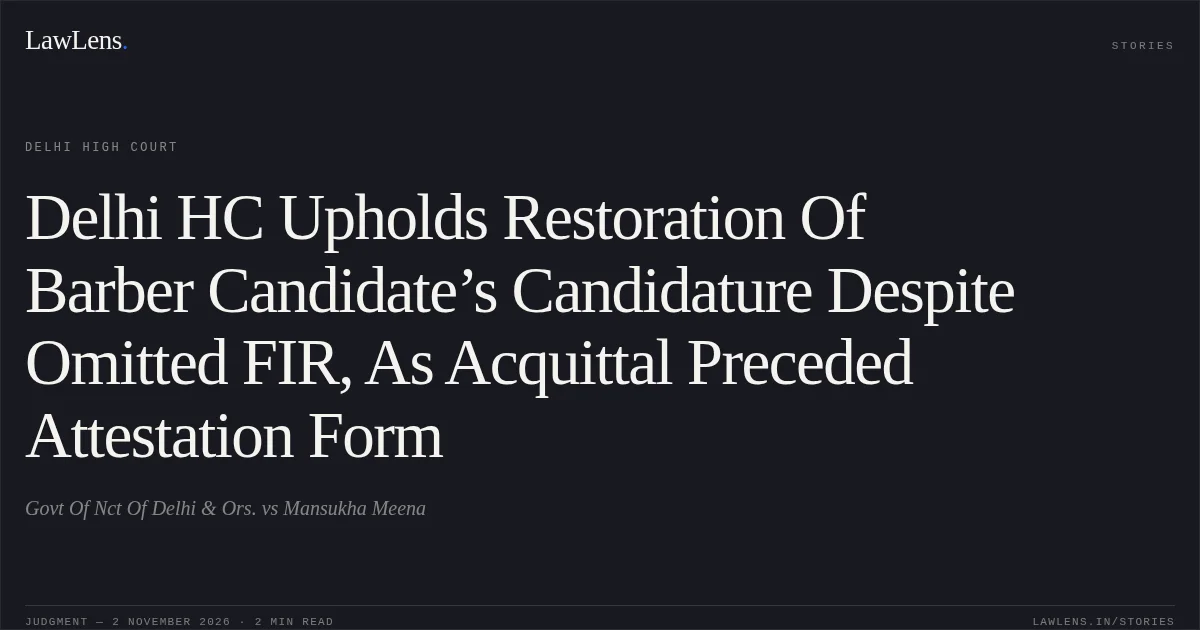
The respondent was provisionally selected for the post of MTS (Barber) in the Delhi Police.
pp. 1–4Before completing his attestation form on 19 March 2020, he had been acquitted, on 7 June 2019, of charges arising from FIR No. 258/2015 under Sections 353, 332 and 504 IPC.
pp. 1–4In the form, he answered “no” to the question concerning criminal proceedings; on 19 February 2021, he submitted an affidavit disclosing the FIR and acquittal.
pp. 1–4The Delhi Police cancelled his candidature on 2 November 2021, finding deliberate concealment.
pp. 1–4The Central Administrative Tribunal set aside the cancellation, and the Delhi Police challenged that decision by writ petition.
pp. 1–402Issues
i.1. Whether cancellation of the respondent’s candidature was justified because he did not disclose, in his attestation form, a criminal case that had concluded in acquittal before he completed the form.
pp. 4–5, 8–9ii.2. Whether the petitioner could sustain the cancellation on the additional ground that the acquittal was not honourable, when that ground was not stated in the cancellation order.
p. 903Law Applied
Under Avtar Singh v. Union of India, suppression or false information about a criminal case must be assessed with regard to the applicable rules and the circumstances of the case; the employer’s decision must be objective, reasonable and attentive to the materiality of the information, the nature of the post and the effect of the suppression on suitability.
pp. 5–6Where proceedings concluded before the candidate completed the form, the employer may adopt an appropriate response depending on the nature of the case and its circumstances.
pp. 5–6Ravindra Kumar v. State of U.P. reaffirmed that a candidate who suppresses material information has no automatic right to appointment, but is entitled not to be treated arbitrarily.
pp. 6–8An administrative order must stand or fall on the reasons it gives and cannot be supplemented by later assertions in court, under Commissioner of Police v. Gordhandas Bhanji and Mohinder Singh Gill v. Chief Election Commissioner.
p. 10Provisions in the judgment · 5 · Linked ones open on LawLens
Indian Penal Code, 1860 Section 353Section 332Section 504Section 325Section 34
04Reasoning
The Court treated the timing of the criminal case as material: unlike State of U.P. v. Dinesh Kumar, the respondent’s proceedings had ended in acquittal before he completed the form, rather than remaining pending when he answered the relevant question.
pp. 8–9Applying Avtar Singh and Ravindra Kumar, the Court found no error in the Tribunal’s decision to set aside the cancellation.
pp. 9–10It also held that the petitioner could not rely on the alleged lack of an honourable acquittal to defend the order, because the cancellation had rested only on non-disclosure and the order could not be improved through later court submissions.
pp. 9–1005Holding
The Court found no error in the Tribunal’s approach and dismissed the writ petition in limine.
p. 10The Tribunal’s order setting aside the cancellation of the respondent’s candidature, with consequential benefits, therefore remained undisturbed.
p. 10Original Court PDF
Govt Of Nct Of Delhi & Ors.vsMansukha Meena
Click to open original judgment
Original judgment, available to read, download and summarize on LawLens.in