01Facts
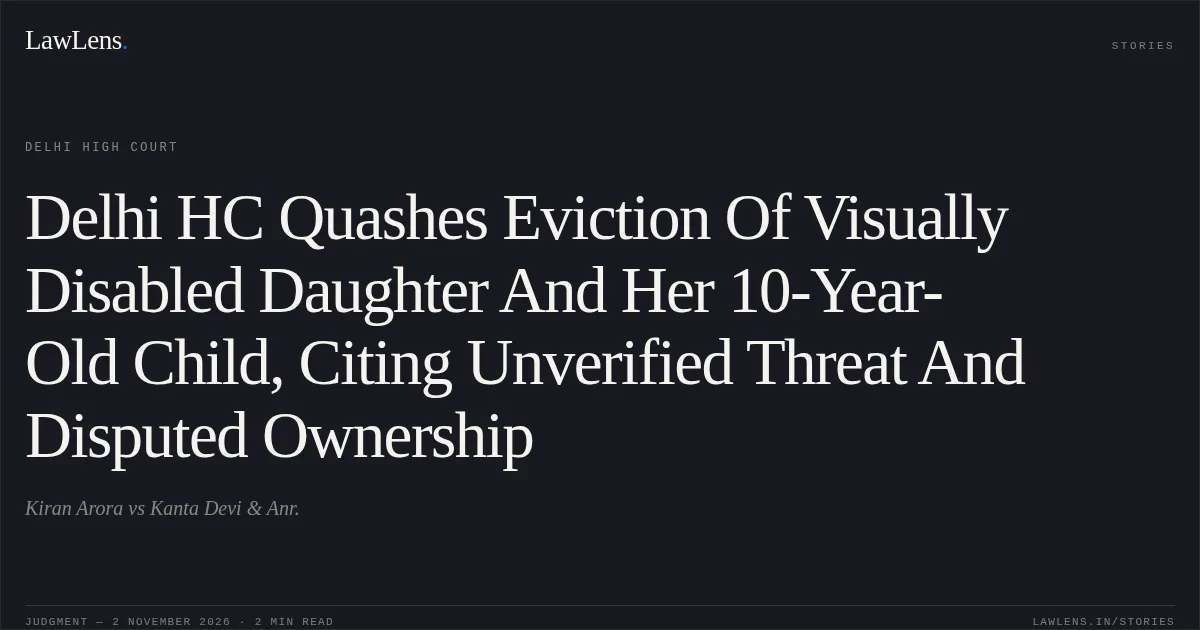
The petitioner, a visually disabled daughter of Respondent No. 1, lived with her husband and minor daughter on the second floor of the property where her mother resided on the first floor.
p. 2The petitioner claimed a share in the property through her late father’s estate; Respondent No. 1 claimed sole ownership.
p. 2Following disputes between the parties, Respondent No. 1 sought the petitioner’s eviction under Rule 22(3) of the Delhi Maintenance and Welfare of Parents and Senior Citizens Rules, 2009.
p. 3The SDM’s enquiry report recorded that ownership and any real threat to Respondent No. 1 could not be verified, and that the complainant wanted the petitioner evicted.
p. 3, 5The District Magistrate nevertheless ordered eviction, and the Appellate Authority upheld that order.
pp. 3–4The petitioner challenged both orders under Article 226.
p. 102Issues
i.1. Whether the eviction order could stand where the SDM’s statutory enquiry could not verify ownership or a real threat, and the District Magistrate did not identify the material supporting its contrary finding of harassment.
pp. 5–6ii.2. Whether, in the circumstances, summary eviction of the petitioner and her minor child was justified despite the serious dispute over title and the potential for disproportionate hardship.
p. 603Law Applied
Rule 22(3)(1) of the Delhi Maintenance and Welfare of Parents and Senior Citizens Rules, 2009 provides for summary eviction where the District Magistrate, on considering the material, is satisfied that a child or legal heir residing in a senior citizen’s property is subjecting the senior citizen to ill-treatment or harassment and is not maintaining them.
p. 5Such proceedings are summary: the authorities need not finally adjudicate complex title or ownership questions, which belong before the competent civil court, and allegations of ill-treatment need not be proved as in a criminal trial.
p. 5However, where the District Magistrate reaches a conclusion contrary to the statutory enquiry report, the decision must disclose the material or circumstances supporting that conclusion.
pp. 5–6Provisions in the judgment · 1 · Linked ones open on LawLens
Protection of Women from Domestic Violence Act, 2005 Section 12
04Reasoning
The SDM could not verify either the ownership of the property or a real threat to Respondent No. 1, while the report also identified an existing property dispute.
pp. 5–6Although the report was not conclusive, the District Magistrate’s order merely asserted harassment and physical abuse without identifying supporting material, and the Appellate Authority did not independently address that deficiency.
p. 6The Court also considered the unresolved title dispute, the petitioner’s allegations against her sister, and the hardship that total eviction would impose on a disabled woman and her minor child.
p. 6It did not decide the merits of title or the competing allegations of harassment and violence.
p. 705Holding
The Court allowed the petition and quashed the Appellate Order dated 8 October 2025 and the underlying Eviction Order dated 29 August 2024.
p. 6It left the parties free to pursue civil remedies and granted Respondent No. 1 liberty to approach the District Magistrate if a future grievance arises concerning peaceful enjoyment of the property.
p. 7Original Court PDF
Kiran AroravsKanta Devi & Anr.
Click to open original judgment
Original judgment, available to read, download and summarize on LawLens.in