01Facts
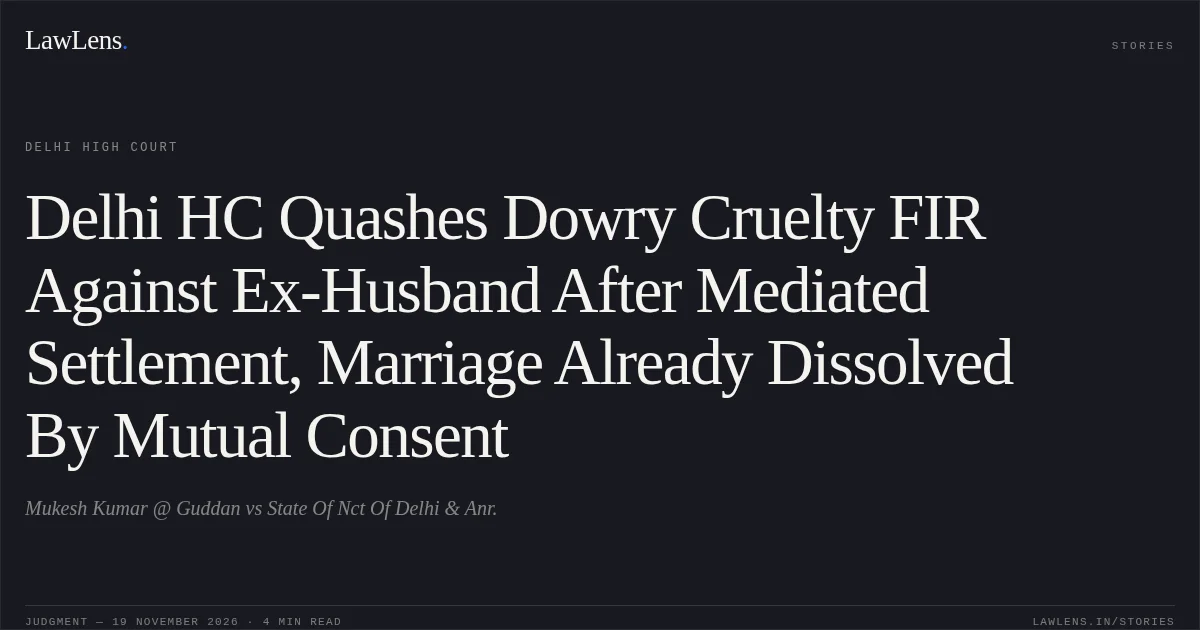
The petitioner husband sought quashing of FIR No. 0818/2015 dated 05.10.2015 at P.S. Jyoti Nagar under Sections 498A/406/34 IPC and Sections 4/5 of the Dowry Prohibition Act, 1961, and all consequential proceedings, under Section 528 BNSS.
¶ 4The petition was filed 64 days late; the delay was condoned.
¶ 1–3The marriage was solemnised on 28.02.2009, a son was born on 23.05.2010 (who remains in the respondent's custody), and the parties have lived separately since 23.09.2013.
¶ 6(i)The FIR was registered on the complaint of the former wife (respondent no. 2), alleging cruelty and dowry demands by the petitioner and family members.
¶ 6(ii)Although the FIR named family members, the chargesheet was filed only against the petitioner. The trial is pending before the JMFC (Mahila Court), Shahdara, and is at the prosecution evidence stage.
¶ 6(ii)In separate proceedings under Section 12 of the Protection of Women from Domestic Violence Act, 2005, the parties were referred to mediation and executed a Settlement Deed dated 04.02.2017 under the Delhi Mediation Centre, Karkardooma Courts, settling all matrimonial disputes.
¶ 5, 6(iii), 7The marriage was dissolved by mutual consent on 27.11.2018.
¶ 10Counsel for the petitioner stated that the settlement amount had been paid in full.
¶ 8Respondent no. 2, appearing virtually, confirmed the voluntary settlement, receipt of the full amount, and no objection to quashing.
¶ 902Issues
i.1. Whether the FIR and proceedings arising from a matrimonial dowry-related dispute, which the parties have settled, may be quashed in exercise of inherent powers under Section 528 BNSS despite the offences not being compoundable under Section 320 CrPC.
¶ 10–13ii.2. Whether continuation of the criminal proceedings would be an abuse of process or serve no useful purpose in light of the voluntary settlement and dissolution of marriage.
¶ 11–1203Law Applied
Section 528 BNSS is the source of the High Court's inherent power to quash proceedings.
¶ 4Inherent power to quash is distinct from compounding under Section 320 CrPC and must be exercised to secure the ends of justice or prevent abuse of process, as laid down in Gian Singh v. State of Punjab, (2012) 10 SCC 303.
¶ 14 · pp. 5–6Under Gian Singh v. State of Punjab, (2012) 10 SCC 303, offences arising out of matrimony relating to dowry and family disputes where the wrong is private in nature may be quashed on settlement, but heinous or socially serious offences may not be, and quashing is permissible where conviction is remote and bleak and continuation would cause oppression and extreme injustice.
¶ 14 · pp. 5–6Narinder Singh v. State of Punjab, (2014) 6 SCC 466, requires the High Court to ask whether continuation would be unfair, contrary to the interest of justice, or an abuse of process despite settlement, and whether quashing would secure the ends of justice, and permits quashing where harmony between the parties is likely to result.
¶ 15 · pp. 6–7 · ¶ 16Provisions in the judgment · 8 · Linked ones open on LawLens
Bharatiya Nagarik Suraksha Sanhita, 2023 Section 528
Indian Penal Code, 1860 Section 406Section 34Section 307
Dowry Prohibition Act, 1961 Section 4Section 5
Protection of Women from Domestic Violence Act, 2005 Section 12
Code of Criminal Procedure, 1973 Section 320
04Reasoning
The Court first characterised the offences as arising from a matrimonial dispute that had been resolved.
¶ 10The Court found the settlement voluntary, based on respondent no. 2's own statement confirming free consent, receipt of the full amount, and no objection.
¶ 9, 11Applying Gian Singh, the Court treated the dowry-linked matrimonial wrong as predominantly private and civil in character, placing the case within the category of offences where compromise may justify quashing.
¶ 14 · p. 6The Court concluded that continuing the prosecution would be futile because the underlying dispute had been finally resolved, including dissolution of the marriage by mutual consent in 2018.
¶ 10, 12Under Narinder Singh, the Court was satisfied that continuation would be unfair and an abuse of process, and that quashing would serve the ends of justice and promote future harmony between the parties.
¶ 13, 16The Court limited the scope of its order by confirming that it does not affect the rights of the minor child.
¶ 17The judgment does not expressly analyse the likelihood of conviction on the evidence, nor does it discuss why the non-compoundable nature of the offences under Section 320 CrPC was not a bar.
05Holding
Applying Gian Singh and Narinder Singh, continuation of FIR No. 0818/2015 would be futile and an abuse of process, given the voluntary, fully paid matrimonial settlement and the dissolution of marriage.
¶ 11–13The petition was allowed. FIR No. 0818/2015 dated 05.10.2015 under Sections 498A/406/34 IPC and Sections 4/5 of the Dowry Prohibition Act, 1961, registered at P.S. Jyoti Nagar, and all proceedings emanating from it were quashed. The order expressly does not affect the rights of the minor child born of the marriage. The delay of 64 days in filing was condoned, and the pending applications were disposed of.
¶ 1–3, 16–18Original Court PDF
Mukesh Kumar @ GuddanvsState Of Nct Of Delhi & Anr.
Click to open original judgment
Original judgment, available to read, download and summarize on LawLens.in