01Facts
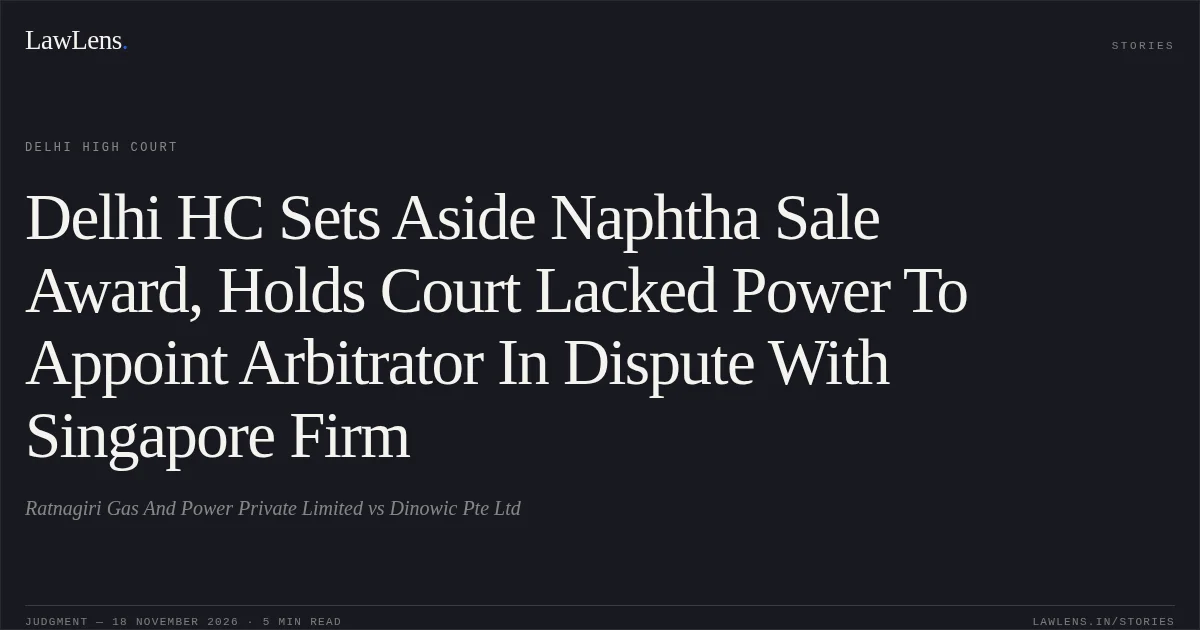
The appellant, Ratnagiri Gas and Power Pvt. Ltd., is an NTPC–GAIL joint venture operating a power plant at Dabhol, Maharashtra. The respondent, Dinowic Pte. Ltd., is a Singapore company.
p. 2The respondent won an e-auction for 40,000 MT of naphtha. A Sale Order dated 02.04.2014 followed, requiring lifting in two lots and payment by Letters of Credit.
p. 2 · ¶ 2.1–2.2Disputes arose over LC delays, remittances and lifting. The appellant deducted USD 714,960.74 from the security deposit as liquidated damages under clause 9.
p. 2 · ¶ 2.3Arbitration under clause 14 of the Special Conditions of Contract (SCC) was invoked on 31.01.2015. The arbitrator was not appointed, so a petition under Section 11 was filed. By order dated 07.04.2015 the Delhi High Court appointed a sole arbitrator.
pp. 2–3 · ¶ 2.4The arbitrator's award dated 03.09.2019 allowed the respondent's refund claim with 6% interest from 17.06.2014 and rejected the appellant's counterclaims.
p. 3 · ¶ 2.5The appellant's Section 34 petition was dismissed on 17.08.2026. The Single Judge held the arbitration was an International Commercial Arbitration (ICA) and found no ground under Section 34.
p. 3 · ¶ 2.6The appellant then raised, for the first time, the objection that the High Court lacked jurisdiction to appoint the arbitrator.
pp. 3–4 · ¶ 3The respondent argued that the objection was waived through participation and non-objection under Section 16(2) and Section 4.
p. 5 · ¶ 4.1–4.302Issues
i.1. Whether the appointment of the sole arbitrator by the Delhi High Court was without jurisdiction, where the arbitration is an ICA seated in India and the power to appoint lies with the Chief Justice of India under Section 11 read with Section 11(12)(a).
¶ 11–12ii.2. Whether a plea of inherent lack of jurisdiction, not raised before the arbitrator or the Single Judge, can be entertained in an appeal under Section 37.
¶ 14–16iii.3. Whether the appellant's participation in the arbitral proceedings and its failure to object under Section 16(2) amount to a waiver under Section 4 of the Act.
¶ 17–2103Law Applied
The Court relied on Section 2(1)(f) of the Arbitration and Conciliation Act, 1996, which defines an ICA to include arbitrations involving a foreign body corporate.
¶ 7Section 2(2) makes Part I applicable where the seat is in India.
¶ 9, 9.1–9.2Section 11 (as reproduced by the Court, described as the pre-2015 amendment text) allows parties to agree on an appointment procedure subject to sub-section (6), and vests residual appointment power in the Chief Justice, which in an ICA means the Chief Justice of India under sub-section (12)(a).
¶ 6, 10–10.4Under Section 4, a party that knowingly proceeds without objecting to non-compliance with a non-derogable provision is deemed to waive its objection.
¶ 6, 17The Court applied Tata Sons Pvt. Ltd. v. Siva Industries (2023) 5 SCC 421 for the proposition that the Supreme Court has exclusive jurisdiction over ICA Section 11 petitions.
¶ 13The Court relied on Hindustan Zinc Ltd. v. Ajmer Vidyut Vitran Nigam Ltd. (2019) 17 SCC 82 and Kiran Singh v. Chaman Paswan (AIR 1954 SC 340) for the doctrine that a decree without jurisdiction is a nullity, and consent cannot cure the defect.
¶ 15The Court applied Lion Engineering Consultants v. State of M.P. (2018) 16 SCC 758 for the proposition that a jurisdictional plea may be raised under Section 34 even without a Section 16 objection.
¶ 16The Court applied Dr. Jagmittar Sain Bhagat v. Director, Health Services (2013) 10 SCC 136 for the proposition that jurisdiction cannot be conferred by consent or waiver.
¶ 20The Court relied on Krishna Rai v. Banaras Hindu University (2022) 8 SCC 713 for the principle that there is no estoppel against statute.
¶ 27Provisions in the judgment · 6 · Linked ones open on LawLens
Arbitration and Conciliation Act, 1996 Section 2Section 4Section 11Section 16Section 34Section 37
04Reasoning
The Court first found that the dispute was an ICA, since the respondent is a Singapore company and the seat is New Delhi, so Part I applies.
¶ 7–10Clause 14 of the SCC required the appellant to propose a panel of three within 30 days of notice. Upon the appellant's failure to do so, the statutory route under Section 11(6) read with Section 11(12)(a) lay before the Chief Justice of India. No separate agreement vested the High Court with appointment power, so the 2015 appointment was held to be without jurisdiction.
¶ 11–12The Court rejected the respondent's argument that the objection was raised too late. An inherent lack of jurisdiction may be raised at any stage, including in a Section 34 petition, even if not raised before the tribunal.
¶ 14–16On waiver, the Court held that Section 4 applies only to derogable provisions. The competent-authority requirement under Section 11 for ICAs is non-derogable, and waiver cannot confer jurisdiction on a court not vested with the power.
¶ 17–19Participation therefore could not cure the defect.
¶ 20–21The Court distinguished Hala Kamel Zabal v. Arya Trading Ltd. (Division Bench, Delhi HC), because there the parties had expressly agreed to appointment by the Delhi High Court.
¶ 22–23The Court noted that China Datang (Madras HC) and SMEC International (MP HC) treated such appointments as void.
¶ 24–25The Court distinguished Narayan Prasad Lohia (domestic tribunal composition, derogable) and Hindustan Construction (review of a Section 11(6) order, not inherent lack of jurisdiction).
¶ 26, 28Relying on Krishna Rai and Tata Chemicals, the Court held that estoppel cannot override statutory requirements.
¶ 27The appellant's admission that the objection had "inadvertently skipped" its attention did not alter the position, because the defect is jurisdictional.
¶ 14–21, 2705Holding
The High Court lacked jurisdiction under Section 11 to appoint the arbitrator in this ICA, so the appointment is void ab initio.
¶ 12, 29A plea of inherent lack of jurisdiction may be raised for the first time at the appellate stage. Participation and non-objection do not amount to waiver under Section 4, because the statutory appointing authority requirement is non-derogable and cannot be conferred by consent.
¶ 14–21The appeal is allowed. The Single Judge's judgment dated 17.08.2026 and the arbitral award dated 03.09.2019 are set aside, and all pending applications are disposed of.
¶ 29–31Original Court PDF
Ratnagiri Gas And Power Private LimitedvsDinowic Pte Ltd
Click to open original judgment
Original judgment, available to read, download and summarize on LawLens.in