01Facts
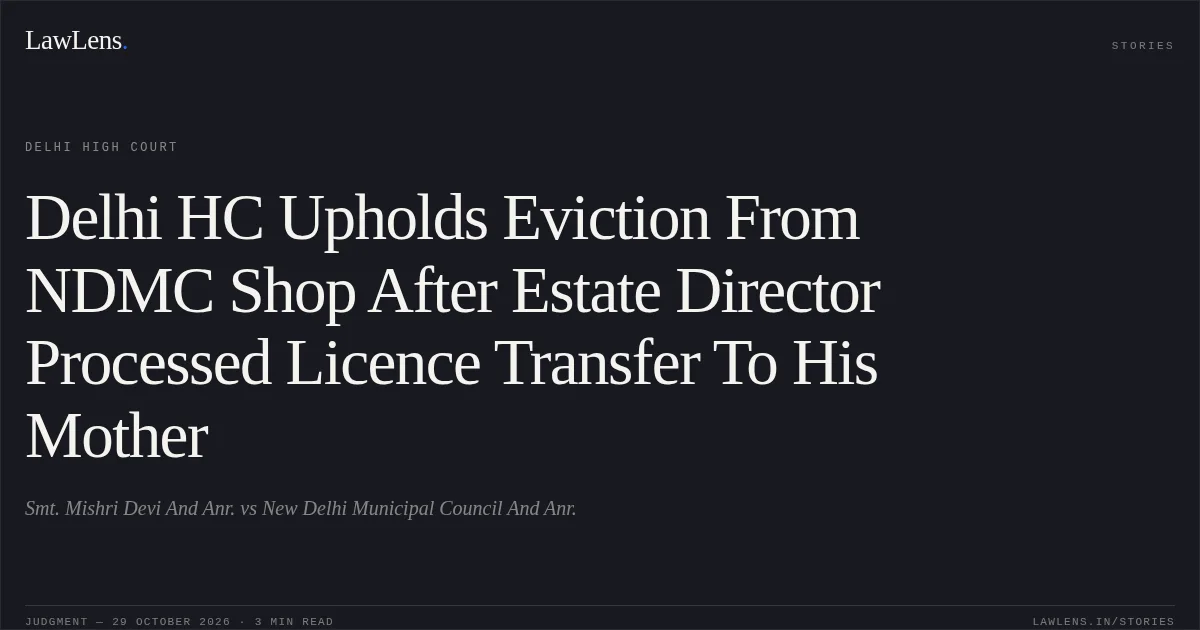
The Petitioners occupied Shop No. 44, Gole Market, New Delhi, under rights arising from their induction into a partnership with the existing licensees and the subsequent transfer/regularisation of the licence in their favour.
¶ 1–6, 25–28Petitioner No. 1’s son, Sh. R.K. Gaur, was then Director (Estate-I), NDMC, and participated in processing the transactions without disclosing their relationship.
¶ 1–6, 25–28After issuing a show-cause notice, NDMC cancelled the Petitioners’ rights on 25 July 2017.
¶ 1–6, 25–28The Estate Officer subsequently ordered eviction under the Public Premises (Eviction of Unauthorised Occupants) Act, 1971 (“PP Act”); the statutory appeal was dismissed.
¶ 1–6, 25–2802Issues
i.1. Whether the cancellation of the Petitioners’ rights, given the role of Petitioner No. 1’s son in processing the transactions and the Petitioners’ natural-justice objections, disclosed a ground for interference under Articles 226 and 227
¶ 23–24, 28–31, 38–47ii.2. Whether, following cancellation of those rights, the Petitioners’ continued occupation was unauthorised under the PP Act and could support eviction
¶ 32–37iii.3. Whether the alleged non-service of notice under Section 4 of the PP Act invalidated the Estate Officer’s proceedings
¶ 48–5503Law Applied
Judicial review under Article 226 examines the legality of the decision-making process, not the merits of the decision as if on appeal; interference is warranted on recognised grounds such as illegality, irrationality, perversity, want of authority, or procedural impropriety (*Tata Cellular v. Union of India*; *Sarvepalli Ramaiah v. District Collector*).
¶ 20–21Article 227 is supervisory and does not permit routine reappreciation of evidence; intervention is confined to jurisdictional error, patent perversity, or manifest failure of justice (*Shalini Shyam Shetty v. Rajendra Shankar Patil*).
¶ 22Section 2(g) of the PP Act includes continued occupation after the authority to occupy has expired or been determined; the Estate Officer’s statutory process includes notice under Section 4 and eviction and related orders under Sections 5 and 7, with an appeal under Section 9.
¶ 33–34, 48–52Administrative decision-making must also meet the rule against bias: a reasonable likelihood of bias may arise where an official participates in a matter concerning a close relative, even without proof of actual bias (*Ashok Kumar Yadav v. State of Haryana*).
¶ 42–46A court should not decide a factual contention that was not pleaded and supported by an adequate factual foundation (*Rani Laxmibai Kshetriya Gramin Bank v. Chand Behari Kapoor*).
¶ 5404Reasoning
The Court found that the relationship between Petitioner No. 1 and Director Gaur was not the sole basis for cancellation: he had participated in processing the partnership and subsequent transfer/regularisation for his mother without disclosing the relationship, and the appellate court had considered that role and the surrounding circumstances.
¶ 29–31, 38–47The Petitioners’ reply to the show-cause notice had been considered, and their participation before the Estate Officer and statutory appellate court further supported the conclusion that they had opportunities to present their case; the Court found no procedural infirmity warranting supervisory interference.
¶ 29–31, 38–47Once the cancellation stood, the Petitioners demonstrated no other subsisting authority to occupy the premises, bringing their continued occupation within Section 2(g) of the PP Act.
¶ 32–37The Section 4 non-service objection was raised orally, was not pleaded, and required factual inquiry; moreover, the Estate Officer’s order recorded that notice had been issued on 4 August 2017.
¶ 48–5505Holding
The Court held that no jurisdictional error, patent illegality, perversity, or procedural infirmity had been established in the appellate order or the Estate Officer’s decision.
¶ 56–62The cancellation left the Petitioners without subsisting authority to occupy the shop, and the eviction proceedings under the PP Act were upheld.
¶ 56–62The writ petition and pending applications, if any, were dismissed/disposed of accordingly.
¶ 56–62Original Court PDF
Smt. Mishri Devi And Anr.vsNew Delhi Municipal Council And Anr.
Click to open original judgment
Original judgment, available to read, download and summarize on LawLens.in