01Facts
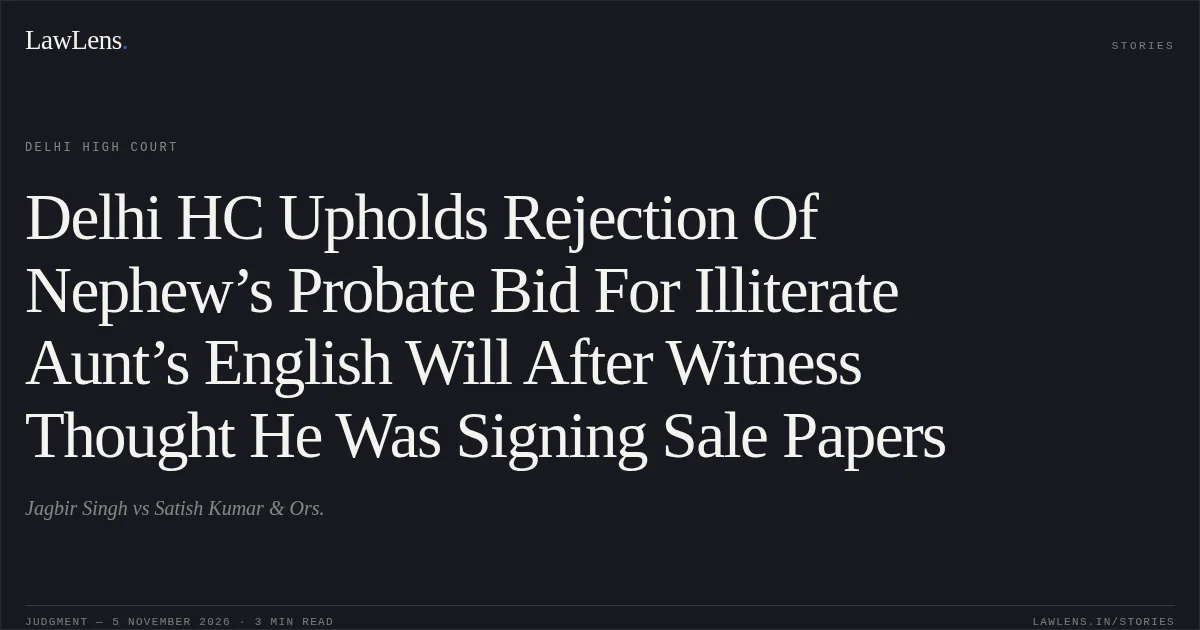
The appellant sought probate of a registered Will dated 16 April 2003, allegedly executed by his aunt, Smt. Chhanno Devi, who left him her property and appointed him executor.
p. 2 · ¶ 3–4The Probate Court dismissed the petition, finding that the Will’s execution and attestation had not been proved and that suspicious circumstances remained unexplained.
p. 4 · ¶ 8In appeal under Section 299 of the Indian Succession Act, the appellant relied on the testimony of one attesting witness and the Will’s registration.
p. 1 · ¶ 1 · p. 5 · ¶ 902Issues
i.Whether the Will was duly executed and attested in accordance with Section 63(c) of the Indian Succession Act and proved as required by Section 68 of the Indian Evidence Act.
p. 3 · ¶ 6 · pp. 5–6 · ¶ 12ii.Whether the appellant had dispelled the suspicious circumstances surrounding the Will, including his role in its execution and the testatrix’s inability to read or understand English.
pp. 7–8 · ¶ 13 · pp. 12–14 · ¶ 20–24iii.Whether registration of the Will or the beneficiaries’ no-objection statements could dispense with the required proof.
pp. 11–12 · ¶ 18–19 · pp. 14–15 · ¶ 2603Law Applied
Section 63(c) of the Indian Succession Act requires attestation by two or more witnesses in the prescribed manner.
pp. 5–7 · ¶ 12Under Section 68 of the Indian Evidence Act, a Will must be proved by calling at least one attesting witness, who must establish the required attestation by both witnesses; where that evidence is incomplete and another attesting witness is available, that witness must be called.
pp. 5–7 · ¶ 12Section 71 is available where attesting witnesses who are called deny or fail to recollect execution, not where an available witness is simply not examined (*Janki Narayan Bhoir v. Narayan Namdeo Kadam*, (2003) 2 SCC 91).
pp. 5–7 · ¶ 12Under *H. Venkatachala Iyengar v. B.N. Thimmajamma*, 1958 SCC OnLine SC 31, a propounder must prove due execution and the testator’s sound, free and disposing mind; suspicious circumstances, including the propounder’s prominent participation and substantial benefit, must be removed by clear and satisfactory evidence.
pp. 7–8 · ¶ 13Registration does not exempt a Will from the statutory mode of proof, and probate proceedings require the Court’s satisfaction even where objections are absent (*Raj Kumari v. Surinder Pal Sharma*, (2021) 14 SCC 500; *Kavita Kanwar v. Pamela Mehta*, (2021) 11 SCC 209).
pp. 11–12 · ¶ 18 · pp. 14–15 · ¶ 26Provisions in the judgment · 3 · Linked ones open on LawLens
Indian Succession Act, 1925 Section 299Section 276Section 63
04Reasoning
The sole attesting witness’s affidavit was unreliable: he disowned its contents, had not sworn it before an Oath Commissioner, and admitted that he did not know what he had signed.
p. 9 · ¶ 15His oral evidence did not establish that he signed in the testatrix’s presence or that the second witness attested the Will as required; the second witness was available but was not examined, so Section 71 could not cure the evidentiary deficiency.
pp. 10–11 · ¶ 16–17Registration did not prove statutory attestation.
p. 11 · ¶ 18The appellant’s evidence that the testatrix was illiterate and could not understand English, the absence of evidence that the Will’s contents were explained to her, and the appellant’s active role in arranging the execution—despite professing ignorance of it—left the suspicious circumstances unresolved.
pp. 12–14 · ¶ 20–24Neither a potentially natural bequest nor no-objection statements substituted for proof of the Will.
p. 14 · ¶ 25–2605Holding
The Court held that the appellant failed to prove due execution and attestation under Section 63 of the Indian Succession Act read with Section 68 of the Indian Evidence Act, and failed to dispel the suspicious circumstances surrounding the Will.
p. 15 · ¶ 27The appeal was dismissed and the Probate Court’s judgment was affirmed.
p. 15 · ¶ 28Original Court PDF
Jagbir SinghvsSatish Kumar & Ors.
Click to open original judgment
Original judgment, available to read, download and summarize on LawLens.in