Facts
Respondent No. 1, a peon in the Basavakalyan Taluk Office, was alleged to have collected a bribe of ₹3,000 from a complainant at the direction of a Second Division Surveyor.
Source reference: p. 3–5, paras. 3–8, 19–21The Lokayukta police trapped him while he collected the money.
Source reference: p. 3–5, paras. 3–8, 19–21In the criminal proceedings arising from the incident, the trial court acquitted respondent No. 1 and convicted the Surveyor; the High Court upheld those outcomes in appeal.
Source reference: p. 3–5, paras. 3–8, 19–21The State subsequently initiated departmental proceedings against respondent No. 1 on the same allegations.
Source reference: p. 6, 10, paras. 10, 22–24The disciplinary authority imposed compulsory retirement on 19 June 2020.
Source reference: p. 6, 10, paras. 10, 22–24The Karnataka State Administrative Tribunal quashed the punishment on 23 March 2022. The State’s writ petition challenged that order.
Source reference: p. 6–7, paras. 11–14Issues
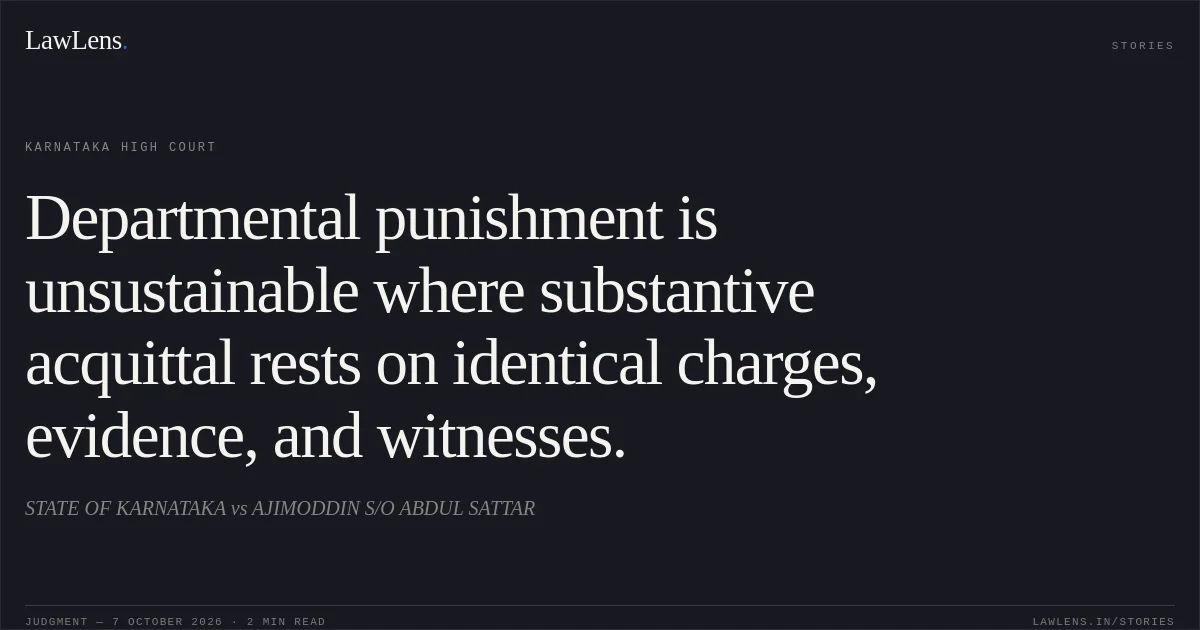
Whether the departmental finding and punishment could stand when the criminal and departmental proceedings involved substantially the same charges, evidence, witnesses, and circumstances, and respondent No. 1 had been acquitted in the criminal case.
Source reference: p. 11–14, paras. 25–29Whether the Tribunal’s decision to quash the compulsory-retirement order disclosed an error warranting interference under Articles 226 and 227 of the Constitution.
Source reference: p. 7–8, 16–17, paras. 14, 30–32Law Applied
An acquittal in a criminal case does not automatically invalidate disciplinary action.
Source reference: p. 14–16, paras. 28–29However, where the charges, evidence, witnesses, and circumstances in the criminal and departmental proceedings are identical or substantially similar, sustaining the disciplinary finding may be unjust, unfair, and oppressive.
Source reference: p. 14–16, paras. 28–29In assessing the effect of an acquittal, the court must consider the substance and basis of the criminal judgment rather than treating expressions such as “benefit of doubt” or “honourably acquitted” as decisive labels.
Source reference: p. 14–16, paras. 28–29The Court relied on Maharana Pratap Singh v. State of Bihar, Civil Appeal No. 5497 of 2025, and referred to the principles in G.M. Tank v. State of Gujarat, (2006) 5 SCC 446, and Ram Lal v. State of Rajasthan.
Source reference: p. 14–16, paras. 28–29The alleged departmental misconduct was framed under Rule 3(1)(i)–(iii) of the Karnataka Civil Services (Conduct) Rules, 1966.
Source reference: p. 12–13, para. 26Reasoning
The Court found that the criminal and departmental proceedings concerned the same alleged bribe transaction and that the witnesses examined in the criminal trial were also examined in the departmental inquiry.
Source reference: p. 11–14, paras. 25–27Respondent No. 1 had been acquitted, while the Surveyor was convicted, and the criminal appeal confirmed those outcomes.
Source reference: p. 9–10, paras. 18–21Given the substantial identity of the allegations, evidence, and witnesses, the Court concluded that the Tribunal had correctly quashed the disciplinary punishment.
Source reference: p. 16–17, paras. 30–31It found no error warranting writ interference.
Source reference: p. 16–17, paras. 30–31Holding
The High Court answered the issues against the State.
It held that the Tribunal’s order quashing respondent No. 1’s compulsory-retirement punishment disclosed no error warranting interference and dismissed the writ petition.
Source reference: p. 17, paras. 30–32Acts & Sections Cited
3 provisions across 2 statutes referred to in this judgment. Each provision opens on LawLens.
Prevention of Corruption Act, 19882
KARNATAKA LOKAYUKTA ACT, 19841
Original Court PDF
STATE OF KARNATAKAvsAJIMODDIN S/O ABDUL SATTAR
Click to open original judgment
Original judgment, available to read, download and summarize on LawLens.in