Facts
The applicant is the daughter of Late Shri Prabhat Chandra Thakur, a former employee of the Indian Military Academy (IMA) who died in 1963
Source reference: para. 2Following his death, his widow, Smt. Shanti Kumari Thakur, received a family pension until her demise on 23.01.2012
Source reference: para. 2, 6The applicant, who married in 2002, claimed she returned to her parental home in July 2011 due to matrimonial discord and was entirely dependent on her mother
Source reference: para. 3-4She initiated divorce proceedings under Section 13 of the Hindu Marriage Act on 22.02.2012 (shortly after her mother’s death) and obtained a final decree of divorce on 25.03.2017
Source reference: para. 5The respondent authorities rejected her claim for family pension via an order dated 29.05.2024, on the grounds that she was not a "divorced daughter" during the lifetime of the pensioner (her mother)
Source reference: para. 8, 14Issues
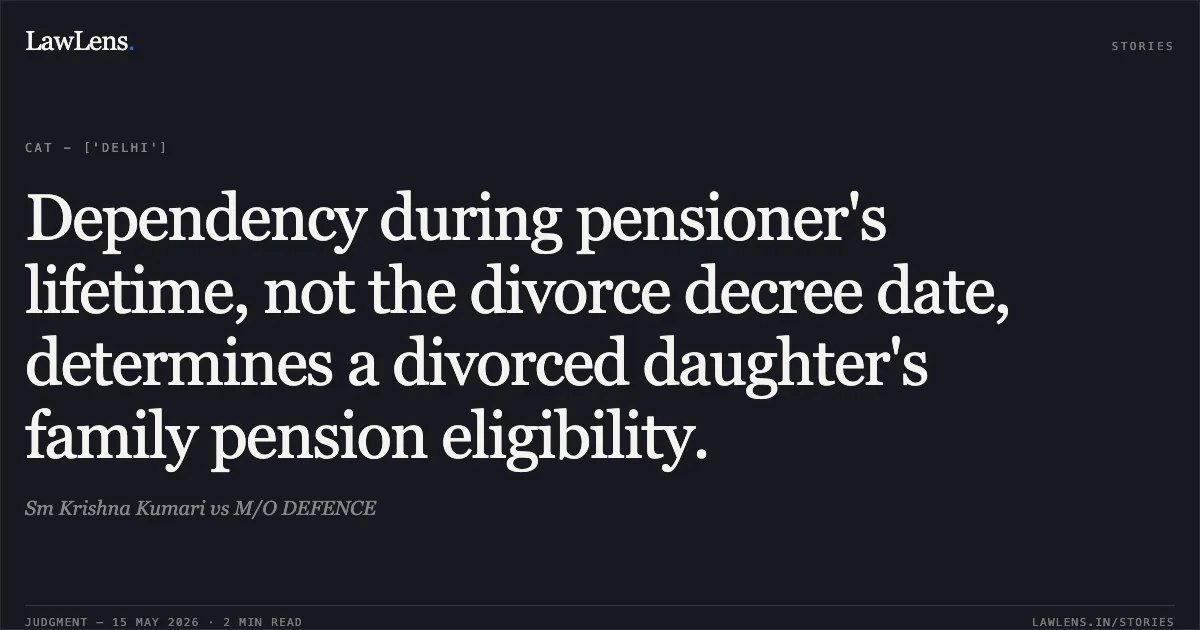
1. Whether a daughter whose divorce decree was finalized after the death of the pensioner is entitled to family pension if dependency is established during the pensioner's lifetime.
Source reference: para. 9, 192. Whether the timing of the divorce decree or the actual financial dependency is the determinative factor for eligibility under Rule 54 of the CCS (Pension) Rules, 1972.
Source reference: para. 24Law Applied
The Tribunal applied Rule 54(6)(iii) of the CCS (Pension) Rules, 1972, which extends family pension to unmarried, widowed, or divorced daughters until marriage/remarriage or gainful employment
Source reference: para. 10It adhered to the principle that pension is a right, not a bounty, as established in Deoki Nandan Prasad v. State of Bihar and that denial of family pension can violate Article 21 of the Constitution as per S.K. Mastan Bee v. General Manager
Source reference: para. 12The Tribunal also adopted the precedent from the Armed Forces Tribunal in Smt. Rita Sharma v. Union of India, affirmed by the Punjab and Haryana High Court, which holds that the beneficial object of the pension scheme must prioritize actual dependency over the formal date of a divorce decree
Source reference: para. 11, 25Reasoning
The Tribunal rejected the respondents' "hyper-technical" interpretation of Rule 54, which required the divorce to be finalized during the pensioner's lifetime
Source reference: para. 19, 23The court observed that the applicant had separated from her husband and was living as a dependent with her mother since 2011, substantiated by criminal proceedings (IPC 498A) and domestic violence litigation initiated before the mother's death
Source reference: para. 4, 21-22The Tribunal reasoned that since the object of the family pension is to provide social security to dependent family members, a "beneficial interpretation" is required
Source reference: para. 23It concluded that "dependency" is the decisive criterion; the fact that legal formalities (the divorce decree) were completed post-death does not negate the reality of the applicant's status as a destitute, dependent daughter at the time the pension became transmissible
Source reference: para. 24-25Holding
The Tribunal held that the impugned rejection order was arbitrary and unsustainable
It quashed the order dated 29.05.2024 and directed the respondents to sanction and release the family pension to the applicant effective from the date of her mother's death, provided she meets other eligibility criteria. The respondents were ordered to clear all consequential arrears within eight weeks
Source reference: para. 27Acts & Sections Cited
6 provisions across 4 statutes referred to in this judgment. Each provision opens on LawLens.
Administrative Tribunals Act, 19851
Indian Penal Code, 18603
Hindu Marriage Act, 19551
Dowry Prohibition Act, 19611
Original Court PDF
Sm Krishna KumarivsM/O DEFENCE
Click to open original judgment
Original judgment, available to read, download and summarize on LawLens.in