01Facts
The Petitioners, father and son, were directors of Prophyla Biologicals Pvt. Ltd. (now Dr. Ashley Labs Ltd.). The father was a director from 1982 and the son from 2001, both until their alleged resignation on 11 September 2009.
p. 3 · ¶ 4They claim to have sold their shares on 22 April 2009 under a Share Purchase Agreement.
p. 3 · ¶ 4The Revenue assessed the company for FY 2005-06 to 2010-11 and passed ex parte orders for Rs. 10,49,56,043/-.
p. 11 · ¶ 12The Company was not struck off and MCA records its status as "Active".
pp. 10–11 · ¶ 12 · p. 13 · ¶ 17In 2022 the Revenue issued a show cause notice (23 March 2022) to the Petitioners under Section 44(6) of the MVAT Act and Section 18 of the CST Act to recover the dues.
pp. 11–12 · ¶ 14Bank accounts were attached; this Court quashed the attachment and remanded the notice for decision (Order dated 20 December 2024).
p. 2 · ¶ 2 · p. 12 · ¶ 14The Petitioners filed written submissions on 22 January 2025.
p. 4 · ¶ 4By the impugned order dated 17 December 2025, Respondent No. 3 confirmed recovery of the dues, and a recovery letter followed on 2 January 2026.
p. 1 · ¶ 1 · p. 12 · ¶ 15The Petitioners challenged both before this Court.
p. 1 · ¶ 1The Revenue relied on a Share Purchase Agreement with indemnity clauses and on the absence of a board resolution accepting the resignation.
pp. 7–8 · ¶ 8–902Issues
i.1. Whether Section 18 of the CST Act can be invoked to recover a company's CST dues from its directors when the company has not been wound up and is shown as "Active" on MCA records.
p. 5 · ¶ 4 · p. 13 · ¶ 17ii.2. Whether the conditions for director liability under Section 44(6) of the MVAT Act, namely non-recovery from the company and gross neglect, misfeasance or breach of duty attributable to the director, are satisfied where the directors claim to have resigned before the relevant period.
pp. 5–6 · ¶ 5 · p. 15 · ¶ 18 · p. 21 · ¶ 26iii.3. Whether the impugned order, which did not consider the Petitioners' submissions and supporting documents, is sustainable.
pp. 21–22 · ¶ 26–2703Law Applied
Section 18 of the CST Act imposes joint and several liability on directors of a private company only when the company is "wound up" and the assessed tax cannot be recovered.
p. 13 · ¶ 16–17Section 44(6) of the MVAT Act applies "subject to the provisions of the Companies Act, 2013" to any private company "whether existing or wound up," and makes directors liable unless they prove non-recovery cannot be attributed to gross neglect, misfeasance or breach of duty.
p. 14 · ¶ 18The three cumulative conditions are: non-recovery from the company, gross neglect, misfeasance or breach of duty by the director during the relevant period, and causal attribution of non-recovery to such conduct.
p. 15 · ¶ 18The Petitioners relied on Satish D. Sanghvi (Bom.), Narinder Singh (P&H), Indubhai T. Vasa (Guj.), Amit Suresh Bhatnagar (Guj.) and Arun Kapoor (P&H) on the requirement of statutory basis and of effective recovery steps.
pp. 16–19 · ¶ 20–24In Mukesh Ramani v. State of Maharashtra (Bom.), it was held that the Director bears the burden to prove absence of attributable gross neglect, that "gross neglect" is distinct from "neglect," and that the authority must examine the Director's grounds.
pp. 20–21 · ¶ 25A reasoned order must consider the submissions and authorities raised.
pp. 22–23 · ¶ 27–28Provisions in the judgment · 4 · Linked ones open on LawLens
Maharashtra Value Added Tax Act, 2002. Section 44Section 74
Maharashtra Land Revenue Code, 1966 Section 267
Central Sales Tax Act, 1956 Section 18
04Reasoning
On the first issue, the Court read Section 18 of the CST Act as operative only after a private company is wound up, and noted that the MCA record showed the Company as "Active". Since the Revenue's reliance on Section 18 was therefore unsupported on the record, the impugned order's reliance on it could not stand.
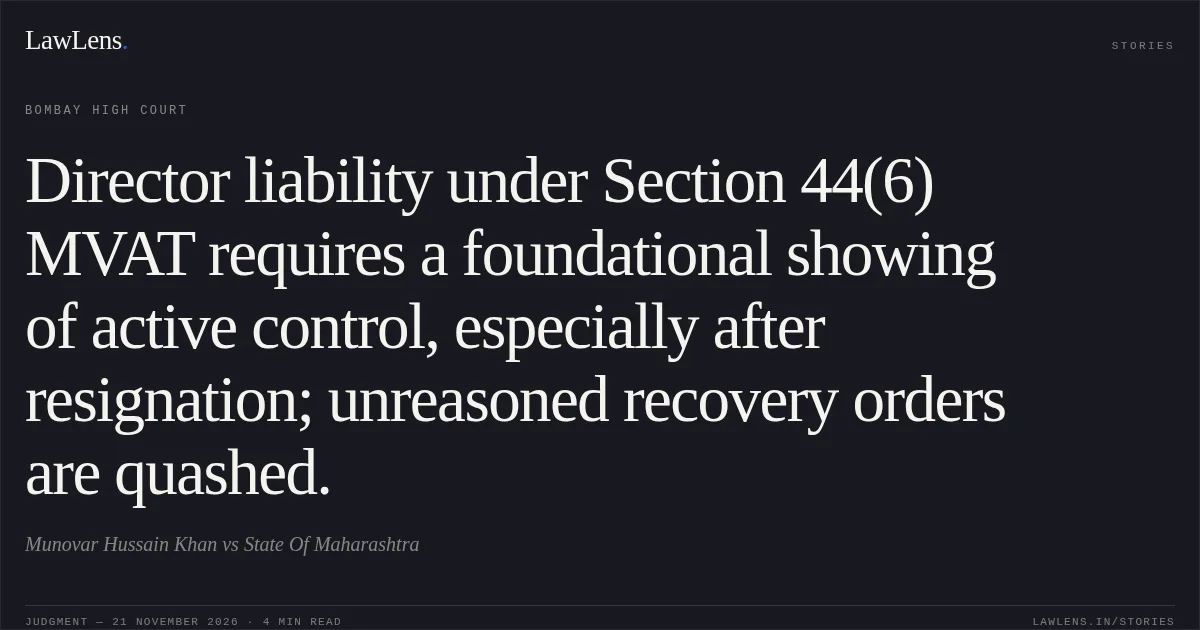
p. 13 · ¶ 17 · p. 12 · ¶ 15On the second issue, the Court held that Section 44(6) of the MVAT Act is not automatically triggered. Although the burden of proof lies on directors, the Department must first set out a foundational basis that the Petitioners were directors during the relevant period and were in active control of the company's affairs, including after their resignation of 11 September 2009.
p. 21 · ¶ 26The Court observed that the Revenue did not even allege continued active control after resignation, and that the legislature's use of "gross neglect" requires more than ordinary neglect.
p. 21 · ¶ 26 · p. 20 · ¶ 25On the third issue, the Court found that the impugned order did not discuss the resignation letters, Form-32 filings, MCA extracts, or the authorities relied on. It merely recorded the show cause notice's allegations under each heading.
p. 22 · ¶ 27–28Because the order did not address the Petitioners' case, the Court did not decide the merits of liability. It reached a decision on the ground of non-consideration and reasoned adjudication.
pp. 22–23 · ¶ 27–2805Holding
The Court did not finally decide whether Section 18 of the CST Act or Section 44(6) of the MVAT Act applies to the Petitioners. It held that the impugned order dated 17 December 2025 is unsustainable because it failed to consider the Petitioners' submissions, documents and authorities and recorded findings without reasons.
pp. 22–23 · ¶ 27–28The Court quashed and set aside the impugned order (Order (i)) and the consequential recovery letter dated 2 January 2026 (Order (ii)).
p. 23 · ¶ 28The Court directed Respondent No. 3 to re-adjudicate the show cause notice dated 23 March 2022 under Section 44(6) of the MVAT Act and Section 18 of the CST Act, after considering and dealing with each of the Petitioners' submissions and giving reasons, within 12 weeks of communication of the order (Orders (iii)–(iv)).
pp. 23–24All contentions were kept open, including the issue of delay, which the Court expressly did not examine (Order (v)).
p. 23 · ¶ 28 · p. 24Original Court PDF
Munovar Hussain KhanvsState Of Maharashtra
Click to open original judgment
Original judgment, available to read, download and summarize on LawLens.in