01Facts
Petitioner Nos. 1–4 are private family trusts/waqfs and Petitioner No. 5 claims as transferee or assignee of their interest.
¶ 2 · p. 4They claim ownership of lands in villages Paspoli and Tirandaz (Taluka Kurla, Mumbai Suburban), part of the larger Powai Estate, under indentures dated 6 July 1938, 23 April 1941 and 8 July 1941.
¶ 2, 2.2 · p. 4In Suit No. 316 of 1953, the Petitioners challenged the applicability of the Salsette Estates (Land Revenue Exemption Abolition) Act, 1951.
¶ 2.3A consent decree dated 19 June 1963 (the Petitioners' pleaded date; the Respondents' submission refers to 1968) recorded that the lands in Exhibit 'B' were appropriated and not vested in the Government.
¶ 2.4–2.5 · p. 5 · ¶ 4.6(e)The Respondents produced land acquisition awards for the first time, showing that 546 Acres 1 Guntha 12 Annas had been acquired for IIT Bombay (Respondent No. 7) under an award dated 15 March 1962.
¶ 3.3, 5, 21The Petition was amended with leave on 31 August 2026.
¶ 3.3The Petitioners, without prejudice, accepted the acquisition chart and claimed balance lands of 58 Acres 9 Gunthas 9 Annas (Tirandaz) and 19 Acres 32 Gunthas (Paspoli).
¶ 3.4–3.5 · pp. 7–8A power of attorney (dated 3 May and 4 June 2026) was executed by Petitioner No. 5.
¶ 4.5The Court had earlier decided a similar petition in Sir Mohammed Yusuf Trust (judgment dated 22 September 2026).
¶ 6The State opposed the Petition, and the Court expressed strong displeasure at its "obdurate" and "untenable" stand.
¶ 8–9 · p. 1802Issues
i.1. Whether a consent decree declaring title in favour of the Petitioners can be rendered nugatory for failure to seek execution, on the ground of limitation or laches.
¶ 4.6(f), 10(ii), 11 · pp. 18–19ii.2. Whether the Petitioners' claims are inconsistent or impermissibly enlarged, and whether the burden of identifying and demarcating acquired and non-acquired lands lies with the State.
¶ 12–13, 16–18 · pp. 22–24iii.3. Whether the Petitioners lack locus, given the transfer to Petitioner No. 5, the non-juristic status of trusts/waqfs, and defects in the power of attorney.
¶ 4.3–4.5, 10(i),(iii), 19 · p. 24iv.4. Whether an unregistered consent decree against the State can be relied upon to direct mutation in revenue records, and whether the State can insist on the statutory mutation process.
¶ 4.6(a)–(d), 4.7, 14–15, 22 · pp. 23–2503Law Applied
The Court relied on Article 226 of the Constitution, and on Article 12 to treat the State and its statutory bodies as a single entity.
¶ 15A consent decree continues to operate until set aside and must be reflected in revenue records; such a decree operates in rem, as drawn from Meena A. Rizvi v. State of Maharashtra (2026 SCC OnLine Bom 818).
¶ 3.2, 14The State speaks with one voice through its departments and statutory bodies, as held in Vadilal Chemicals Ltd. v. State of A.P. (2005) 6 SCC 292.
¶ 15A decree declaring title cannot be defeated on limitation or for want of execution, and once final it must be implemented.
¶ 24A consent decree against the State binds statutory bodies constituted under it.
¶ 14The State must identify and demarcate acquired and balance lands and record them in revenue records.
¶ 13, 17Where the prayer seeks recording of the names of Petitioner Nos. 1–4 (not the attorney's), objections based on locus and the power of attorney are unwarranted.
¶ 17, 19Director of Elementary Education, Odisha v. Pramod Kumar Sahoo (2019) 10 SCC 674 was held distinguishable on facts, since the State had produced the awards in this case, and counsel's statement in the prior judgment was treated as not binding on the State.
¶ 4.8Provisions in the judgment · 2 · Linked ones open on LawLens
Indian Trust Act, 1882 Section 1
Maharashtra Stamp Act Section 33
04Reasoning
The consent decree was not a dead cause of action. The decree was treated as an operative declaration of title binding on the State's statutory authorities, and the State cannot disown its own role or feign ignorance of this Court's orders.
¶ 11 (quoting Sir Mohamed Yusuf Trust, paras 14–24)The State's limitation and execution objections were rejected. The contention that the Petitioners should have executed the decree was characterised as the kind of stance "private litigants generally take," which a public authority under Article 12 cannot adopt.
¶ 15The "changing goalposts" objection was rejected because the State, not the Petitioners, was obliged to identify and demarcate the acquired lands; the Petitioners could not demarcate by their own understanding.
¶ 13, 16–18Counsel's statement, given on instructions, that the Petitioners claim no part of the IIT lands was accepted.
¶ 21The locus and power-of-attorney objections failed because the relief sought is the recording of Petitioner Nos. 1–4's names, not the attorney's.
¶ 17, 19The Court did not separately decide the joinder of trustees under the Atmaram/Shankar Padam Thapa line, the Waqf Act, 1995 argument, the stamp-impounding objection under G.M. Shahul Hameed, or the MLRC mutation procedure beyond holding that the State's duty to make entries displaces that objection. Those objections are not settled by this judgment.
¶ 4.3–4.5, 4.7(IV), 15, 1905Holding
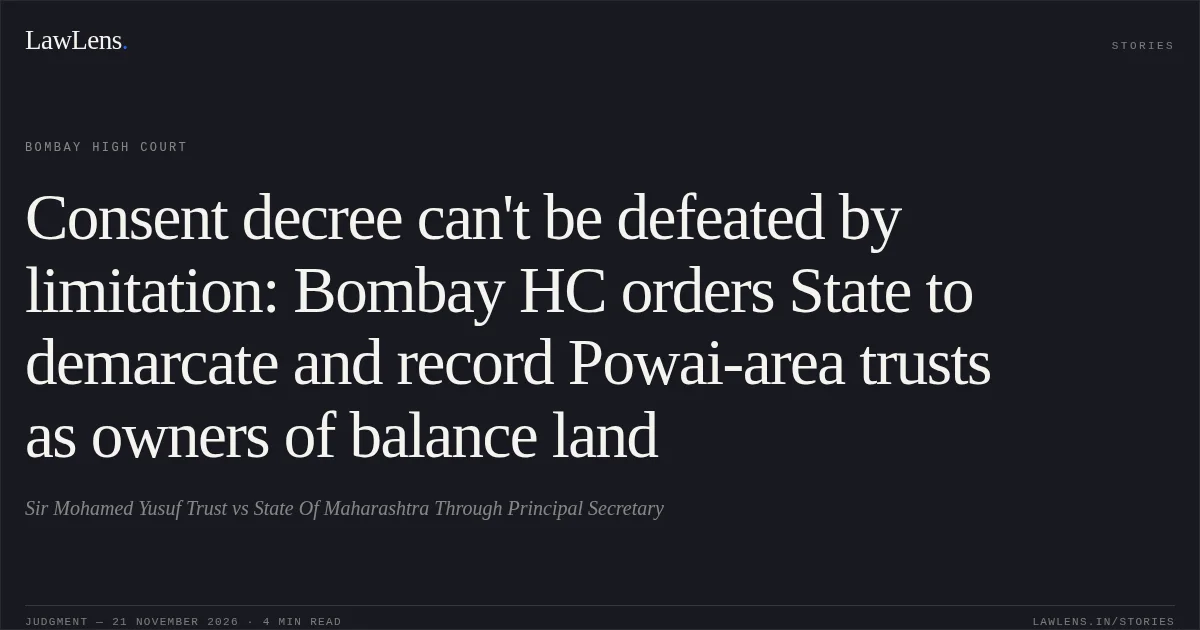
A consent decree declaring title cannot be rendered infructuous for failure to seek execution or on limitation grounds, and the State must identify, demarcate and record the acquired and balance lands.
¶ 11, 13, 17, 24The Petition was allowed in terms of prayer clauses (a) to (e). Respondent Nos. 2 to 6 were directed to demarcate the subject property by metes and bounds within six weeks of uploading the judgment on the High Court website. The Petition was allowed with no order as to costs, and Interim Application (L) No. 30226 of 2026 was disposed of. The Court also recorded its strong disapproval of the State's conduct.
¶ 8–9, 22, 23, 24Original Court PDF
Sir Mohamed Yusuf TrustvsState Of Maharashtra Through Principal Secretary
Click to open original judgment
Original judgment, available to read, download and summarize on LawLens.in