Facts
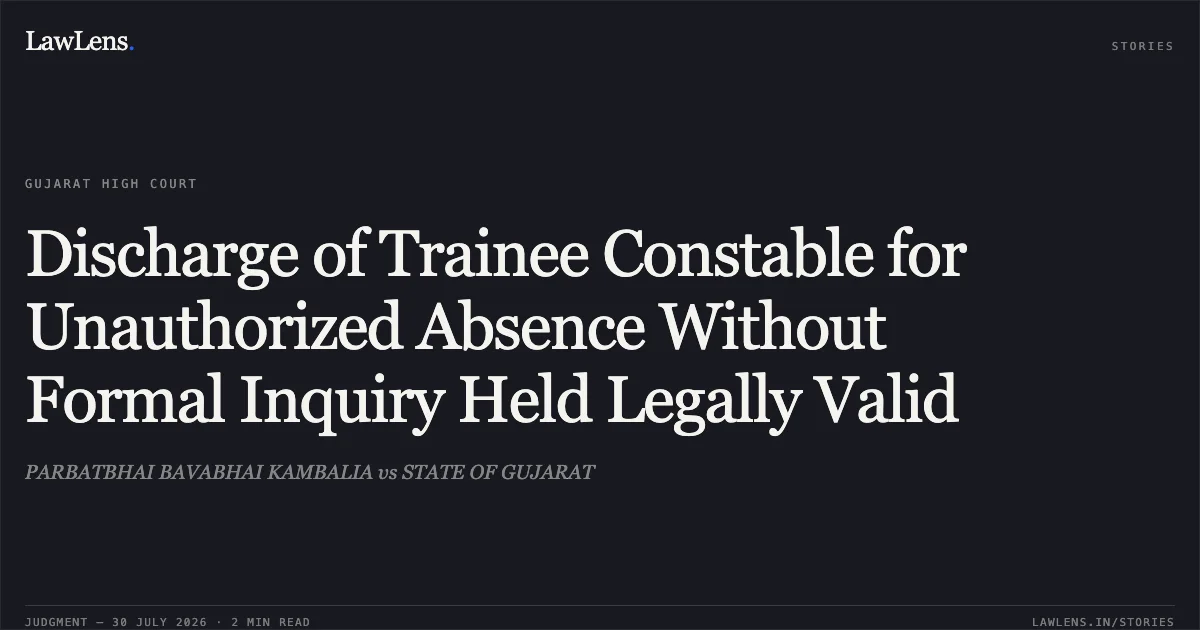
The Appellant was selected as a Police Constable trainee by the Respondent in 1989. During his training at Vadodara, he left the institute on 15/05/1986 without prior permission or written intimation, later claiming he suffered from a medical condition termed "Fumerizam"
Source reference: p. 2Consequently, the District Superintendent of Police (DSP), Junagadh, discharged him from service on 22/07/1986
Source reference: p. 3The Appellant approached the training institute a year later (July 1987) with a fitness certificate, but was refused reinstatement. He filed Regular Civil Suit No. 580 of 1990 seeking a declaration that his termination was illegal.
Source reference: p. 2The Trial Court decreed the suit in favor of the Appellant on 17/04/2001. However, the First Appellate Court reversed this decree on 05/08/2004, finding the medical evidence provided by the Appellant to be contradictory and "bogus"
Source reference: p. 4, 9The Appellant then preferred this Second Appeal under Section 100 of the CPC
Source reference: p. 1Issues
1. Whether the Appellate Court erred in discarding the medical evidence and witness testimony regarding the Appellant’s illness
Source reference: p. 42. Whether the Appellate Court was justified in upsetting the Trial Court's findings as being "perverse"
Source reference: p. 43. Whether the termination order was punitive and thus ab-initio void for lack of a formal inquiry
Source reference: p. 5Law Applied
The Court applied the Gujarat Police Manual Rules, 1989, specifically Rule 129(5) and Rule 139(5), which empower the authority to discharge a trainee or ad-hoc employee without a formal inquiry if they fail to complete training or remain unauthorizedly absent
Source reference: p. 6, 11The Court also relied on Section 100 of the Code of Civil Procedure (CPC), which limits the High Court's jurisdiction in second appeals to substantial questions of law, strictly prohibiting the reappreciation of facts unless findings are perverse
Source reference: p. 1, 12The Court followed the precedent in Russi Fisheries (P) Ltd. v. Bhavna Seth (2026 SCC OnLine SC 555), which reinforces that even erroneous findings of fact by a lower court cannot be disturbed in a second appeal if they are based on evidence
Source reference: p. 12-13Reasoning
The Court observed that the Appellant failed to prove a genuine medical emergency for his 14-month unauthorized absence. Analysis of the medical certificates revealed significant contradictions: Exhibit 70 claimed fitness from 25/07/1987 for "cold and cough," while Exhibit 77 claimed fitness from 16/07/1987 for "rheumatism," neither mentioning "Fumerizam" as alleged in the plaint
Source reference: p. 9-10The Court reasoned that since the Appellant was an ad-hoc trainee and not a confirmed employee, the rigors of a full disciplinary inquiry were not mandatory under the Gujarat Police Manual
Source reference: p. 11The Appellate Court's decision to reverse the Trial Court's judgment was deemed proper because the Trial Court had ignored the lack of devotion to duty required by police personnel and the suspicious nature of the evidence
Source reference: p. 12Holding
The High Court held that the termination was legal under the Gujarat Police Manual as the Appellant abruptly left training without leave
The Court concluded that the findings of fact regarding the "bogus" medical certificates were not perverse and did not warrant interference under Section 100 of the CPC; the High Court dismissed the appeal and upheld the First Appellate Court's judgment.
Source reference: p. 12, 14Acts & Sections Cited
1 provisions across 1 statute referred to in this judgment. Each provision opens on LawLens.
Code of Civil Procedure, 19081
Original Court PDF
PARBATBHAI BAVABHAI KAMBALIAvsSTATE OF GUJARAT
Click to open original judgment
Original judgment, available to read, download and summarize on LawLens.in