Facts
The petitioner, a Junior Engineer, was accused of causing financial loss to the respondent company by unauthorizedly using a password to extend credit benefits to consumers
Source reference: para. 2Following a departmental inquiry, the disciplinary authority imposed a punishment of withholding one annual increment without cumulative effect via an order dated August 31, 2017
Source reference: para. 2, 5The petitioner’s subsequent appeal was rejected by the appellate authority on June 28, 2022
Source reference: para. 2, 7The petitioner approached the High Court under Article 226 of the Constitution, seeking to quash these orders and claiming consequential benefits
Source reference: para. 1Issues
1. Whether the disciplinary and appellate authorities exercised their quasi-judicial powers properly by passing speaking and reasoned orders
Source reference: para. 6, 82. Whether the impugned orders of punishment and rejection of appeal are legally sustainable if they fail to record justifiable reasons for their conclusions
Source reference: para. 9, 13Law Applied
The court primarily applied the principles of natural justice and administrative law governing quasi-judicial authorities, emphasizing that such bodies must pass "speaking orders" that reflect an application of mind
Source reference: para. 6, 8The court relied on the Supreme Court precedent in State of Punjab v. Bandip Singh, which mandates that administrative decisions must be self-sustaining and impregnated with reasons to avoid capriciousness
Source reference: para. 10, 11Furthermore, it cited Kranti Associates Pvt. Ltd. v. Masood Ahmed Khan, which establishes that recording reasons is an indispensable component of the decision-making process and the "soul of justice"
Source reference: para. 12Reasoning
The Court examined the text of the punishment and appellate orders, noting that while they referenced the inquiry report and the petitioner's replies, they failed to discuss the specific facts or the grounds raised in the petitioner's defense
Source reference: para. 5, 7The Court observed that a quasi-judicial authority must demonstrate that relevant factors were objectively considered
Source reference: para. 12In this case, the disciplinary authority merely expressed agreement with the inquiry report without providing independent justification
Source reference: para. 5, 6Similarly, the appellate authority passed a non-speaking order that did not address the merits of the appeal
Source reference: para. 7, 8The Court reasoned that without recorded reasons, the "affected party" cannot know how their defense was evaluated, rendering the process arbitrary
Source reference: para. 9, 12Holding
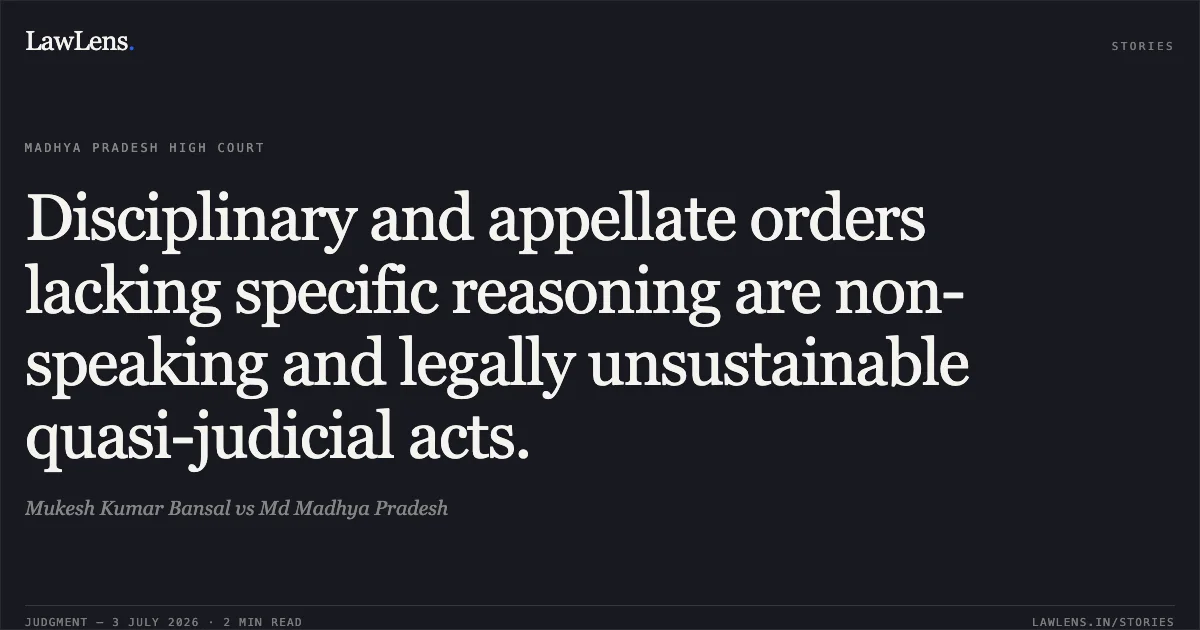
The Court allowed the petition, holding that the impugned orders were not speaking orders and lacked the necessary legal reasoning
It quashed the punishment order dated August 31, 2017, and the appellate order dated June 28, 2022
Source reference: para. 13The respondents were directed to provide all consequential benefits to the petitioner within three months, though the Court granted the respondents liberty to initiate fresh action in accordance with the law
Source reference: para. 14, 15Original Court PDF
Mukesh Kumar BansalvsMd Madhya Pradesh
Click to open original judgment
Original judgment, available to read, download and summarize on LawLens.in