Facts
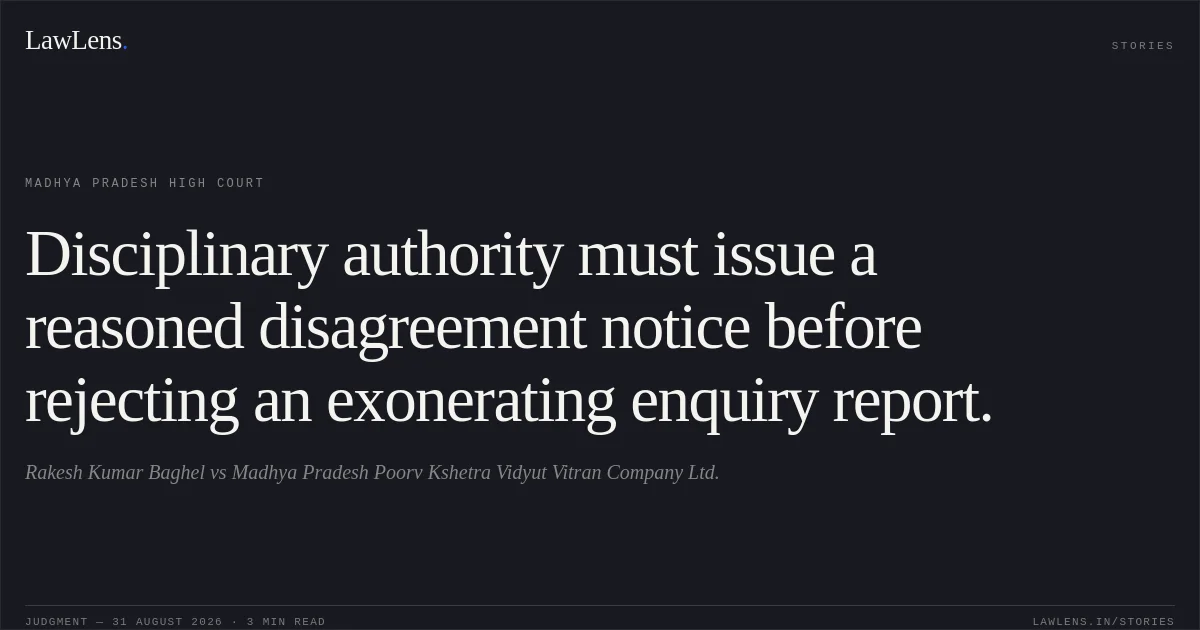
The petitioner challenged an order imposing the major penalty of reversion to the initial pay scale of Assistant Engineer following a departmental enquiry.
Source reference: p.1, para.1The charge-sheet alleged that, in connection with the execution of electrical works under the Saubhagya Scheme in District Sidhi, the petitioner had committed malpractices causing a loss of ₹6,31,59,351, and had caused a further loss of ₹2,35,71,643 through other alleged irregularities.
Source reference: p.1, para.2The Enquiry Officer found both charges un proved.
Source reference: p.1, para.3The Disciplinary Authority disagreed with the Enquiry Officer’s findings and constituted a five-member committee to scrutinise the enquiry report and the alleged lapses.
Source reference: p.1, para.4The committee effectively acted as a fresh enquiry body; however, its report was not supplied to the petitioner, no notice of disagreement was issued, and the petitioner was not heard before the penalty was imposed.
Source reference: pp.1–2, paras.4, 8–9The respondents opposed the writ petition on the ground that the petitioner had an alternative departmental remedy of appeal under Rule 9(2)(1) of the Madhya Pradesh Civil Services Pension Rules, 1976 and Rule 23 of the Madhya Pradesh Civil Services (Classification, Control and Appeal) Rules, 1966.
Source reference: p.2, para.5Issues
Whether the Disciplinary Authority could disagree with the Enquiry Officer’s findings and impose a penalty without issuing a notice of disagreement containing the reasons for such disagreement?
Source reference: p.2, paras.7–9Whether the constitution and acceptance of the report of a five-member committee, without supplying its report to the petitioner or affording him an opportunity of hearing, violated the principles of natural justice and Rule 15 of the Madhya Pradesh Civil Services (CCA) Rules, 1966?
Source reference: pp.2–3, paras.8–9Whether the existence of an alternative departmental appeal barred the exercise of the High Court’s writ jurisdiction in the circumstances of the case?
Source reference: p.3, para.10Law Applied
Although a Disciplinary Authority is not bound by the findings of the Enquiry Officer and may disagree with them, it must first issue a notice of disagreement setting out the prima facie issues or reasons for such disagreement and provide the delinquent employee an opportunity to respond, as held in Punjab National Bank v. Kunj Behari Mishra, (1998) 7 SCC 84.
Source reference: p.2, para.7The Court further relied on Rule 15 of the Madhya Pradesh Civil Services (Classification, Control and Appeal) Rules, 1966, which governs the procedure for remand or further enquiry.
Source reference: p.2, para.9The Court also applied the exception to the alternative-remedy rule recognised in Whirlpool Corporation v. Registrar of Trade Marks, (1998) 8 SCC 1, under which writ jurisdiction may be exercised where there is a blatant violation of natural justice.
Source reference: p.3, para.10Reasoning
The Court found that the Enquiry Officer had exonerated the petitioner on both charges, but the Disciplinary Authority neither issued a reasoned notice of disagreement nor gave the petitioner an opportunity to contest the proposed departure from the enquiry findings.
Source reference: p.1, para.3; p.2, para.7Instead, the five-member committee functioned as an additional enquiry authority. Its report was not furnished to the petitioner, and no hearing was afforded before the penalty was imposed.
Source reference: p.2, paras.8–9This procedure was inconsistent with the safeguards prescribed by Rule 15 and violated the principles of natural justice.
Source reference: p.2, paras.8–9Because the punishment was founded upon a process in which the petitioner had not been heard and in which the favourable Enquiry Officer’s report was bypassed without procedural compliance, the Court held that the case fell within the recognised exceptions to the rule requiring exhaustion of alternative remedies.
Source reference: p.3, para.10Holding
The High Court allowed the writ petition and set aside the penalty order reverting the petitioner to the initial pay of Assistant Engineer, holding that it had been passed in utter disregard of the principles of natural justice.
The Disciplinary Authority was granted liberty either to issue a proper notice of disagreement on the Enquiry Officer’s report and pass a final order, or, where justified by a procedural violation, to remand the matter in accordance with Rule 15 of the Madhya Pradesh Civil Services (CCA) Rules, 1966 for a fresh enquiry.
Source reference: p.3, para.11Any fresh order was required to comply with the prescribed procedure.
Source reference: p.3, para.11Original Court PDF
Rakesh Kumar BaghelvsMadhya Pradesh Poorv Kshetra Vidyut Vitran Company Ltd.
Click to open original judgment
Original judgment, available to read, download and summarize on LawLens.in