Facts
The petitioner, posted as a Driver under the Directorate of Culture and Archaeology since 2018, was subjected to a departmental enquiry for allegedly remaining absent from duty from 22 December 2018 to 20 September 2019.
Source reference: para. 1–6The Inquiry Officer, after conducting the enquiry, found the charges not proved. The disciplinary authority, however, disagreed with the enquiry report and, by order dated 19 March 2021, treated the period of absence under the principle of “no work, no pay,” without properly recording reasons for disagreement or recording its own findings on the charges. The petitioner challenged that order under Article 226 of the Constitution.
Source reference: para. 1–6Issues
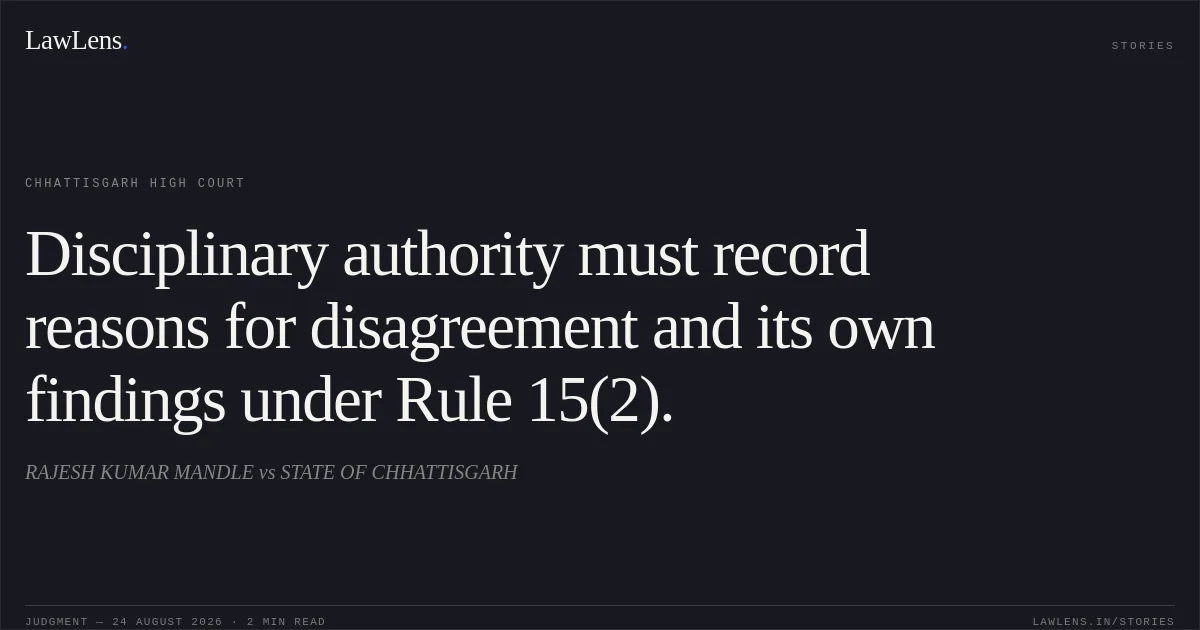
Whether the disciplinary authority could disagree with the findings of the Inquiry Officer without recording reasons for such disagreement as required under Rule 15(2) of the Chhattisgarh Civil Services (Classification, Control and Appeal) Rules, 1966?
Source reference: para. 2–4, 7–9Whether the disciplinary authority was required to record its own findings on each charge before imposing the consequence of “no work, no pay”?
Source reference: para. 6–9Law Applied
The Court primarily applied Rule 15(2) of the Chhattisgarh Civil Services (Classification, Control and Appeal) Rules, 1966, which mandates that where the disciplinary authority disagrees with the Inquiry Officer’s findings on any charge, it must record reasons for the disagreement and its own finding on that charge, provided the evidence on record is sufficient. Rule 15(3) further requires the disciplinary authority to record reasons in writing while imposing a penalty.
Source reference: para. 7The Court held that mere disagreement with the enquiry report is insufficient; the disciplinary authority must disclose the basis of disagreement and independently determine the findings on the charges.
Source reference: para. 8–9Reasoning
The Inquiry Officer had found all allegations against the petitioner unproved. Although the disciplinary authority possessed the enquiry report and the underlying evidence, it neither identified the evidentiary basis for disagreeing with the Inquiry Officer nor recorded its own findings on the individual charges.
Source reference: para. 6–9Instead, it simultaneously recorded disagreement and applied “no work, no pay” for the period of absence. This failed to satisfy the mandatory requirements of Rule 15(2), and the absence of recorded reasons also rendered the consequential order legally unsustainable.
Source reference: para. 6–9Holding
The High Court held that the order dated 19 March 2021 was contrary to Rule 15(2) of the 1966 Rules because the disciplinary authority had not recorded reasons for disagreement or its own findings on the charges.
The impugned order was quashed, the writ petition was allowed, and consequential reliefs were directed to follow.
Source reference: para. 9–10Original Court PDF
RAJESH KUMAR MANDLEvsSTATE OF CHHATTISGARH
Click to open original judgment
Original judgment, available to read, download and summarize on LawLens.in