Facts
The petitioners (tenants) sought a review of the High Court’s order dated August 7, 2025, which had upheld an eviction decree passed by the Appellate Bench of the Court of Small Causes, Mumbai.
Source reference: para. 1The eviction was originally granted on grounds of unlawful subletting, non-user, and acts contrary to Section 108(o) of the Transfer of Property Act.
Source reference: para. 4-5The tenants filed this review petition claiming they discovered "new evidence"—three Indentures of Assignment (dated 1990, 1993, and 1995)—which purportedly showed that Respondent No. 1 (Plaintiff) was not the owner or landlord of the suit premises at the time the suit was filed in 1994, thereby challenging the court's inherent jurisdiction.
Source reference: para. 6-7Respondent No. 1 countered that it held sub-lease rights since 1946 through registered agreements, which were not extinguished by subsequent assignments of the head-lease.
Source reference: para. 8-9Issues
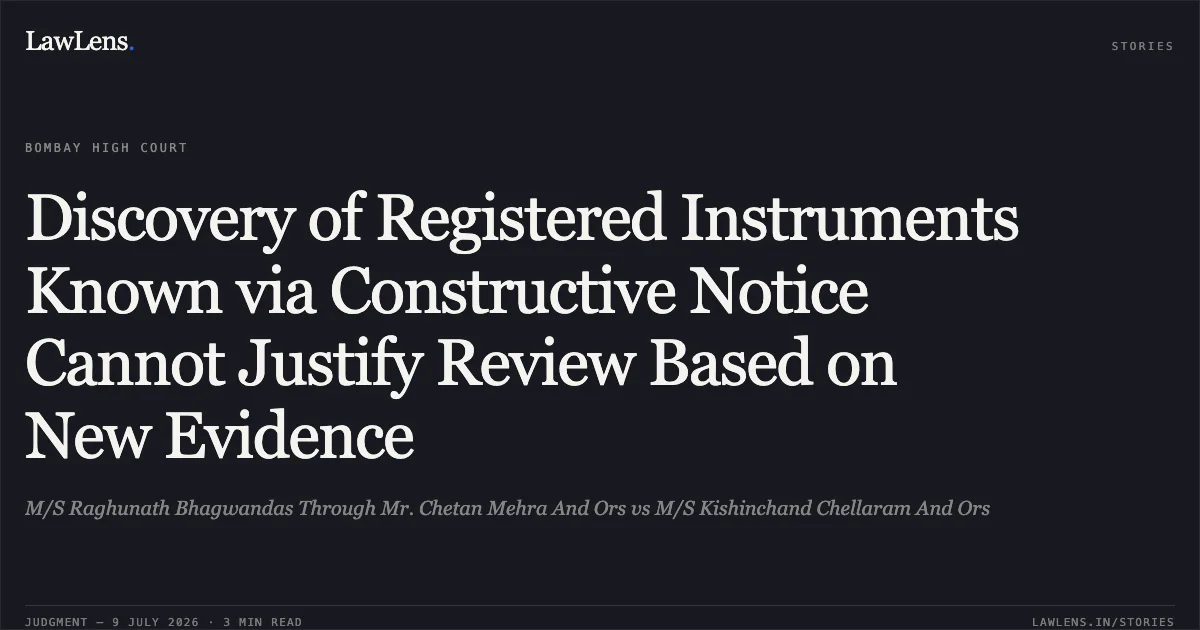
1. Whether the discovery of registered Indentures of Assignment constitutes "new and important matter or evidence" warranting a review under Order XLVII Rule 1 of the CPC.
Source reference: para. 27-282. Whether Respondent No. 1 satisfies the definition of "landlord" under Section 5(3) of the Bombay Rent Act, 1947, despite the alleged transfer of head-lease rights to third parties.
Source reference: para. 42-43Law Applied
Section 114 and Order XLVII Rule 1 of the Code of Civil Procedure (CPC), noting that review is not an "appeal in disguise" and is limited to patent errors or discovery of new evidence that could not be produced despite "due diligence".
Source reference: para. 18-21Section 3 of the Transfer of Property Act, 1882, regarding "constructive notice" of registered instruments.
Source reference: para. 32Section 5(3) of the Bombay Rent Act, 1947, which defines a landlord as any person receiving or entitled to receive rent, even if not the owner.
Source reference: para. 43Principle from K.D. Dewan v. Harbhajan S. Parihar reinforcing that ownership is immaterial for "landlord" status under Rent Acts.
Source reference: para. 45Section 116 of the Indian Evidence Act, regarding tenant’s estoppel from denying the landlord's title.
Source reference: para. 48-49Reasoning
The court found that the "new" documents did not meet the criteria for review because they were registered instruments; therefore, the petitioners had "constructive notice" under Section 3 of the TP Act and failed the "due diligence" test.
Source reference: para. 32-36The court noted that Respondent No. 1's sub-lease rights originated in 1946-1955 and were not explicitly terminated by the 1993 assignment to which Respondent No. 1 was not even a party.
Source reference: para. 40-41Applying the expansive definition of "landlord" in Section 5(3) of the Bombay Rent Act, the court reasoned that since the tenants had admittedly paid rent to Respondent No. 1 for decades and were inducted by them, Respondent No. 1 was legally the "landlord" regardless of owner status.
Source reference: para. 44-46Furthermore, under Section 116 of the Evidence Act, the tenants were estopped from challenging the title of the landlord who inducted them.
Source reference: para. 49-50Holding
The court dismissed the Review Petition, holding that no case for review was made out.
The court concluded that the Plaintiff remained a "landlord" within the meaning of the Rent Act and that the subsequent assignments of the head-lease did not automatically extinguish the Plaintiff's sub-lease rights or the jural relationship between the parties. The original order dated August 7, 2025, remains undisturbed.
Source reference: para. 50-52Acts & Sections Cited
4 provisions across 2 statutes referred to in this judgment. Each provision opens on LawLens.
Transfer of Property Act, 18822
Code of Civil Procedure, 19082
Original Court PDF
M/S Raghunath Bhagwandas Through Mr. Chetan Mehra And OrsvsM/S Kishinchand Chellaram And Ors
Click to open original judgment
Original judgment, available to read, download and summarize on LawLens.in