Facts
The appellants (purchasers) bought two parcels of land in 1975 via a registered sale deed.
Source reference: p. 4-5In 1981, the Deputy Collector declared the sale void for violating the Gujarat Prevention of Fragmentation and Consolidation of Holdings Act, 1947, and ordered eviction.
Source reference: p. 5Despite this, the appellants remained in continuous possession for 45 years.
Source reference: p. 18-19In 2020, the respondents (heirs of the original seller) unsuccessfully applied to the Mamlatdar to implement the 1981 order.
Source reference: p. 6, 18The appellants then filed Revision Applications before the Special Secretary, Revenue Department (SSRD) in 2021/2023 with a 40-year delay.
Source reference: p. 6, 8The SSRD condoned the delay, but the learned Single Judge set aside that order, ruling the delay was unpardonable as the appellants had prior knowledge of the 1981 order through revenue entries and a 2012 partition suit.
Source reference: p. 9-17Issues
1. Whether the heirs of a seller (who pocketed sale consideration) have the locus standi to contest a delay condonation application in a revision filed by the purchaser.
Source reference: p. 3, 272. Whether the SSRD properly exercised its discretionary jurisdiction in condoning a 40-year delay based on the "cause of justice" and the specific fact of long-term possession.
Source reference: p. 32, 393. Whether a Writ Court under Article 226/227 can independently re-appreciate evidence to overturn a discretionary order of condonation passed by a lower authority.
Source reference: p. 21, 42Law Applied
Section 5 of the Limitation Act, 1963, regarding the liberal construction of "sufficient cause" to advance substantial justice.
Source reference: p. 35-37Shivamma v. Karnataka Housing Board (2025) and Sheo Raj Singh v. Union of India (2023), which establish that an appellate/supervisory court should not interfere with the discretionary exercise of condonation unless it is "wholly untenable, arbitrary, or perverse".
Source reference: p. 38-39Full Bench decision in Dashratbhai M. Patel v. Maganbhai Joitram regarding the Collector's duty to summarily evict unauthorized occupants under Section 9(3) of the Fragmentation Act, 1947.
Source reference: p. 27-28Reasoning
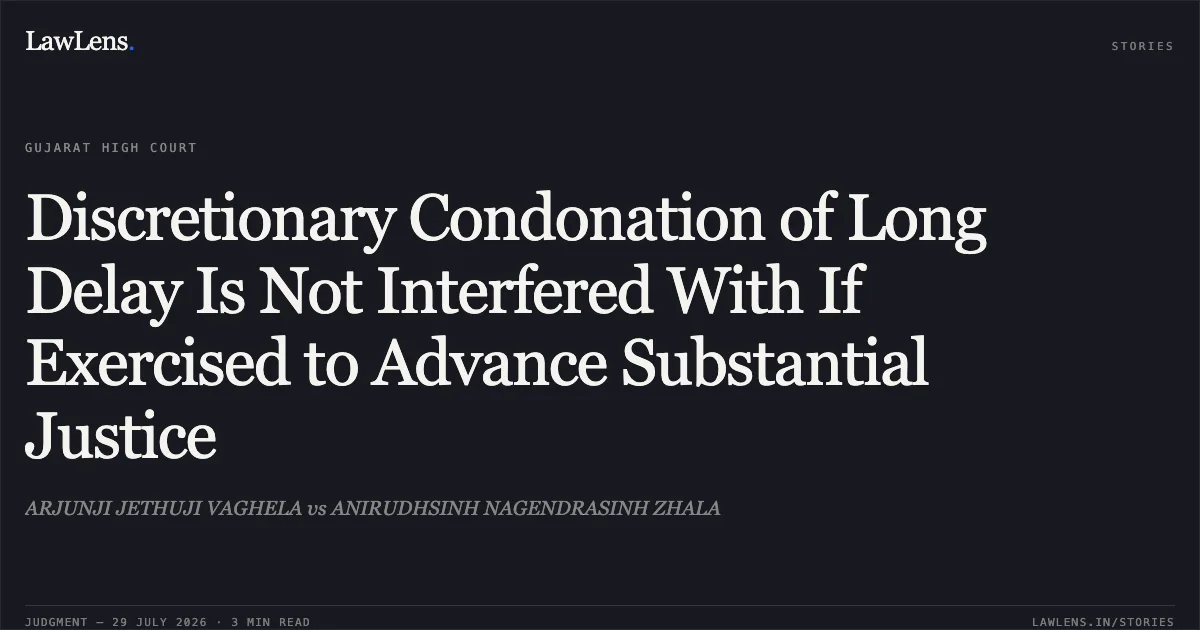
The Court reasoned that while the length of delay (40 years) was substantial, the "adequacy and acceptability" of the explanation is what matters in law.
Source reference: p. 36, 43The SSRD’s decision to condone delay was not mechanical; it considered the necessity of deciding the matter on merits given that the appellants had remained in undisturbed possession for over four decades.
Source reference: p. 18, 30The Division Bench found that the learned Single Judge erred by conducting an "independent inquiry" and re-appreciating revenue records to prove the appellants' "knowledge," effectively acting as a Court of Appeal rather than a supervisory Court.
Source reference: p. 21, 42The Bench emphasized that because the original seller’s heirs also stayed silent for 40 years and only moved in 2020 after their mutation plea was rejected, the "status-quo" of the land suggested that perhaps neither party was actively aware of the 1981 order's legal finality.
Source reference: p. 40-41Thus, the SSRD’s exercise of discretion was not perverse.
Source reference: p. 42Holding
The High Court allowed the Letters Patent Appeals and set aside the Single Judge’s judgment dated 06.04.2026.
The Court held that the SSRD's order dated 18.12.2024 condoning the delay is affirmed, as it was a valid exercise of discretionary power aimed at advancing justice.
Source reference: p. 43Regarding locus, the Court held that since the delay is condoned, the original petitioners (sellers' heirs) shall have the right to participate in the final hearing of the Revision Applications on merits.
Source reference: p. 43The SSRD is directed to decide the revisions independently without being influenced by previous observations.
Source reference: p. 43Acts & Sections Cited
4 provisions across 2 statutes referred to in this judgment. Each provision opens on LawLens.
Gujarat Prevention of Fragmentation and Consolidation of Holdings Act, 19472
Original Court PDF
ARJUNJI JETHUJI VAGHELAvsANIRUDHSINH NAGENDRASINH ZHALA
Click to open original judgment
Original judgment, available to read, download and summarize on LawLens.in