Facts
The petitioner (complainant) initiated proceedings against the respondent (accused) under Sections 138/142 of the Negotiable Instruments Act, 1881, following the dishonor of cheques totaling ₹1.25 Crore due to the account being closed.
Source reference: p. 1-2After the matter reached the stage of final arguments and nearly three years after the accused’s right to cross-examine was closed, the accused moved an application under Section 311 CrPC to recall the complainant's authorized representative (CW-1) for cross-examination.
Source reference: p. 2The Trial Court allowed the application on 11.03.2022, citing the necessity of the evidence for a just decision, subject to costs of ₹10,000.
Source reference: p. 1, 6The petitioner challenged this order, alleging dilatory tactics and mala fides by the accused.
Source reference: p. 2-3Issues
1. Whether the Trial Court’s exercise of discretionary power under Section 311 CrPC to recall a witness at the stage of final arguments was legally sustainable and essential for a just decision.
Source reference: p. 4, para. 8Law Applied
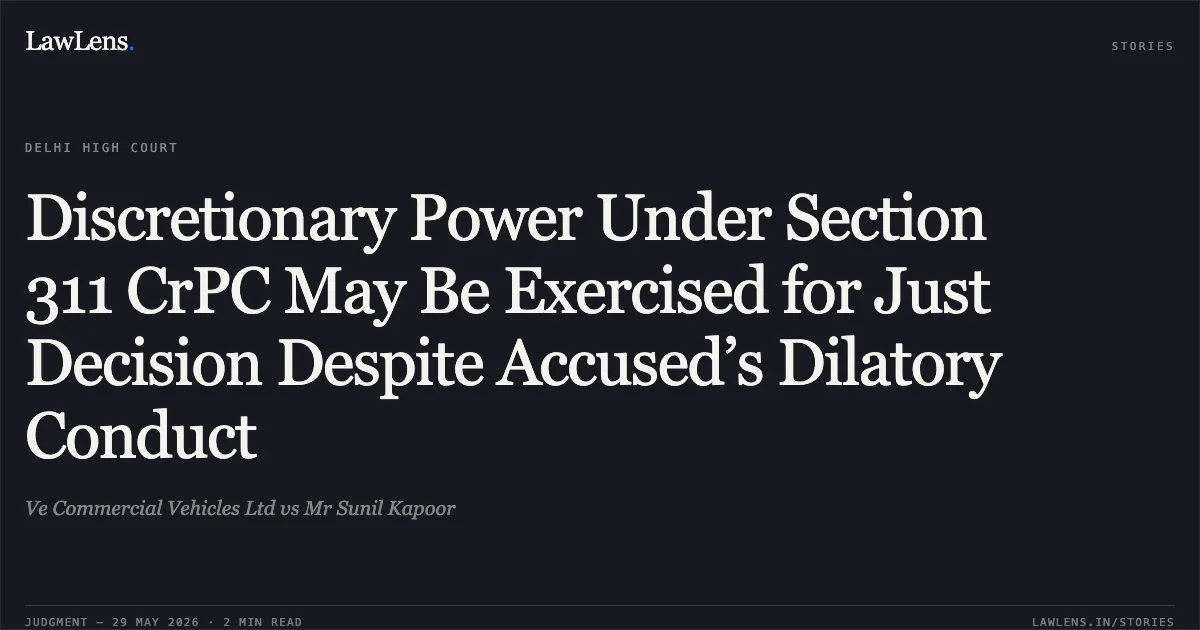
Section 311 of the Code of Criminal Procedure, 1973, which grants the court wide discretionary power to summon or recall witnesses at any stage if their evidence appears essential to a just decision.
Source reference: p. 5, para. 9The court relied on Rajaram Prasad Yadav v. State of Bihar and Manju Devi v. State of Rajasthan to emphasize that the paramount consideration is the search for truth and preventing a miscarriage of justice.
Source reference: p. 4-5Statements in State (NCT of Delhi) v. Shiv Kumar Yadav and Ashutosh Pathak v. State of U.P. warning against the arbitrary use of such powers or allowing the filling of lacunae without valid reasons.
Source reference: p. 5-6Reasoning
The High Court observed that while Section 311 CrPC must be exercised with circumspection, the Trial Court provided cogent reasons for its decision. Specifically, the accused had maintained a consistent defense regarding a lack of liability and claimed partial repayment of the dues in 2014—facts involving significant sums (crores).
Source reference: p. 6, para. 11The Court found that despite the accused’s past negligence and delays, granting one final opportunity to cross-examine CW-1 was necessary to adjudicate the case on its merits and ensure a fair trial.
Source reference: p. 6The High Court rejected the petitioner’s argument that the change of counsel was the sole reason for the order, noting other mitigating circumstances like a fire in the accused's warehouse were substantiated.
Source reference: p. 7, para. 13By imposing costs, the Trial Court effectively balanced the equities between the parties.
Source reference: p. 7, para. 12Holding
The High Court concluded that there was no perversity or arbitrariness in the impugned order.
The Trial Court rightly exercised its discretion to ensure a "just decision" based on the specific defenses raised by the accused.
Source reference: p. 7, para. 14The petition was dismissed, upholding the Trial Court's order allowing the recall of CW-1 for cross-examination subject to the payment of costs.
Source reference: p. 7, para. 16Acts & Sections Cited
2 provisions across 2 statutes referred to in this judgment. Linked provisions open on LawLens.
Code of Criminal Procedure, 19731
Negotiable Instruments Act, 18811
Original Court PDF
Ve Commercial Vehicles LtdvsMr Sunil Kapoor
Click to open original judgment
Original judgment, available to read, download and summarize on LawLens.in