01Facts
The plaintiff (63 Moons Technologies Ltd.) sued for a declaration that the audit report prepared by the first defendant, Grant Thornton Bharath LLP, is null and void
¶ 3The first defendant denied the plaint averments. The second defendant, National Spot Exchange Ltd., supported the plaintiff's case and sought a decree in the plaintiff's favour
¶ 4The plaintiff's chief-examination of PW1 ran from 30.08.2024 to 12.06.2025. The first defendant cross-examined PW1 from 12.06.2025, completing it on 29.04.2026
¶ 7The second defendant then cross-examined PW1 and, during that cross-examination, marked Exs. D2 to D10 through him. These documents comprise a judicial order, an FIR, a charge sheet, news articles and a press release. PW1 neither authored nor was a party to them, and they were marked as documents relied upon by the second defendant
¶ 4, 13The first defendant raised no objection to the sequence of cross-examination at the time
¶ 7, 11The first defendant then filed A.No. 3589/2026 to expunge Exs. D2–D10 and A.No. 3590/2026 to recall PW1 for further cross-examination
¶ 1–2, 502Issues
i.1. Whether Exs. D2 to D10, marked through PW1 during the second defendant's cross-examination, are liable to be expunged from the records of the suit.
¶ 10(i)ii.2. Whether PW1 is required to be recalled for further cross-examination at the instance of the first defendant.
¶ 10(ii)03Law Applied
Order VIII Rule 1A(4) CPC requires a defendant to produce the documents it relies upon. The court held that this provision does not by itself warrant expunging documents at this stage, and that compliance and admissibility are for consideration in the proper context
¶ 6, 15Order XVIII Rules 1 and 2 CPC, on the right to begin and the order of leading evidence, must be applied in light of the pleadings and how the trial has proceeded
¶ 12The first defendant's reliance on Section 143 of the Bharatiya Sakshya Adhiniyam, 2023 and on the Division Bench decision in O.S.A. No. 187 of 2024 was noted, but neither was separately analysed in the order
¶ 6Section 151 CPC permits evidence to be reopened or a witness recalled where necessary to meet the ends of justice or prevent abuse of process, but not routinely or to fill lacunae, following K.K. Velusamy v. N. Palanisamy, (2011) 11 SCC 275, which recognises this power and makes its exercise fact-dependent
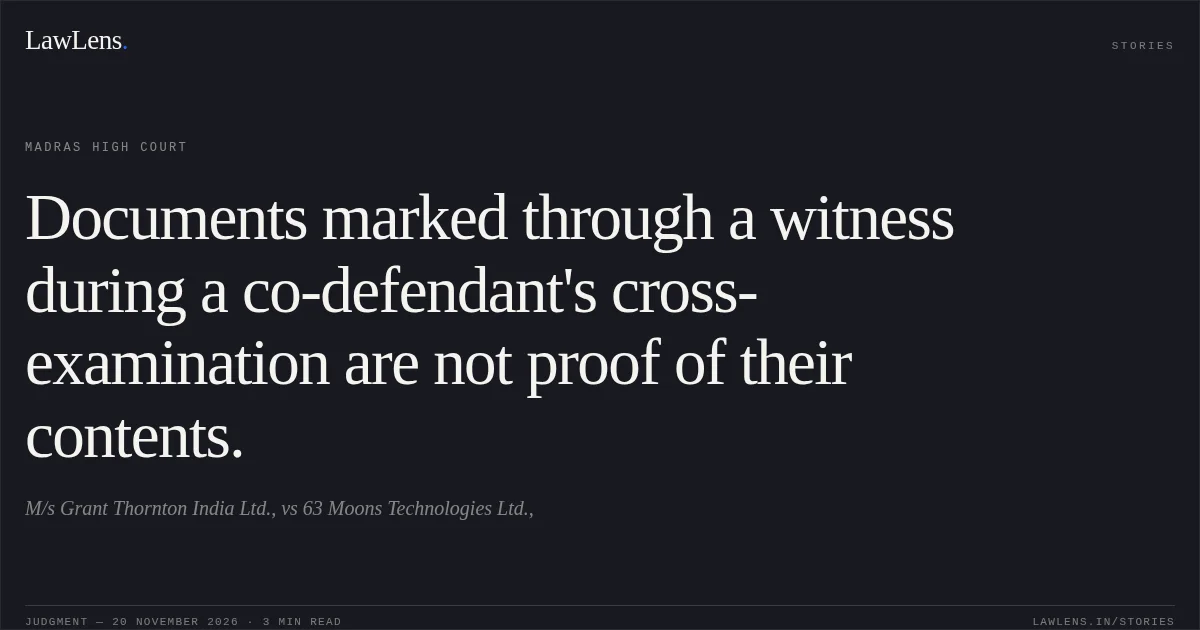
¶ 8, 19, 20Marking a document does not amount to proof of its contents, and admissibility and relevance remain open
¶ 15, 25Provisions in the judgment · 2 · Linked ones open on LawLens
Bharatiya Sakshya Adhiniyam, 2023 Section 143
Code of Civil Procedure, 1908 Section 151
04Reasoning
The sequence objection was rejected because the first defendant had completed a full cross-examination of PW1 and raised no objection when the second defendant cross-examined thereafter. The objection was not taken at the appropriate stage, and the first defendant could not later invalidate those proceedings
¶ 11–12The second defendant's support for the plaintiff in its written statement does not bar it from producing documents in its own defence or from confronting PW1 with them
¶ 14Because PW1 was neither author nor party to the documents, and they were marked as the second defendant's documents, no proof of their contents arose from the marking alone
¶ 13, 15Any prejudice is addressed by the availability of cross-examination of the second defendant once it enters the witness box. Failure to do so would invite relief and possibly an adverse inference
¶ 16–17PW1 had already been extensively cross-examined and no specific prejudice had been shown. Recall would only reopen a completed cross-examination without serving a real purpose, and the first defendant's interest was adequately protected by cross-examining the second defendant
¶ 21–2205Holding
Exs. D2–D10 are not liable to be expunged; A.No. 3589/2026 is dismissed
¶ 18Recall of PW1 under Section 151 CPC is not warranted; A.No. 3590/2026 is dismissed
¶ 22–23Both applications are dismissed without costs. The matter is posted before the Additional Master No. I on 30.11.2026, with a direction to complete recording of the parties' evidence within three months
¶ 23–24The marking of Exs. D2–D10 is not proof of their contents or admissibility, and all objections on proof, relevance and admissibility are left open. If the second defendant does not enter the witness box, the first defendant may seek appropriate relief, including an adverse inference
¶ 17, 25Original Court PDF
M/s Grant Thornton India Ltd.,vs63 Moons Technologies Ltd.,
Click to open original judgment
Original judgment, available to read, download and summarize on LawLens.in