Facts
The Appellant occupied the basement and ground floor of property No. 2271, Hudson Lines, Delhi, under a registered Rent Agreement dated 26 April 2010 for a three-year term ending on 31 March 2013, at a last-paid rent of ₹52,200 per month.
Source reference: paras. 2–3The Respondents alleged that the tenancy expired by efflux of time and claimed possession, mesne profits, and enforcement of Clause 17 of the Agreement, which required payment of twice the monthly rent for continued occupation after termination.
Source reference: paras. 4–9The Appellant contended that the tenancy had been orally agreed to continue for 15 years, or at least until 2016, and denied that his possession after 31 March 2013 was unauthorised.
Source reference: paras. 10–17During the suit, the Trial Court directed delivery of possession and payment of ₹52,200 per month; possession was handed over on 31 March 2015 and the contractual rent for that period was paid.
Source reference: paras. 19–21The Trial Court thereafter awarded an additional ₹52,200 per month as damages from 2 August 2013 to 31 March 2015, treating Clause 17 as enforceable under Section 74 of the Indian Contract Act, 1872.
Source reference: paras. 25–30The Appellant challenged only this additional award in the present appeal.
Source reference: paras. 31–40Issues
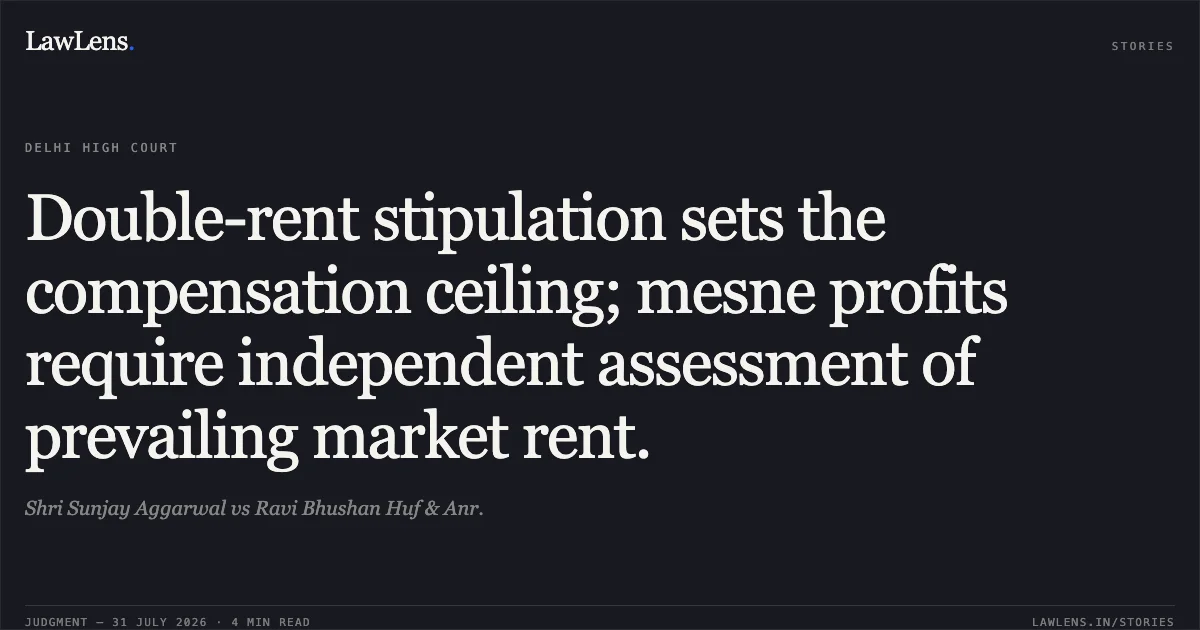
Whether the stipulated amount of twice the monthly rent under Clause 17 was automatically recoverable under Section 74 of the Indian Contract Act, 1872, without an independent determination of reasonable compensation.
Source reference: paras. 40–54Whether the Respondents had established the market rental value and mesne profits payable for the Appellant’s wrongful occupation from 2 August 2013 to 31 March 2015 under Section 2(12) of the CPC.
Source reference: paras. 55–61, 67–81Whether the award of an additional ₹52,200 per month, over and above the rent already paid, was legally sustainable.
Source reference: paras. 82–86Law Applied
The Court applied Section 74 of the Indian Contract Act, 1872, holding that a sum stipulated for breach is only the ceiling for recovery and not the automatic measure of compensation; the Court must award reasonable compensation, and the existence of legal injury remains necessary.
Source reference: paras. 41–51It relied on Fateh Chand v. Balkishan Das, (1964) 1 SCR 515, ONGC Ltd. v. Saw Pipes Ltd., (2003) 5 SCC 705, and Kailash Nath Associates v. DDA, (2015) 4 SCC 136, which establish that stipulated damages may be awarded without proof of precise loss only where loss is difficult or impossible to quantify and the stipulation is a genuine pre-estimate.
Source reference: paras. 41–51Section 2(12) CPC defines mesne profits as profits actually received or which might, with ordinary diligence, have been received by a person in wrongful possession; such profits are ordinarily assessed by reference to the prevailing market rent of comparable premises.
Source reference: paras. 55–59Under Atma Ram Properties (P) Ltd. v. Federal Motors (P) Ltd., (2005) 1 SCC 705, an erstwhile tenant is liable to pay damages at the rate at which the landlord could have let the premises after termination.
Source reference: para. 57The Court also relied on M.C. Aggarwal, HUF v. Sahara India, 2011 SCC OnLine Del 3715, and State Bank of India v. Dr. Meera Luthra, 2017 SCC OnLine Del 9513, concerning proof and assessment of prevailing market rent.
Source reference: paras. 62–65Reasoning
The Court held that the Trial Court had erred in treating Clause 17 as automatically enforceable merely because the Appellant had continued in possession; under Section 74, ₹1,04,400 per month was only the contractual ceiling.
Source reference: paras. 42–54However, unlike cases where loss is difficult to quantify, the rental value of the premises was capable of being proved through evidence of comparable properties.
Source reference: paras. 59–64The Respondents had pleaded that the property could fetch approximately ₹1,50,000 per month and produced lease deeds concerning the same property and a neighbouring property approximately 200 metres away.
Source reference: paras. 67–77Those lease deeds showed that, during the relevant period, the combined rent for comparable basement and ground-floor premises ranged from approximately ₹1,65,250 to ₹1,73,513 per month.
Source reference: paras. 70–73Although differences in frontage, accessibility, and surroundings required downward adjustment, the Court found that the suit property could nevertheless have commanded more than ₹1,04,400 per month.
Source reference: paras. 74–81Accordingly, the contractual ceiling of ₹1,04,400 per month also represented reasonable compensation supported by the market evidence. Since ₹52,200 per month had already been paid, the additional amount payable was ₹52,200 per month.
Source reference: paras. 82–85Holding
The appeal was dismissed.
The Court held that Clause 17 was not automatically enforceable under Section 74, but independently determined that the market rental value and reasonable compensation exceeded the stipulated ceiling of ₹1,04,400 per month.
Source reference: paras. 82–87The award of an additional ₹52,200 per month for the period from 2 August 2013 to 31 March 2015, over and above the ₹52,200 per month already paid, was therefore affirmed as mesne profits and reasonable compensation.
Source reference: paras. 82–87Original Court PDF
Shri Sunjay AggarwalvsRavi Bhushan Huf & Anr.
Click to open original judgment
Original judgment, available to read, download and summarize on LawLens.in