Facts
Munwa Devi, the informant’s youngest daughter, married appellant Shankar Bhuiyan in April 1992.
Source reference: paras. 4, 9–10The prosecution alleged that, after marriage, the appellant and his relatives subjected her to cruelty, assault and harassment for dowry, including a demand for ₹10,000, and that the appellant maintained an illicit relationship and deprived her of food and clothing.
Source reference: paras. 4, 9–10On 27 October 1996, the informant learned that Munwa Devi had sustained burn injuries and had been admitted to Sadar Hospital, Dhanbad; he was not informed by the accused.
Source reference: paras. 4–5, 9He subsequently learned that she had died during treatment on 24 October 1996.
Source reference: paras. 4–5, 9The post-mortem attributed her death to infection, sepsis and shock resulting from extensive ante-mortem burn injuries.
Source reference: para. 15After investigation, the appellant and co-accused Mundari Devi were tried in S.T. No. 224 of 1997.
Source reference: para. 3The trial court convicted them under Sections 304B/34 of the IPC and sentenced them to seven years’ rigorous imprisonment.
Source reference: para. 3Mundari Devi’s appeal abated upon her death on 12 October 2019.
Source reference: para. 1The appellant challenged the conviction, contending that the death was accidental, the dowry demand and cruelty were unproved, there was delay in lodging the FIR, and the investigating officer was not examined.
Source reference: para. 11Issues
Whether the prosecution proved that Munwa Devi’s death constituted a dowry death under Section 304B of the IPC, including the requirements of an unnatural death within seven years of marriage and cruelty or harassment soon before death in connection with a dowry demand?
Source reference: paras. 14, 16–22Whether the conviction under Sections 304B/34 of the IPC suffered from any legal or evidentiary infirmity warranting appellate interference?
Source reference: para. 14Law Applied
The court applied Section 304B of the IPC, which requires proof that a woman died from burns, bodily injury or otherwise than under normal circumstances within seven years of marriage and that, soon before her death, she was subjected by her husband or his relatives to cruelty or harassment for, or in connection with, a dowry demand; upon proof of these foundational facts, the death is treated as a dowry death.
Source reference: paras. 16–17The court also applied Section 113B of the Indian Evidence Act, 1872, which mandates a presumption that the accused caused the dowry death once such cruelty or harassment soon before death is shown.
Source reference: paras. 16–17, 22Section 498-A IPC and Section 2 of the Dowry Prohibition Act, 1961 were referred to for the concepts of cruelty, harassment and dowry.
Source reference: para. 16The court clarified that Section 304B does not require the death to be specifically homicidal or suicidal; a death by burning or otherwise than under normal circumstances may attract the provision if the remaining ingredients are established.
Source reference: para. 18Reasoning
The court found the first statutory ingredient established through the post-mortem evidence showing extensive ante-mortem burns and death from resulting infection, sepsis and shock; the death was therefore otherwise than under normal circumstances.
Source reference: paras. 15, 19The marriage in 1992 and death in 1996 established that the death occurred within seven years of marriage.
Source reference: para. 20Regarding cruelty and dowry demand, the court relied principally on the testimony of the informant-father and mother, who stated that the appellant and his relatives demanded dowry, assaulted and harassed Munwa Devi, and that she had narrated the ill-treatment to them.
Source reference: para. 21The surrounding testimony of other witnesses and the medical evidence were treated as corroborative.
Source reference: no citationOn this basis, the court held that all four foundational ingredients of Section 304B were proved and that the statutory presumption under Section 113B arose.
Source reference: paras. 22–23The defence failed to rebut that presumption, and the court consequently found no merit in the claims of accidental death, absence of dowry demand, delay in the FIR, or non-examination of the investigating officer sufficient to disturb the conviction.
Source reference: paras. 22–23Holding
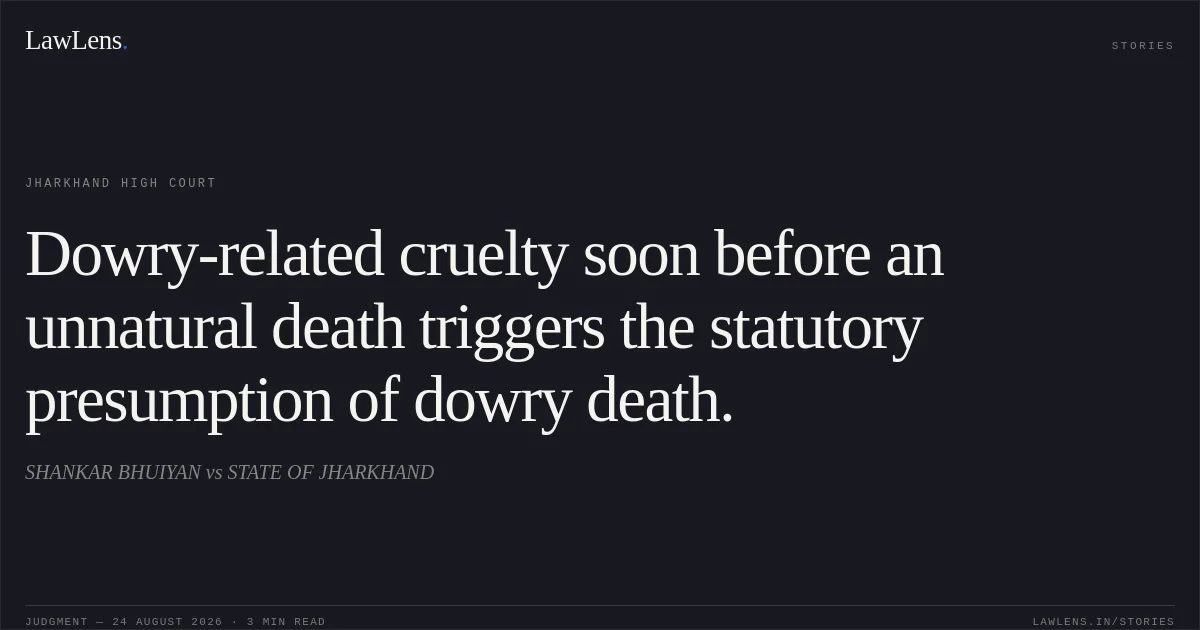
The High Court held that the prosecution had proved Munwa Devi’s dowry death and that the conviction of Shankar Bhuiyan under Sections 304B/34 IPC was legally sustainable.
The appeal was dismissed and the trial court’s conviction and sentence of seven years’ rigorous imprisonment were confirmed.
Source reference: paras. 3, 23–24The bail granted during the appeal was cancelled, and the appellant was directed to surrender before the trial court within two months to undergo the remaining sentence; failing surrender, coercive steps were directed to be taken for his arrest and detention.
Source reference: para. 25Acts & Sections Cited
5 provisions across 3 statutes referred to in this judgment. Each provision opens on LawLens.
Indian Penal Code, 18602
Bharatiya Nyaya Sanhita, 20231
Original Court PDF
SHANKAR BHUIYANvsSTATE OF JHARKHAND
Click to open original judgment
Original judgment, available to read, download and summarize on LawLens.in