Facts
The applicant, a candidate from the Bharatiya Janata Party, was declared elected as Mayor/Councilor in the elections held on July 17, 2022, under the Madhya Pradesh Municipal Corporation Act, 1956.
Source reference: para. 2Respondent No. 1, the contesting candidate from the Indian National Congress, challenged the election by filing Election Petition No. 02/2022.
Source reference: para. 3The applicant filed an application (I.A. No. 02/2022) under Order VII Rule 11 of the Code of Civil Procedure (CPC), seeking rejection of the election petition on grounds of non-compliance with Section 441 of the Act of 1956 and Rules 62, 69, and 72 of the M.P. Nagarpalika Nirvachan Niyam, 1994.
Source reference: para. 3The applicant further contended that the petition lacked a cause of action, proper verification under Order VI Rule 15 CPC, and the mandatory affidavit regarding "corrupt practices".
Source reference: para. 3The Principal District Judge, Ujjain, dismissed the application on February 19, 2026.
Source reference: para. 1The applicant subsequently moved the High Court in revision.
Source reference: para. 1Issues
1. Whether the election petition was liable for rejection under Order VII Rule 11 of the CPC for alleged non-compliance with statutory provisions and procedural requirements?
Source reference: para. 52. Whether the objections raised by the applicant regarding the lack of evidence and procedural infirmities could be decided at the preliminary stage without recording evidence?
Source reference: para. 6, 7Law Applied
Order VII Rule 11 of the CPC, which mandates the rejection of a plaint only on specific grounds, such as the failure to disclose a cause of action or being barred by law.
Source reference: para. 5Section 441 of the Madhya Pradesh Municipal Corporation Act, 1956, and Rules 62, 69, and 72 of the M.P. Nagarpalika Nirvachan Niyam, 1994, concerning election dispute procedures.
Source reference: para. 3Precedents, including Kanimozhi Karunanidhi v. A. Santhana Kumar (2023) and Karim Uddin Barbhuiya v. Aminul Haque Laskar (2024), which clarify the threshold for summarily dismissing election petitions.
Source reference: para. 3.1Reasoning
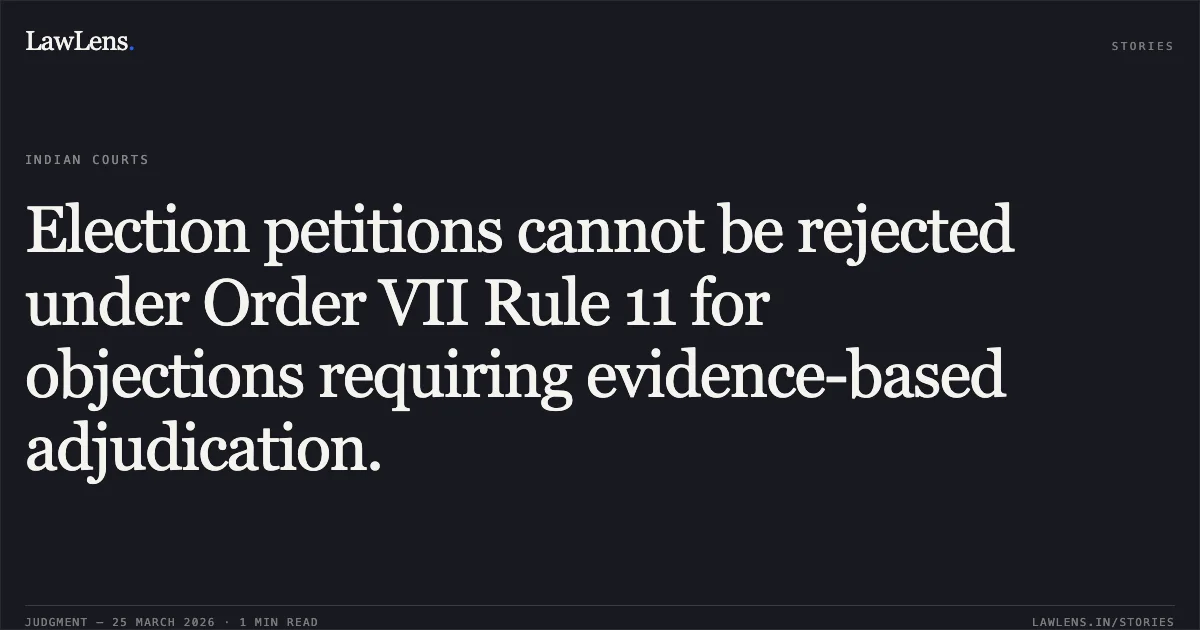
The Court observed that the power to reject a plaint under Order VII Rule 11 is restricted to the specific conditions enumerated in the provision.
Source reference: para. 5It noted that the applicant's objections—ranging from improper verification to the absence of substantive documents and affidavits for corrupt practices—did not automatically attract the summary rejection of the petition under the CPC.
Source reference: para. 5The Court concurred with the Trial Court’s reasoning that such objections involve mixed questions of fact and law that cannot be adjudicated without a full trial.
Source reference: para. 6Specifically, the Court held that the alleged violations of the Act of 1956 and the Rules of 1994 require the recording of evidence from both sides to determine their validity.
Source reference: para. 7Consequently, the Court found no jurisdictional error or illegality in the Trial Court’s refusal to dismiss the petition at the threshold.
Source reference: para. 7Holding
The High Court dismissed the Civil Revision petition, upholding the Trial Court’s order.
It held that the grounds raised by the applicant under Order VII Rule 11 were not sustainable at the preliminary stage because the points of contention necessitated a trial and the recording of evidence.
Source reference: para. 7The election petition will proceed to be heard on its merits.
Source reference: no citationActs & Sections Cited
1 provisions across 1 statute referred to in this judgment. Each provision opens on LawLens.
Code of Civil Procedure, 19081
Original Court PDF
Mukesh TatwalvsMahesh Kumar Parmar
Click to open original judgment
Original judgment, available to read, download and summarize on LawLens.in