Facts
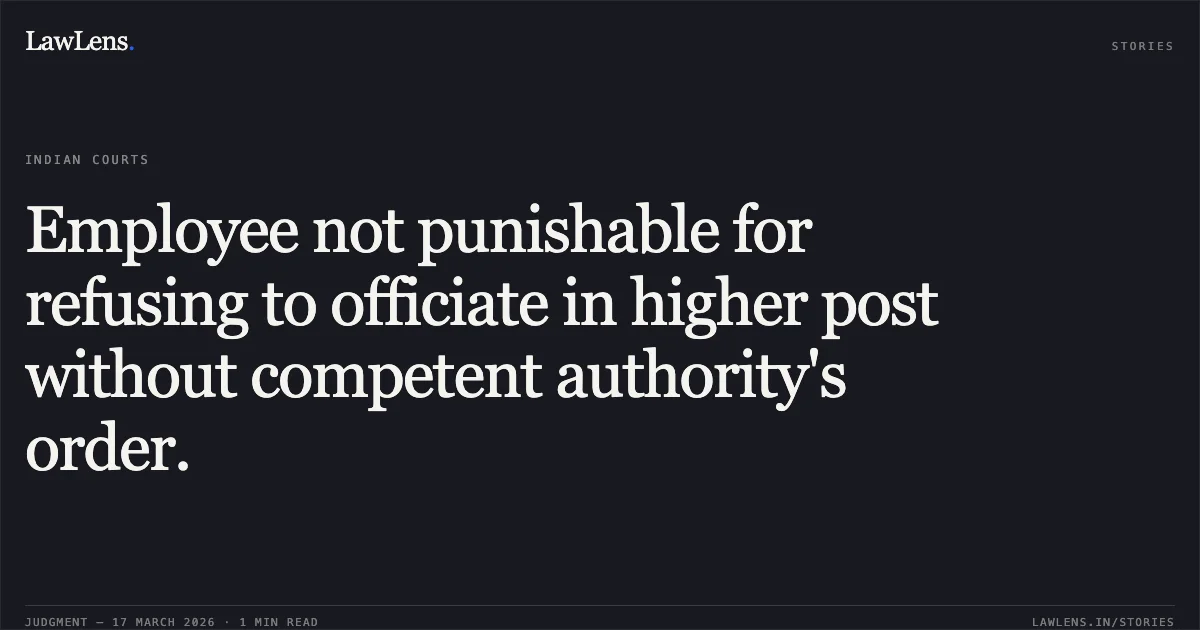
The applicant, an Sr. Asst. Loco Pilot, was asked to officiate in the higher post of Loco Pilot/Shunting by an alleged incompetent authority.
Source reference: p.2The applicant requested orders from a competent authority, citing rules and safety concerns, but this was treated as disobedience by the 4th Respondent, who imposed a penalty of reduction to a lower stage in the time scale.
Source reference: p.2The applicant's appeal was not considered favorably by the 3rd Respondent.
Source reference: p.3Upon filing a Revision Application, the 2nd Respondent reduced the penalty to six months.
Source reference: p.3The applicant then filed the present OA seeking to quash the impugned orders and related penalties, and to receive consequential benefits.
Source reference: p.2The applicant's counsel argued that the issue was covered by a previous order of the Tribunal in OA 1564/2018, which was affirmed by the Hon'ble High Court of Madras in WP No. 7046 of 2025 and WMP No. 7768 of 2025.
Source reference: p.3Issues
Whether the penalty of reduction to a lower stage in the time scale imposed on the applicant for refusal to officiate in a higher post without proper authorization from a competent authority is warranted.
Source reference: p.2Whether the impugned orders imposing the penalty on the applicant should be quashed and set aside.
Source reference: p.2Whether the applicant is entitled to consequential benefits, including the difference in pay.
Source reference: p.2Law Applied
The Tribunal and High Court primarily applied Rule 103(33) of the Indian Railway Establishment Code (IREC), which defines "officiating" as performing duties in a post where another person holds a lien or when a competent authority appoints an individual to officiate in a vacant post.
Source reference: p.4, 5They also referred to Appendix VI of the IREC, which specifies that the power to appoint a railway servant to officiate in a vacant post rests with the authority competent to make a substantive appointment to that post.
Source reference: p.5The High Court further invoked Article 14 of the Constitution of India, emphasizing the rule of law and that only lawful orders are capable of enforcement.
Source reference: p.6Reasoning
The Court found that the issue presented in the OA was decisively covered by its prior judgment in OA 1564/2018, which the Madras High Court subsequently affirmed.
Source reference: p.3, 4The prior judgment established that the Depot Supervisor, who issued the order for the applicant to officiate in a higher post, was not a competent authority under Rule 103(33) and Appendix VI of the IREC.
Source reference: p.4, 5The applicant's insistence on an order from a competent authority was deemed a call for adherence to rules, not disobedience.
Source reference: p.4The Court concluded that penalizing the applicant for seeking compliance with established legal procedures was unjust and contrary to the rule of law, as emphasized by Article 14 of the Constitution.
Source reference: p.6Therefore, the previous orders confirming the penalty were based on a misunderstanding of the rules and were unwarranted.
Source reference: p.4, 6Holding
The Tribunal held that the orders imposing the penalty on the applicant were liable to be and were accordingly quashed and set aside.
The applicant was found entitled to the consequential benefits, which the respondents were directed to pay within a period of three months from the receipt of the order.
Source reference: p.7The OA was allowed.
Source reference: p.7Acts & Sections Cited
1 provisions across 1 statute referred to in this judgment. Each provision opens on LawLens.
Indian Penal Code, 18601
Original Court PDF
P ANANDHANvsM/o Railways
Click to open original judgment
Original judgment, available to read, download and summarize on LawLens.in