Facts
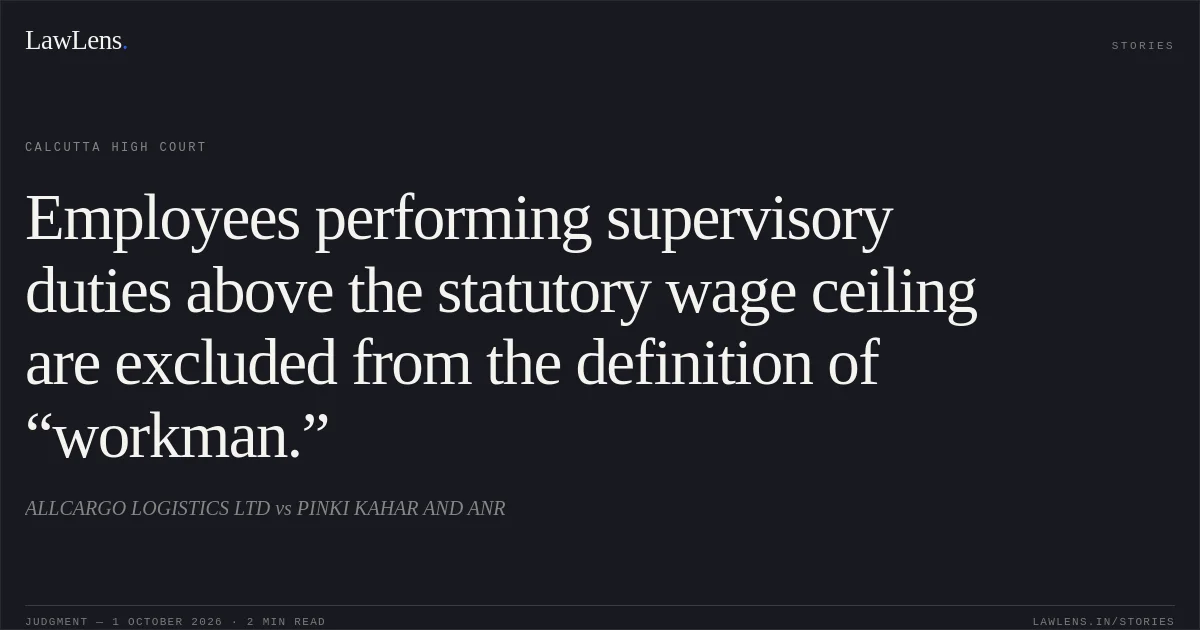
The petitioner challenged the Eighth Industrial Tribunal’s award dated 19 March 2026, which held respondent no. 1 to be a “workman” under Section 2(s) of the Industrial Disputes Act, 1947, and directed her reinstatement with continuity of service, full back wages and consequential benefits.
Source reference: para. 1, 4The award followed a remand by the High Court directing the Tribunal to decide whether respondent no. 1 was a workman.
Source reference: para. 22Respondent no. 1 had been promoted to Senior Executive (Level E-I) and was working as a shift in-charge; the petitioner relied on her position, duties, salary and admissions concerning staff working under her to contend that she was not a workman.
Source reference: para. 11–15, 19–21The Tribunal relied, among other matters, on the terms of her employment and the company’s standing orders in finding that she was a workman.
Source reference: para. 31, 34–38Issues
1. Whether respondent no. 1 was a “workman” within the meaning of Section 2(s) of the Industrial Disputes Act, 1947, having regard to her principal duties, supervisory role and employment terms.
Source reference: para. 31–33, 39–412. Whether the Tribunal’s finding that respondent no. 1 was a workman, and its resulting reinstatement award, could be sustained.
Source reference: para. 34–42Law Applied
Section 2(s) of the Industrial Disputes Act, 1947 includes employees performing manual, unskilled, skilled, technical, operational, clerical or supervisory work, but excludes, among others, employees employed mainly in a managerial or administrative capacity and employees in a supervisory capacity who draw wages above the statutory ceiling or exercise functions mainly of a managerial nature.
Source reference: para. 32As stated in Lenin Kumar Ray v. Express Publications (Madurai) Ltd., the determinative consideration is the principal duties and functions actually performed, not the employee’s designation; the person claiming workman status bears the burden of proving the nature of the employment.
Source reference: para. 32–33Reasoning
The Court held that the Tribunal had improperly inferred from the promotion letters’ statement that other terms and conditions remained unchanged that the company’s standing orders continued to govern respondent no. 1; the Tribunal had added language not present in those letters.
Source reference: para. 34–38It also found that the Tribunal had overlooked material evidence concerning respondent no. 1’s supervisory responsibilities, including that staff worked under her and that she held a senior position relative to the officer who issued the show-cause notice.
Source reference: para. 39–40Considering these circumstances together with her promotion to Senior Executive and the nature of her duties, the Court concluded that she was not a workman under Section 2(s).
Source reference: para. 41Holding
The Court answered the workman-status issue in the negative and held that the Tribunal’s findings were not in accordance with law.
It set aside the award dated 19 March 2026, allowed the writ petition and disposed of any connected application; any interim order was vacated.
Source reference: para. 42–45Acts & Sections Cited
2 provisions across 1 statute referred to in this judgment. Linked provisions open on LawLens.
Industrial Disputes Act, 19472
Original Court PDF
ALLCARGO LOGISTICS LTDvsPINKI KAHAR AND ANR
Click to open original judgment
Original judgment, available to read, download and summarize on LawLens.in