Facts
The petitioner completed an M.A. through the University of Mysore in 1993 and a three-year LL.B. through Bangalore University in 1997.
Source reference: para. 3–11, 22–24He had been admitted to the LL.B. course despite not holding a conventional bachelor’s degree; the University initially withheld his first-year results on that ground, but ultimately permitted him to continue and conferred the LL.B. degree.
Source reference: para. 3–11, 22–24After retiring from Government service in July 2023, he applied for enrolment as an Advocate.
Source reference: para. 3–11, 22–24The Karnataka State Bar Council rejected his application because he lacked a bachelor’s degree.
Source reference: para. 3–11, 22–24He challenged that decision under Articles 226 and 227 of the Constitution.
Source reference: para. 3–11, 22–24Issues
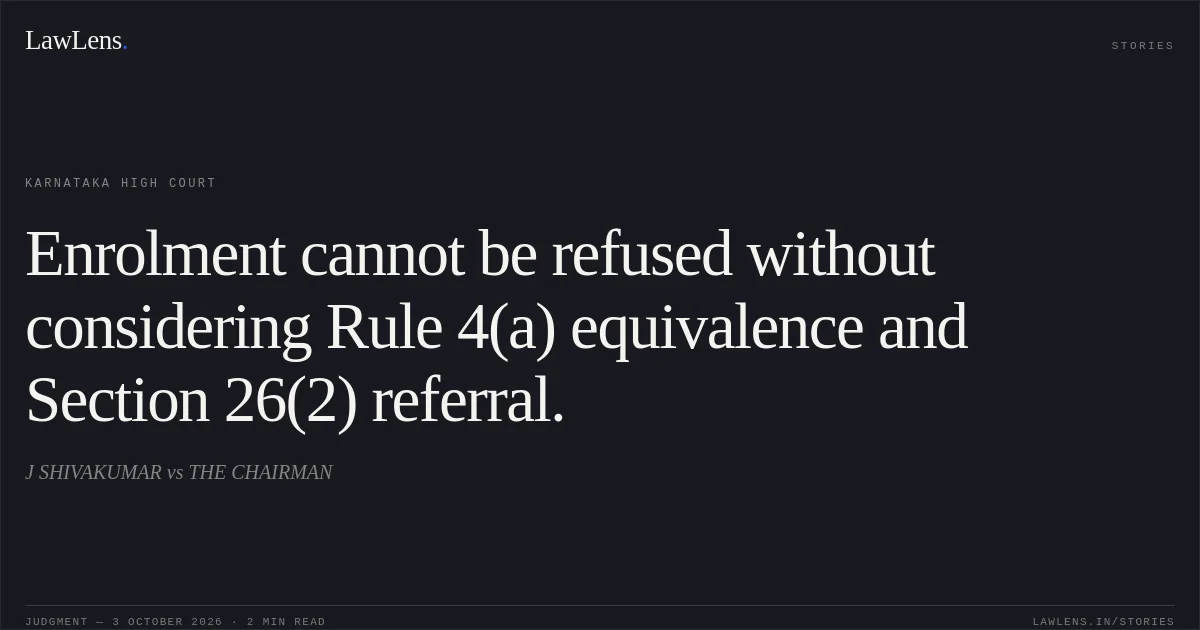
Whether the State Bar Council could reject the petitioner’s enrolment application solely because he lacked a bachelor’s degree, without considering whether his M.A. could qualify as an equivalent qualification under Rule 4(a) of the Bar Council of India Rules of Legal Education, 2008.
Source reference: para. 14–19Whether the proposed refusal was required to be referred to the Bar Council of India under Section 26(2) of the Advocates Act, 1961.
Source reference: para. 13.1–13.3, 20–21Law Applied
Rule 4(a) of the Bar Council of India Rules of Legal Education, 2008 provides for a three-year law degree course after a bachelor’s degree or “any other qualification considered equivalent by the Bar Council of India”; the latter language requires consideration of possible equivalent qualifications by the competent authority.
Source reference: para. 15–19Section 26(2) of the Advocates Act, 1961 requires a State Bar Council proposing to refuse an enrolment application to refer it to the Bar Council of India with the grounds supporting the proposed refusal.
Source reference: para. 13.1–13.3, 20Article 19(1)(g) protects the right to practise a profession, subject to lawful restrictions; authorities must apply the statutory and regulatory framework in its entirety.
Source reference: para. 27Reasoning
The State Bar Council rejected the application on the basis that the petitioner lacked a bachelor’s degree, but Rule 4(a) expressly permits consideration of another qualification as equivalent by the Bar Council of India.
Source reference: para. 18–25, 29–31The Court did not decide whether the petitioner’s M.A. was equivalent; that question belonged to the competent authority.
Source reference: para. 18–25, 29–31The petitioner’s completed LL.B., the University’s award of the degree, and the history of his admission and studies were relevant matters that could not be disregarded.
Source reference: para. 18–25, 29–31Since the record did not show that the proposed refusal had been referred to the Bar Council of India, the rejection could not stand in its existing form.
Source reference: para. 18–25, 29–31Holding
The petition was partly allowed, and the State Bar Council’s rejection was set aside.
The State Bar Council was directed to reconsider the application and, if it proposed to refuse it, refer the matter to the Bar Council of India with supporting grounds and relevant aspects by 30 October 2026.
Source reference: para. 29–35The Bar Council of India was directed to consider the reference, including the possible application of Rule 4(a), and pass orders within 60 days thereafter, by 30 December 2026.
Source reference: para. 29–35The Court did not direct enrolment or determine that the petitioner’s M.A. was equivalent to a bachelor’s degree.
Source reference: para. 29–35Acts & Sections Cited
1 provisions across 1 statute referred to in this judgment. Each provision opens on LawLens.
Advocates Act, 19611
Original Court PDF
J SHIVAKUMARvsTHE CHAIRMAN
Click to open original judgment
Original judgment, available to read, download and summarize on LawLens.in