Facts
The petitioner, a Senior Social Security Assistant (SSSA) in the Employees' Provident Fund Organization (EPFO), was prematurely retired under Rule 56(j) of the Fundamental Rules (FR) and Rule 48 of the CCS (Pension) Rules, 1972, effective March 10, 2021.
Source reference: p. 3, 5The decision was based on a Review Committee’s recommendation following a service history marked by persistent misconduct, including unauthorized absences, insubordination, negligence in death claim cases, and a criminal case involving charges under Sections 376 and 417 of the IPC (though he was eventually acquitted due to witnesses turning hostile).
Source reference: p. 11, 19-25The Petitioner’s APAR scores for 2017-19 were near zero.
Source reference: p. 25The Central Administrative Tribunal (CAT) dismissed the petitioner’s challenge in 2025 and subsequently dismissed a review application in December 2025.
Source reference: p. 2, 7The petitioner approached the High Court alleging malice and arguing that his 2008 promotion "washed away" prior adverse entries.
Source reference: p. 7, 26Issues
1. Whether the order of compulsory retirement was vitiated by malice or bias due to the participation of the immediate controlling authority in the decision-making process.
Source reference: p. 182. Whether the grant of promotion in 2008 had the legal effect of "washing away" all prior adverse entries in the petitioner's service record for the purpose of Rule 56(j).
Source reference: p. 263. Whether the subjective satisfaction of the authority to retire the petitioner as "deadwood" in the public interest was based on sufficient material.
Source reference: p. 13, 27Law Applied
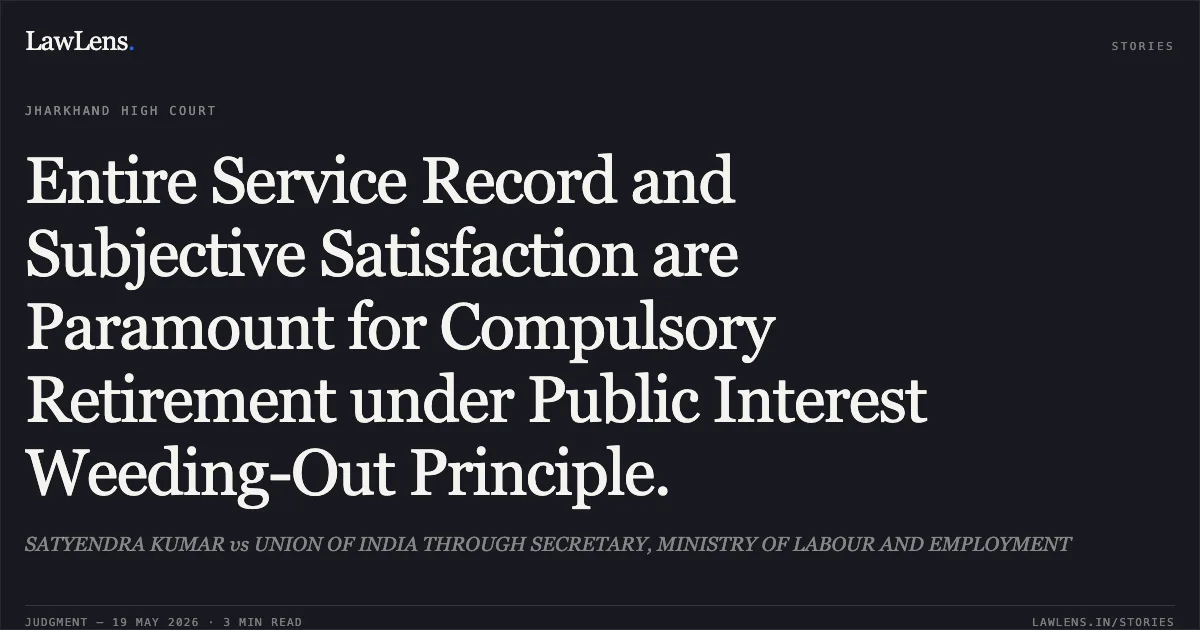
Rule 56(j) of the Fundamental Rules grants the government an absolute right to retire a servant in the public interest.
Source reference: p. 14Baikuntha Nath Das v. Chief District Medical Officer established that compulsory retirement is not a punishment, requires no prior notice or adherence to natural justice, and involves the "subjective satisfaction" of the government based on the entire service record.
Source reference: p. 14-15Punjab State Power Corp. Ltd. v. Hari Krishan Verma held that such orders are non-stigmatic unless they expressly incorporate misconduct as a penalty.
Source reference: p. 17State of Punjab v. Gurdas Singh clarified that adverse entries are not "wiped out" by promotion for the purposes of evaluating overall performance under the "weeding out" principle.
Source reference: p. 16-17Reasoning
The High Court rejected the plea of bias, noting it was raised for the first time during judicial review and that the "subjective satisfaction" was based on documented service records rather than personal animosity.
Source reference: p. 18, 25Regarding the "washing away" doctrine, the Court held that while a promotion may reduce the "sting" of an entry, the authorities are legally mandated to review the entire service career to identify "deadwood".
Source reference: p. 15, 26The Court observed a consistent pattern of "unbecoming conduct" spanning from 1999 to 2019, including 25 distinct adverse incidents/memorandums involving financial loss to the organization and judicial acquittal on technical grounds (hostile witnesses) rather than exoneration.
Source reference: p. 11, 19-25The Court found that the Near-Zero APAR gradings in 2017-18 and lack of recent positive contributions justified the authority's conclusion that the petitioner had outlived his utility.
Source reference: p. 11, 27Holding
The High Court held that the power under Rule 56(j) was exercised appropriately based on the petitioner's overall poor record and that there was no manifest error or perversity in the Tribunal’s findings.
The High Court dismissed both writ petitions, upholding the orders of the CAT and the respondent authorities, affirming that compulsory retirement in public interest is a supervisory tool to maintain administrative efficiency.
Source reference: p. 27, 12Acts & Sections Cited
6 provisions across 2 statutes referred to in this judgment. Each provision opens on LawLens.
Indian Penal Code, 18603
Administrative Tribunals Act, 19853
Original Court PDF
SATYENDRA KUMARvsUNION OF INDIA THROUGH SECRETARY, MINISTRY OF LABOUR AND EMPLOYMENT
Click to open original judgment
Original judgment, available to read, download and summarize on LawLens.in