01Facts
The petitioners challenged an order dated 20 December 2024 passed by the Regional Provident Fund Commissioner-II under Section 7A of the Employees’ Provident Funds and Miscellaneous Provisions Act, 1952, assessing provident fund, pension fund, administrative and allied dues of ₹1,31,47,107 for the period September 2019 to January 2022, along with recovery notices dated 29 January 2026 and 19 February 2026.
¶ 1 · ¶ 3The proceedings originated from enforcement reports dated 6 December 2021 and 10 December 2021 concerning employees of BMA Wealth Creators Ltd., which had allegedly closed pursuant to SEBI orders in August 2019 and whose employees subsequently joined the petitioner establishments from September 2019.
¶ 2 · ¶ 9The show-cause notices alleged discontinuation of provident fund membership of approximately 10 employees in the case of Ganeshdham and 29 employees in the case of Gangadhar, failure to submit Form 11, non-compliance with Paragraph 69(5) of the EPF Scheme, and bifurcation of salary into various allowances to minimise provident fund liability.
¶ 7The petitioners contended that the enforcement reports were not supplied to them, the concerned employees were neither identified nor heard, and the final assessment substantially exceeded the dues originally indicated in the show-cause notice without any further notice.
¶ 5–6 · ¶ 12–16The Provident Fund authorities opposed the writ petitions on the ground of availability of a statutory appeal, relying on Whirlpool Corporation v. Registrar of Trade Marks .
¶ 21–2202Issues
i.1. Whether the Section 7A assessment order was vitiated for relying upon inspection reports that were not supplied to the petitioners and for denying them a meaningful opportunity to respond.
¶ 5, 31–32ii.2. Whether the authority acted beyond the scope of the show-cause notices by assessing dues in respect of all employees who had joined the petitioner establishments, instead of adjudicating the specific allegations concerning approximately 10/29 employees and salary bifurcation.
¶ 23–26iii.3. Whether the assessment order was unsustainable for failing to disclose the basis and computation of the assessed amount of ₹1,31,47,107 and for not recording findings on the alleged salary bifurcation.
¶ 28–30iv.4. Whether the availability of a statutory appeal barred the writ petitions in circumstances involving alleged perversity, breach of natural justice and abuse of process.
¶ 2103Law Applied
The Court applied Section 7A of the Employees’ Provident Funds and Miscellaneous Provisions Act, 1952, which empowers the Provident Fund authority to determine the amounts due from an establishment, but requires a fair adjudicatory process and a reasoned determination.
¶ 1, 3The proceedings also concerned Sections 2(b), 2(f) and 6 of the Act and Paragraphs 26A, 29, 30, 36, 36-B, 38 and 69(5) of the EPF Scheme, 1952, relating to employees’ provident fund membership, computation of contributions, and cessation or transfer of membership.
¶ 2, 7The Court applied the principles of natural justice, including disclosure of material relied upon, a meaningful opportunity of hearing, adjudication within the confines of the show-cause notice, and the duty to provide reasons.
It considered Narinder Mohan Arya v. United India Insurance Co. Ltd. , (2006) 4 SCC 713, and Gurbir Kaur v. Regional Provident Fund Commissioner , 2006 (2) L.L.N. 791, relied upon by the petitioners, and Whirlpool Corporation v. Registrar of Trade Marks , (1998) 8 SCC 1, relied upon by the respondents, on the maintainability of writ proceedings despite an alternative statutory remedy.
¶ 20–22Provisions in the judgment · 3
Employees’ Provident Funds And Miscellaneous Provisions Act, 1952 Section 2Section 6Section 7A
04Reasoning
The Court found that the authority relied substantially on the enforcement reports, but the reports had not been served on the petitioners and their contents were not properly discussed in the impugned order.
¶ 5, 31The show-cause notices concerned specific allegations regarding discontinuation of PF membership of approximately 10/29 employees, failure to submit Form 11, and alleged manipulation of salary components. However, the final order stated broadly that the establishments had failed to remit dues for all employees who had earlier worked for BMA Wealth Creators and subsequently joined the petitioner establishments, thereby enlarging the scope of the proceedings beyond the notices.
¶ 23–26The Court also noted that the employees allegedly excluded were not identified, the basis for treating them as covered employees was not explained, and no finding was recorded on the alleged bifurcation of salary.
¶ 12–13, 30, 32Further, the enforcement report supplied only a consolidated figure and did not explain the computation of the alleged evaded wages, while the final assessment increased from the amount mentioned in the show-cause proceedings to ₹1,31,47,107 without a fresh notice or disclosed supporting material.
¶ 10, 14–15, 29These defects demonstrated denial of natural justice, absence of independent reasoning and a failure to make a legally sustainable determination under Section 7A.
In view of these prima facie jurisdictional and procedural defects, the existence of an appellate remedy did not prevent the Court from exercising writ jurisdiction.
¶ 2105Holding
The Court held that the impugned Section 7A orders were beyond the show-cause notices, unsupported by adequate reasons, based on undisclosed inspection material, and contrary to the principles of natural justice.
¶ 31–33The orders dated 20 December 2024 and the consequential recovery notices were quashed and set aside.
¶ 33–36WPA 5968 of 2026 and WPA 5969 of 2026 were allowed; connected applications were disposed of, and any interim order stood vacated.
¶ 33–36Original Court PDF
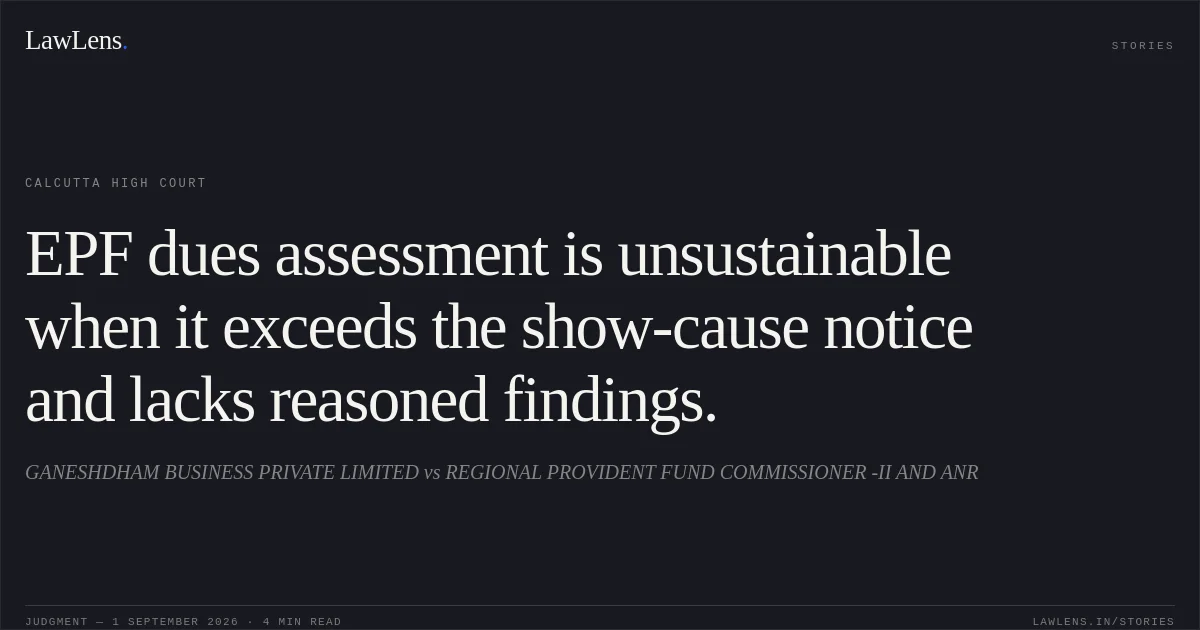
GANESHDHAM BUSINESS PRIVATE LIMITEDvsREGIONAL PROVIDENT FUND COMMISSIONER -II AND ANR
Click to open original judgment
Original judgment, available to read, download and summarize on LawLens.in