Facts
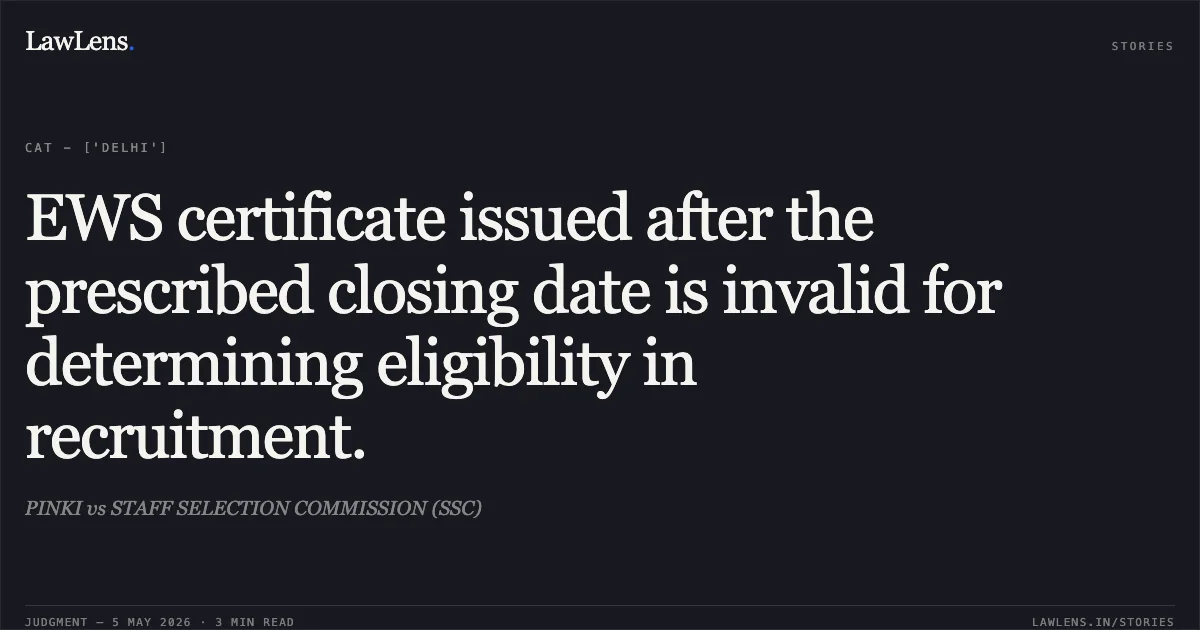
The applicant applied for the post of Constable (Female) in the Delhi Police under the Economically Weaker Section (EWS) category pursuant to an advertisement dated 01.09.2023.
Source reference: p.2She secured 60.18 marks, exceeding the EWS cut-off (53.40) but falling short of the General (UR) cut-off (61.04).
Source reference: p.2-3During document verification on 18.01.2024, the respondents rejected her EWS status because her EWS certificate (dated 05.01.2024) was issued after the "crucial date" (closing date of applications), i.e., 30.09.2023, as stipulated in Clause 6.4 of the advertisement.
Source reference: p.3The applicant had also provided a written statement during the verification process agreeing to be considered under the UR category due to the late certificate.
Source reference: p.6She subsequently challenged the validity of Clause 6.4 and sought a direction to be appointed under the EWS category.
Source reference: p.2Issues
1. Whether the requirement of possessing a valid EWS certificate on or before the closing date of applications is a mandatory eligibility condition or a mere technical/procedural formality.
Source reference: para. 7-82. Whether the applicant, having submitted a written undertaking to be treated as a General/UR candidate, is estopped from later claiming the benefit of the EWS category.
Source reference: para. 9Law Applied
The Tribunal applied the recruitment conditions specified in Clause 6.4 of the Delhi Police Advertisement and Standing Order No. HRD/04/2022, which mandate that EWS eligibility must be established on the "crucial date" (the closing date of online applications).
Source reference: p.3, 7It relied on the Department of Personnel and Training (DoPT) Office Memorandum dated 31.01.2019, which defines the closing date of applications as the crucial date for EWS income and asset certificates.
Source reference: p.6The Tribunal distinguished the principle of retrospective certificate acceptance established in Ram Kumar Gijroya v. DSSSB (regarding OBC status) by noting that EWS status is dynamic and depends on annual financial assessments rather than inherent caste status.
Source reference: para. 8It further followed the precedent set by the Supreme Court in Divya v. Union of India, which affirmed that eligibility must be determined with reference to the cut-off date.
Source reference: para. 10Reasoning
The Tribunal reasoned that unlike Caste certificates (SC/ST), which certify a pre-existing and permanent status, an EWS certificate is based on specific income and asset criteria for a particular financial year, making the date of issuance critical to determining eligibility at the time of application.
Source reference: para. 8The court found that Clause 6.4 of the advertisement was unambiguous and consistent with DoPT guidelines.
Source reference: para. 11Since the applicant’s certificate was issued on 05.01.2024—well after the 30.09.2023 deadline—she failed to meet a core eligibility condition.
Source reference: para. 11Furthermore, the Tribunal observed that the applicant had voluntarily waived her claim by providing a written statement at the time of verification to be treated as a UR candidate, thereby precluding her from challenging the rejection after the final results were declared.
Source reference: para. 9Holding
The Tribunal dismissed the Original Application, holding that the "crucial date" for EWS certificates is sacrosanct and must be strictly adhered to as per the recruitment notice and DoPT guidelines.
The court found no illegality in the respondents' action of treating the applicant as a General category candidate. Consequently, the interim protection previously granted was vacated, and the applicant's prayer for appointment under the EWS category was denied.
Source reference: para. 11, 12-13Acts & Sections Cited
1 provisions across 1 statute referred to in this judgment. Each provision opens on LawLens.
Administrative Tribunals Act, 19851
Original Court PDF
PINKIvsSTAFF SELECTION COMMISSION (SSC)
Click to open original judgment
Original judgment, available to read, download and summarize on LawLens.in