Facts
The Petitioner, an Assistant Registrar at Vallabhbhai Patel Chest Institute (VPCI), was dismissed on February 18, 2013, following a major penalty inquiry.
Source reference: para 2.2, 2.3This dismissal was set aside by the High Court in 2014 because the Governing Body (GB) lacked the authority to institute proceedings under Rule 69 of the 1971 Rules, which vested such power in the Executive Council (EC).
Source reference: para 2.4Despite subsequent appeals and a 2015 EC resolution delegating powers prospectively, the High Court (in contempt and LPA proceedings) held the original defect remained uncured.
Source reference: para 2.9On May 2, 2017, VPCI issued a fresh termination order based on a new EC Resolution (No. 32 of 2017), which "endorsed" the 2013 dismissal and claimed the GB had always been the competent authority since 1955.
Source reference: para 2.11, 2.12The Petitioner challenged this second termination.
Source reference: para 2.13Issues
1. Whether the Executive Council Resolution of 1955 vested the Governing Body with disciplinary authority sufficient to override the requirements of the 1971 Rules.
Source reference: para 7.12. Whether the 2017 Resolution validly cured the jurisdictional defect ex post facto or merely attempted to retrospectively validate a void action.
Source reference: para 7.23. Whether the termination order dated May 2, 2017, constitutes a fresh lawful exercise of power.
Source reference: para 7.3Law Applied
Rule 69 of the University Non-Teaching Employees (Terms & Conditions of Service) Rules, 1971, which mandates that disciplinary proceedings be instituted only by the Executive Council or an authority specifically empowered by it.
Source reference: para 2.4, 12The principle from Marathwada University v. Seshrao Balwant Rao Chavan that an action taken by an authority lacking statutory competence is void ab initio and cannot be cured by subsequent ratification.
Source reference: para 24The doctrine from Union of India v. B.V. Gopinath and Union of India v. S.K. Jasra, which establish that the lack of approval by a competent disciplinary authority at the initiation stage renders the entire proceeding non est.
Source reference: para 22, 23Reasoning
The Court reasoned that the 1955 Resolution only conferred the power to "appoint" and did not expressly delegate disciplinary authority under the 1971 Rules.
Source reference: para 9, 11The Court noted that the Delhi University itself had previously admitted in court that no such delegation existed.
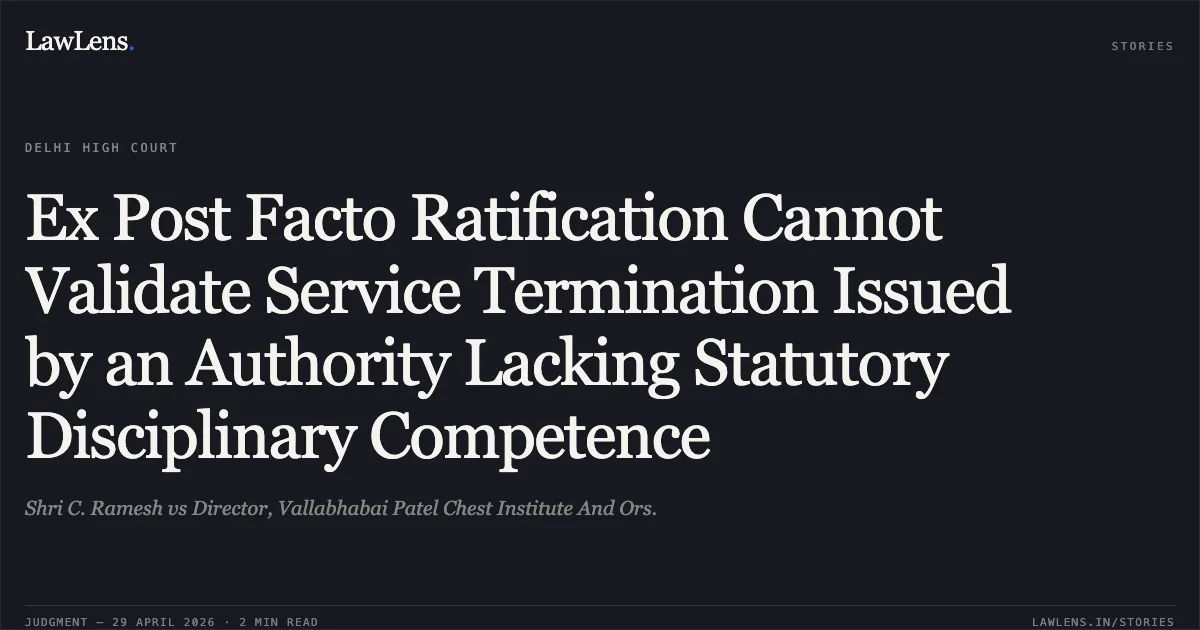
Source reference: para 12The Court found the 2017 Resolution was not a fresh exercise of power but an attempt at "retrospective validation" of a void 2013 decision.
Source reference: para 19, 20The Court distinguished the Respondents' reliance on Pannalal Choudhury, noting that in the present case, there was no contemporaneous authorization or monitoring by the EC during the 2011–2013 proceedings; the EC only intervened years later to "endorse" a concluded, unauthorized act.
Source reference: para 26, 27Thus, the foundational defect identified in the first round of litigation persisted.
Source reference: para 28Holding
The Court held that the 2017 Resolution could not operate retrospectively against the Petitioner to validate the 2013 dismissal.
The Court allowed the writ petition and set aside the termination order dated May 2, 2017, ordered the Petitioner’s reinstatement, but granted the Respondents liberty to initiate fresh disciplinary proceedings via the competent authority under the 1971 Rules within four weeks.
Source reference: para 31.1, 31.3, 31.4Acts & Sections Cited
1 provisions across 1 statute referred to in this judgment. Linked provisions open on LawLens.
University of Delhi Ordinance XX1
Original Court PDF
Shri C. RameshvsDirector, Vallabhabai Patel Chest Institute And Ors.
Click to open original judgment
Original judgment, available to read, download and summarize on LawLens.in